Category Archives: Texas History

Today in Texas History – February 4

From the Annals of the Wildcatters –  In 1918, the No. 1 Chaney oil well began producing in Breckenridge.  There had been drilling in the area since 1911, but the success of the Chaney No. 1 began a boom which increased the population of Breckenridge from 800 to over 30,000.   Within months, over 200 derricks were drilling in the town and within two years there were over 2000 drilling sites in the immediate area. By 1919, production in the Breckenridge area was over 10 million barrels and peaked at over 31 million barrels in 1921.

Today in Texas History – February 3

From the Annals of Rock and Roll –  In 1959, Charles “Buddy” Holly was killed in a plane crash near Clear Lake, Iowa.  Holly and his new band had performed at the Surf Ballroom in Clear Lake the night before as part of the “Winter Dance Party” tour. Holly’s band consisting of Waylon Jennings (bass), Tommy Allsup (guitar) and Carl Bunch (drums) was also the backing band for the other acts on the tour which included Richie Valens, J.P. “The Big Bopper” Richardson, and Dion DiMucci.   The tour had been poorly planned as the distances between venues and the badly equipped tour buses were adversely affecting the performers.  Several band members were suffering from the flu and Bunch was hospitalized due to frostbite. Holly decided to charter a flighte from Clear Lake to Fargo, North Dakota where they would catch up with the tour for its next performance in Moorhead, Minnesota.  Richardson, sick with the flu, swapped places with Waylon Jennings, Allsup lost his place to Ritchie Valens on a coin toss. DiMucci decided not to board the plane because of the $36 fee.

The loss to music was immeasurable.  Holly and Valens were likely headed to even greater stardom.  Holly was an incredible and inventive songwriter and doubtless would have had a considerable influence over popular music for decades.  His catalogue of hits from his short career is nothing short of astonishing.  It truly was the day the music died.

Today in Texas History – February 2

From the Annals of Unjust Wars –  In 1848, the United States and Mexico signed the Treaty of Guadalupe Hidalgo ending the Mexican-American war – the last time the U.S. fought with one of its neighbors. The Treaty was a humiliating defeat for Mexico stripping it of approximately 1/3 of its territory and adding that 525,000 square miles to United States territory.  The new territory comprised California, Nevada, Utah, New Mexico, Arizona as well as parts of Texas, Colorado and Wyoming.  The war had been launched over controversy regarding the border between Texas and Mexico.  The U.S. claimed the Rio Grande while Mexico claimed the Nueces River as the boundary.

The last act of President John Tyler before leaving office in 1845 had been to annex the Republic of Texas. Incoming President James Polk had greater designs on the west.  Polk did attempt to buy land from Mexico, but his emissary John Slidell was stonewalled by the Mexican government.  Rebuffed, Polk sent American troops to the disputed border region in Texas in January of 1846 to provoke the Mexicans into war. When the Mexicans fired on American troops in April of 1846, Polk had the excuse he needed. He declared, “[Mexico] has invaded our territory and shed American blood upon American soil,” and sent the order for war to Congress on May 11.

Polk’s motives were likely mixed.  He had run for President in 1844 on a Democratic platform that supported manifest destiny, but many Northerners believed that Polk was trying to gain land for the slaveholding South.  Others opposed the war on the grounds that it was a war of territorial conquest.  Ulysses S. Grant, who fought in the war with many others who would be come famous in the U.S. Civil War, called the war “one of the most unjust ever waged by a stronger against a weaker nation. It was an instance of a republic following the bad example of European monarchies, in not considering justice in their desire to acquire additional territory.”  The newly acquired territory certainly helped lead the U.S. into more controversy over the expansion of slavery as the U.S. slid inexorably into civil war only 13 years later.

Today in Texas History

From the Annals of the Texas Abolitionists –  In 1844, Republic of Texas president Sam Houston granted an empresario contract to Charles Fenton Mercer.  The grant was notable because the former U.S. Representative from Virginia was considered an abolitionist even though he was probably more accurately characterized as a strong advocate of developing the American West for the white race and colonizing “free people of color” through emigration to Africa.  After resigning from Congress to staunch the drain on his personal finances, he became interested in bringing settlers to North Texas.  Mercer organized the Texas Association and quickly recruited more than 100 families as potential settlers.  But Mercer’s vision never came to fruition.  Texas was turning away from the empresario system and Mercer’s well-known abolitionist sentiments made the colony an issue in the abolition and annexation controversy.  Mercer’s resources were further drained by court disputes over land claims.  Ultimately, Mercer assigned his interest in the contract to other members of the Texas Association in return for a $2,000 annuity.

Today in Texas History – January 28

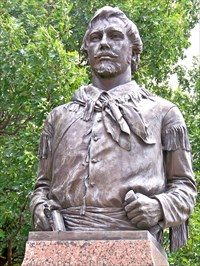
From the Annals of the Italo-Texicans –  In 1836, Italian native Prospero Bernardi arrived in Texas after a voyage from New Orleans aboard the schooner Pennsylvania as part of a volunteer company raised by Captain Amasa Turner.  After arriving in Texas, Bernardi enlisted in the Texas army on February 13, 1836.  His most distinguished service came during the Battle of San Jacinto which secured Texas’ independence. He remained in the army until January or February 1837, when he received a medical discharge because of a spinal injury sustained during combat.  Bernardi received a bounty grant and a first-class headright grant for his military service.  Both grants were somehow assigned to other parties. Bernardi quickly disappeared from history.  In February of 1838, two former fellow soldiers testified as to their belief that he was deceased but little else is known. A bust of Bernardi  stands in front of the Hall of State at Fair Park in Dallas.

Today in Texas History – January 27

From the Annals of  Crime –   In 1928, Marshall Ratliff was convicted for his role in the infamous “Santa Claus Bank Robbery.”  On December 23, 1927, Ratliff robbed the First National Bank in Cisco, TX, while wearing a Santa Claus outfit.  Ratliff was an ex-con who had lived in Cisco before being tracked down and imprisoned for a bank robbery by Cisco Chief of Police, G.E. “Bit” Bedford. Ratliff had been paroled just before the infamous bank robbery. Ratliff enlisted two men he had met in Huntsville and a fourth man who was supposedly a good safecracker. Ratliff knew that he would be recognized in Cisco and thus, decided to conceal his identity by disguising himself as Santa Claus.  For the fascinating and grisly details of the actual robbery – well, wait until Christmas time.

Today in Texas History – January 26

From the Annals of the Trans-Texas Corridor or Something Like It –  In 1839, the Republic of Texas chartered the Houston and Brazos Rail Road with authorization to build railroads and turnpikes from Houston to the Brazos River.  The effort began more than a year later with an auspicious ground-breaking ceremony.  In July of 1840, the celebration began at the Presbyterian church in Houston.  A procession of volunteer companies, members of the bar, medical faculty, army and naval officers, citizens, county officers, mayor and aldermen, Odd Fellows, Masons, the president and directors of the railroad company, the committee of arrangements, orator, and officiating clergyman formed at the Church and marched to the planned spot for the beginning of the railroad.  Unfortunately, the company never came close to actually constructing the railroad and soon lost its charter privileges.  Rick Perry knows how they felt.

Today in Texas History – January 23

From the Annals of New Spain  – In 1691, the Conde de Gálvez appointed Domingo Terán de los Ríos as the first governor of the Spanish province of Coahuila and Texas.  This was the first recognition of Texas as a governmental entity. Terán was instructed to establish seven missions among the Tejas Indians; to investigate the possible existence of foreign settlements on the coast; and record the geography, natives, flora and fauna of the region.  Terán and his small army crossed into present day Texas in May and explored  as far as the Caddo settlements on the Red River until December. Terán returned to Matagorda Bay by March of 1692.  His further explorations were curtailed by bad weather and he returned to Veracruz in April.  This first serious attempt at colonization was considered to be a complete failure. Terán  did not found any missions and his explorations added little new information about the region.

Today in Texas History – January 22

From the Annals of the Supreme Court –  In 1973, the U.S. Supreme Court issued its decision in Roe v. Wade, 410 U.S. 113 (1973), which declared that criminal laws against abortion were unconstitutional.  The case involved Norma L. McCorvey (using the alias Jane Roe) who discovered she was pregnant with her third child.  When she returned to Dallas, she first sought an illegal abortion at a site that had been closed by the police. Eventually, she was referred to Texas attorneys Linda Coffee and Sarah Weddington.   Coffee and Weddington filed suit in a U.S. District Court in Texas on behalf of McCorvey against Dallas County District Attorney Henry Wade who represented the State of Texas.  Although McCorvey would give birth before the case was finally decided, the Supreme ultimately invalidated laws criminalizing abortion.

The much hailed and criticized opinion expanded on the previous decision in Griswold v. Connecticut, 381 U.S. 479 (1965),in which the Court ruled that the U.S. Constitution protected a right to privacy.  That case overturned a Connecticut statute that prohibited use of contraceptive devices and drugs on the grounds that it violated the “right to marital privacy”.   Roe v. Wade was an expansion of the right to privacy into the area of the right of a woman to choose to terminate a pregnancy in the first two trimesters.

The U.S. has an interesting history when it comes to the legality of abortion. Roe did not mark the first time that abortion became a legal procedure.  Some historians point out that for much of the country’s early history, abortion was not a criminal offense and not generally thought to be immoral.  In the 1700s and early 1800s, the word “abortion” referred only to the termination of a pregnancy after “quickening,” the time when the fetus first began to make noticeable movements.  Before quickening, women had a variety of drugs available to end an unwanted pregnancy.

 The first state prohibition was passed In 1827 by Illinois.  That law made the use of abortion drugs or devices punishable by up to three years’ imprisonment.  Other states passed similar laws but “Female Monthly Pills,” as the abortifacients were known were commonly sold until the middle of the 19th century.

Abortion was widely criminalized between 1860 and 1880. But the practice was not outlawed because of widespread moral outrage over the practice.  Rather, the anti-abortion movement was an anti-competitive campaign waged by the recently established American Medical Association. Doctors viewed abortionists as unwanted competition.  When the Catholic Church, which had long accepted terminating pregnancies before quickening, joined the doctors in condemning the practice, the end of legal abortion quickly followed.

By 1900, abortion was illegal throughout all 50 states.  The prohibition did not stop abortion because the laws were rarely enforced and any women with enough money could terminate a pregnancy. Things changed by mid-century as law enforcement stepped up crack-downs on abortion providers.  This led to a reform movement that succeeded in lifting abortion restrictions in California and New York even before the Supreme Court decision in Roe v. Wade.

The controversy over Roe continues today as many states, including Texas, have attempted to legislate around the margins of Roe and restrict abortion as much as possible without running afoul of constitutional challenges.

Today in Texas History – January 21

From the Annals of the Civil War –   In 1863, Confederate forces recaptured Sabine Pass opening one of the last ports available to the Confederacy. Sabine Pass controlled access to the Sabine River which divides Texas and Louisiana.  In 1861, the Confederacy constructed a major fort to retain control of the river. Union troops captured the fort in September of 1862 and quickly seized control of the major port of Galveston giving the Union control of most of the Texas coast. In November, Confederate General John Bankhead Magruder was given the daunting assignment of expelling the Union forces from Sabine Pass and Galveston.

Magruder’s forces recaptured Galveston before turning their attention to Sabine Pass.  Magruder’s plan involved fortifying the decks of two Rebel ships, the Bell and the Uncle Ben, with cotton bales. Sharpshooters were placed behind the bales.  The ships approached the two Union ships at the Pass, the Morning Light and the Velocity.  The Rebel ships chased the Union vessels into open water while the sharpshooters injured many Union gunners. The Union ships quickly surrendered reopening the Texas coast for Confederate shipping.