
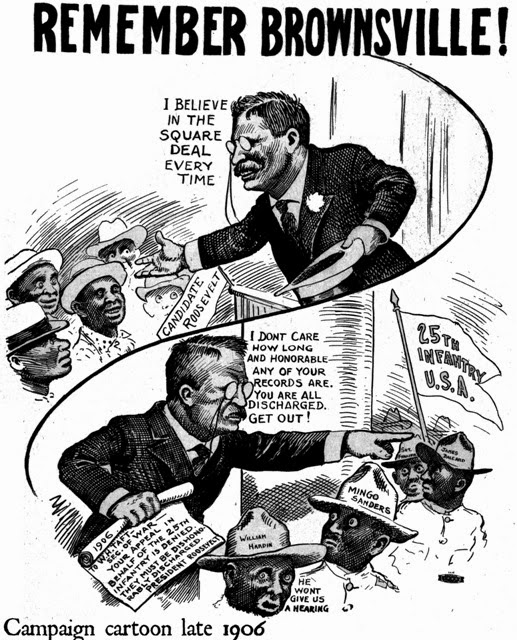
From the Annals of Discrimination – In 1906, an alleged attack by soldiers from the black 25th Infantry Division stationed at Fort Brown resulted in the largest summary dismissals US Army history. The troops fresh from duty in the Phillippines arrived in Brownsville on July 28. . The First Battalion, minus Headquarters and Company A, arrived at Brownsville. The town greeted them racial hostility and discrimination with many local businesses refusing to serve them. After reports of an attack on a white woman on the night of August 12, Maj. Charles W. Penrose, after consultation with Mayor Frederick Combe, declared an early curfew the following day to avoid trouble with the increasing tension. Sometime around midnight, a locol bartender was killed in a shootout that also critically wounded a police officer. Some townspeople blamed the troops and made unverified claims that the soldiers were running through the streets shooting.
A series of investigations followed, but no individual soldiers were ever identified as having committed criminal acts. Maj. Augustus P. Blocksom, of the army’s Southwestern Division, found that the soldiers were uncooperative and recommended dismissal. The troops for their part denied any knowledge of the shooting. Texas Ranger Cap. William J. McDonald arrested 12 men but none were ever indicted. Inspector General Ernest A. Garlington claimed there was a “conspiracy of silence” and urged dismissal of the men. On November 5 President Theodore Roosevelt summarily discharged “without honor” all 167 enlisted men who had been stationed at Fort Brown.
A Senate investigation of the matter instigated by Roosevelt rival Sen. Joseph B. Foraker (R-Ohio) resulted in conflicting majority and minority reports and no action for the men who had been summarily dismissed. When some of the men reapplied for enlistment, Roosevelt was forced to appoint a board of retired army officers to review the applications. After interviewing about half the applicants, the Court of Military Inquiry approved only fourteen of the men for re-enlistment.
The matter lay dormant until 1972, when Rep. Augustus Hawkins (D-California) took up the cause of the wrongly dismissed soldiers. The Nixon administration concurred and awarded honorable discharges without back pay. Dorsie Willis, the only surviving veteran, received a $25,000 pension.
 Paradise in Hell