Category Archives: Texas History

Today in Texas History – October 29

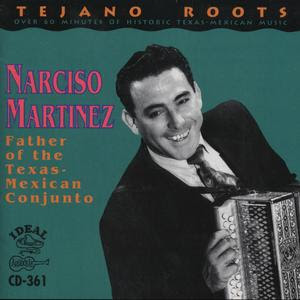
Father of Conjunto, Narciso Martínez was born in Reynosa, Mexico in 1911.  Shortly after his birth, his family moved across the Rio Grande to the town of La Paloma near Brownsville.  Martínez took up the accordion only at the age of 17 when he moved to Bishop and was influenced by the local Czech and German musicians. Martinez incorporated the accordion into Mexican music and along with his partner, bajo sexto player Santiago Almeida, established the accordion and bajo sexto as the basic instruments of Conjunto music.  Martínez made his first recording in 1936 on the Bluebird Records label.  In 1946 he switched to the Ideal label.   Known as “El Huracán del Valle”  because of his rapid keywork, Martinez played throughout the 1950s.  His career declined after a new wave Conjunto artists established themselves in the 1960s.  He had later success, however, after being  featured in a 1976 documentary about Tex-Mex music Chulas Fronteras.  He was inducted into the Conjunto Music Hall of Fame in 1982 and received a National Heritage Award from the National Endowment for the Arts in 1983.

Today in Texas History – October 28

Texian militia and Mexican regular army troops under the command of Gen. Domingo Ugartechea skirmished at the battle of Concepción on the grounds of Mission Conception near San Antonio de Bexar.  The skirmish was the opening engagement in the siege of Bexar and is considered by historians to be the first major conflict of the Texas Revolution. The Texians were commanded by James Bowie and James W. Fannin, Jr.  When Ugartechea’s forces approached, the Texians took cover in a horseshoe shaped gully which provided an excellent defensive position.  The Texian long rifles proved to be effective military weapons because of their longer range and accuracy.  Reported losses (which are frequently exaggerated) included 14 Mexican killed and 39 wounded.  The Texans claimed only one killed and one wounded.

Today in Texas History – October 27

From the annals of corporate ambition –  In 1892, the Pan American Railway company was chartered. Boston investors dreamed up a plan to connect Victoria, Texas with Rio de Janeiro in Brazil.  Citizens of Victoria – anxious to expand their railroad opportunities – offered a $150,000 bonus.  The dream died quickly as only 10 miles of track extending south from Victoria were ever constructed.  The company could not raise funds to construct a bridge over the Guadalupe River.  One wonders how they imagined conquering the swamps of southern Panama.  No trains ever ran on the line and it was ultimately abandoned.  Interestingly, there is still not a direct land link between North and South America today.

Today in Texas History – October 24

In 1868, a Marion County mob killed three Republicans who had been arrested the previous night after a Republican meeting ended in a gunfight with local Democrats.  Five Republicans were dragged from the Jefferson jail and the mob killed three of them, a white and two blacks.  Reconstruction officials arrested thirty-five suspects, and eventually tried twenty-four of them. The trial involved the testimony of 176 witnesses, and a verdict was not delivered until August 23, 1869. Seven of the defendants were found guilty, but it is unclear whether any of them served any time in prison.

Today in Texas History – October 23

In 1989, 23 people were killed in an explosion at Phillips Petroleum Co.’s chemical complex in Pasadena, Texas. The accident resulted from a release of flammable gasses that occurred during regular maintenance operations due to an improperly connected release valve. A vapor cloud formed and traveled rapidly through the polyethylene plant. Within two minutes, the vapor cloud came into contact with an ignition source and exploded with the force of 2.4 tons of TNT.  Ten to fifteen minutes later, that was followed by the explosion of the 20,000- gallon isobutane storage tank, then by the catastrophic failure of another polyethylene reactor, and finally by other explosions, probably about six in total.  Another 314 people were injured and property loss was over $700 million.  Debris was thrown as far as six miles from the site.  OSHA issued 566 willful and 9 serious violations with a combined total proposed penalty of $5,666,200 to Phillips.

Today in Texas History – October 21

George Hermann, a millionaire oilman and Houston native, died in 1914.  In his will, Hermann gave the City of Houston 250 acres in which to create a park and open Hermann Hospital.  The park that bears his name is now one of the nation’s great urban parks featuring, among other things, the Houston Zoo, Museum of Natural History, Hermann Park golf course, the Miller Outdoor Theatre, the newly renovated and redesigned Gardens, the Japanese Tea Garden, running and carriage trails, a miniature train, lake and playgrounds.  About the only thing missing is a swimming pool.  Yet, Hermann’s statute stands almost unnoticed in an underutilized corner of the park.

Today in Texas History – October 15

In 1853, the first Saengerfest was held in New Braunfels.  The New Braunfels Germania singing society invited similar groups from Austin, San Antonio and Sisterdale.  Each group performed a cappella.  The groups joined together to sing works by Mendelssohn and Marschen.  Hermann Seele a committee member for the first Saengerfest later built the Seele Sangerhalle where the festival was held for many years.  A modern version – the Wein & Saengerfest – continues today in downtown New Braunfels.

Today in Texas History – October 9

Houston Astrodome Exterior

The Astros played their last game in the Astrodome during the 1999 MLB playoffs.  As usual they lost to the Atlanta Braves in the first round ending their season and closing out their 35 year run in the Eighth Wonder of the World on a down but not unexpected note.  The Braves were up 7-0 on a good performance by John Smoltz, but late in the game the Astros scored 5 with Ken Caminiti hitting a 3 run shot in the 8th.  There was hope going into the 9th with the Astros down 7-5.  When Jeff Bagwell came up against John Rocker in the bottom of the 9th with a runner on second, my friend turned to me and said, “This is kind of a career defining moment for him.”  And he promptly struck out and his career was defined.  Caminiti at least hit one to the warning track in left to end the game.  I suppose the ‘Roids were fading by the 9th.

Today in Texas History – October 6

There’s nothing like a good old-fashioned duel to make you glad you live in days of modern and more random violence.  In 1839, Reuben Ross, standing in for Alonzo B. Sweitzer, wounded Ben McCulloch in a duel. The dueling tradition was firmly ensconced in the early days of the Republice of Texas despite anti-dueling laws.  Sweitzer and McCulloch apparently got cross-wise in an earlier election contest and the bad blood continued on several Indian raids.  When Sweitzer issued a challenge through Ross, McCulluch refused because Sweitzer was not a “gentleman.”  Ross was an acceptable substitute and the two faced off at 40 paces with rifles.  McCulluch was permanently wounded in the arm  by Sweitzer – an experienced duelist.  The wound did not prevent him from serving as a general in the Confederate Army.  He was killed at the battle of Pea Ridge in northern Arkansas – the battle being notable for its use of Native American fighters.   Ross met his end in another duel.

Today in Texas History – October 1

In 1849, the first inmates arrived at the site of the Texas State Penitentiary at Huntsville. The inmates were placed in temporary structures until the actual prison was constructed. The original prison still exists inside of the Huntsville (or “Walls”) Unit in downtown Huntsville.  It was completely surrounded by the later construction and no longer used.  The original prison cells were open air and all faced outside.  Even after the newer prison was built, many inmates preferred these older cells in the summertime because they were cooler.  In the winter, they hung blankets inside the bars to keep out the cold. The Huntsville Unit now serves as one of the TDCJ’s regional release centers for male prisoners.