Category Archives: Texas History

Today in Texas History – September 29

Immaculate Conception of the Blessed Virgin Mary Catholic Church in Panna Maria Texas

In 1856, Father Leopold Moczygemba consecrated the first Polish Catholic church in the United States in Panna Maria. The first church was destroyed by lightning in 1875. The present church was completed in 1877 and was enlarged in 1937. During a recent renovation,  a painted ceiling was discover and restored. Panna Maria claims to be the oldest Polish settlement in America.

Today in Texas History – September 26

In 1927, the “Toonerville Trolley” streetcar service from Houston to the then suburban community of Bellaire was replaced with bus service.  A sad day for public transportation.  The Trolley was designed to bring prospective buyers to Bellaire and to make Bellaire accessible from Houston.  A brochure mentioned a 30 minute trip from Houston, though there were those who remembered it sometimes took more like 2 hours for a round trip.  There was only one trolley in service at a time and it was #124, dubbed the Toonerville Trolley.  The last Trolley car sits uselessly in the Paseo Park median of Bellaire Blvd where the trolley lines used to run.  The City tries to keep the Trolley spirit alive with the Trolley 5K Run and Trolley Tunes concerts in the park.

Today in Texas History – September 25

In 1922, radio station WOAI in San Antonio began broadcasting. It was the first station in South Texas. The station had an initial power of 500 watts. It grew to what was considered a powerful 5,000 watts by 1925 and eventually 50,000 watts allowing the station to be heard throughout most of Texas. The station later joined the world’s first communication network, the National Broadcasting Company.  Notably, WOAI was one of the first stations to employ a local news staff.  It is now given over to mostly predictable and pedestrian right-wing talk radio.  But,  on my radio dial, 1200 will never mean anything other than WOAI.

Today in Texas History – September 24

In 2005, Hurricane Rita made landfall devastating Beaumont, Texas and portions of southwestern Louisiana. Rita was the fourth–most intense Atlantic ever recorded and the most intense hurricane ever observed in the Gulf of Mexico.  Although it began to rapidly weaken after making landfall, nine counties in the Texas were declared disaster areas after the storm.

Rita was almost as famous for what preceded it as for the destruction it caused.  Coming just three weeks after Hurricane Katrina devastated New Orleans and the northern Gulf Coast, the prospect of another major hurricane prompted mass mandatory and voluntary evacuations in Southeast Texas. Somewhere between 2.5 – 3.7 million people evacuated the Gulf Coast region prior to Rita’s landfall.  This was the largest evacuation in US history and exposed major flaws in the system for evacuating mass numbers of people from the region.  The evacuation was rife with tales of 15-20 hours spent in cars traveling only 5-10 miles, many people simply giving up and returning home or running out of gas.  The debacle prompted new measures to ensure quicker evacuations.

Today in Texas History – September 23

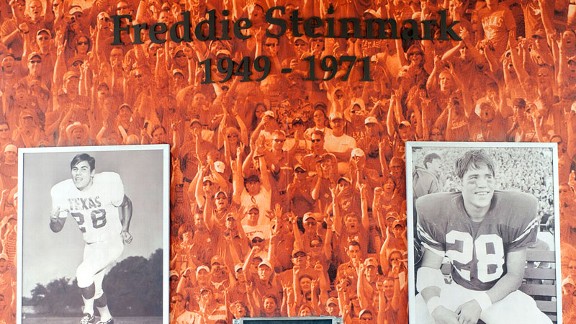
In 1972, the University of Texas’s dedicated a new modern scoreboard to former Longhorn football player Freddie Steinmark. Steinmark played defensive back for UT during his sophomore and junior years. As a sophomore he was the team’s leading punt returner. In December 1969, a mere six days after helping Texas defeat Arkansas in the “Big Shootout,” Steinmark was diagnosed with cancer in his left leg which had to be immediately amputated.  He went from starring on the field for a National Championship team to never being able to play or even walk normally again within a week.  He was on crutches on the sideline for Texas’ victory over Notre Dame in the 1970 Cotton Bowl.  He died in 1971.

For many long-time UT football fans, the Arkansas game in Fayetteville in 1969 is still the most exciting game in Texas history.  One of the first regular season games to be played in December, it pitted the top two teams in the country in a showdown for the National Championship.  It even featured Richard Nixon flying into watch the game and later declare the Horns to be the National Champions.  The excitement of that game was later tempered by the sad reality of Steinmark’s diagnosis and the end of his career.

The original Steinmark scoreboard was itself a victim of progress and has been replaced by a larger version.