Category Archives: Today in Texas History

Today in Texas History – November 30

From the Annals of Lawlessness –  In 1890, Texas pioneer and author John H. Jenkins was killed in a gunfight in Bastrop.  Jenkins was attempting to save his son, the County Sheriff, from an ambush when he was shot down.  Jenkins had moved to Texas as a young boy with his family eventually settling on the banks of the Colorado near present-day Bastrop.  After his father was mysteriously killed while working his fields, Jenkins became the ward of Edward Burleson.  Jenkins joined the Texas revolution at age 13 fighting in Burleson’s First Regiment of the Texas Volunteers.  He is reputed to have been the youngest Texian soldier in the San Jacinto campaign although he was not present at the battle having been dispatched to aid his mother and siblings escape from the advancing Mexican armies.  He later served in the Texas Rangers and with the Confederate Army in the Civil War.  Jenkins is best known for his well-written and colorful memoir – Recollections of Early Texas – published by the University of Texas Press in 1958.

Today in Texas History – November 24

From the Annals of Law Enforcement – In 1835, the Republic of Texas authorized a special law enforcement unit known as the Texas Rangers. Stephen F. Austin had hired ten experienced frontiersmen as “rangers” as early as 1823, but the 1835 legislation formalized the organization.  The Rangers have a mixed history at best.  They were instrumental in securing the early Republic, but at the expense of various Indian tribes who had claims to the land and not all of whom were aggressive warriors like the Comanche and Kiowa.   The Rangers  were also employed to restore order during various blood feuds, border disturbances, and civic upheavals. In the early twentieth century, however, certain renegade Rangers abused their positions of authority predated on Hispanics, African-Americans and other powerless groups.  The force was decimated in 1933 when Gov. Ma Ferguson dismissed the entire squad in an overt act of political retaliation for the Rangers open support of her opponent Ross Sterling.  When the Department of Public Safety was created in 1935, the Rangers took on a new role.  Today they are recognized as an elite unit of 150 commissioned officers drawn from the ranks of DPS officers with at least 8 years of law enforcement experience.  Prospective Rangers undergo rigorous selection, testing and the position requires specialized training.  Their responsibilities include major incident crime investigations, unsolved crime/serial crime investigations, public corruption investigations, officer involved shooting investigations, and border security operations.


Today in Texas History – November 20

From the Annals of Journalism – In 1941, writer Hubert Renfro Knickerbocker gave a speech at Southern Methodist University in which he advocated for United States entry into World War II.  After his address, HRK engaged in a heated debate with students who opposed his views.  Knickerbocker was born in Yoakum, Texas and graduated from Southwestern University in Georgetown.  He moved to New York and began a distinguished career in journalism. HRK later relocated to Munich, Germany, with the intention of studying psychiatry, but witnessed Adolf Hitler’s Beer Hall Putsch in November 1923.  He resumed his journalism career becoming chief Berlin correspondent for the New York Evening Post and the Philadelphia Public Ledger. In 1931 Knickerbocker won the Pulitzer Prize for his articles describing and analyzing the Soviet Five-Year Plan. With the Nazi takeover in 1933, however, due to his strong opposition to Hitler, he was expelled from Germany.  He forecast the coming conflagration in his book Will War Come to Europe and after the outbreak spent much of his energy attempting to convince Americans that the U.S. should join in the fight against Nazism.

Today in Texas History – November 19

From the Annals of the Civil War – In 1863,  Pres. Abraham Lincoln delivered the Gettysburg Address at the dedication of a national cemetery for the soldiers who had fallen in the epic battle the previous July near the small Pennsylvania town.  Barely two weeks before the dedication, Lincoln was asked to make some appropriate dedicatory remarks.  His three minute address followed a two-hour stemwinder given by famed orator Edward Everett.  Lincoln considered the address to be a failure, but it has become recognized as the most forceful and eloquent defense of the democratic ideals of our country ever spoken.

“The world will little note, nor long remember what we say here, but it can never forget what they did here. It is for us the living, rather, to be dedicated here to the unfinished work which they who fought here have thus far so nobly advanced. It is rather for us to be here dedicated to the great task remaining before us—that from these honored dead we take increased devotion to that cause for which they gave the last full measure of devotion—that we here highly resolve that these dead shall not have died in vain—that this nation, under God, shall have a new birth of freedom—and that government of the people, by the people, for the people, shall not perish from the earth.”

Today in Texas History – November 18

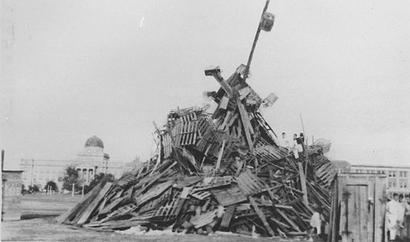
From the Annals of Texas A&M –  In 1999, 11 Texas A&M students were killed, one former student was killed and another 28 injured during construction of the annual bonfire for the UT (or TU as the Aggies would have it) game.  The bonfire had been a tradition at A&M for almost 90 years.  Early Bonfires were just that – piles of trash. But over the years, the Bonfire grew exponentially, setting the world record in 1969.  By the time of the 1999 Bonfire collapse, the Bonfire ritual had become a months long endeavor producing what ultimately proved to be a precarious 90 foot tall six tiered structure centered around two telephone poles affixed end to end.   The ensuing investigation revealed that there were no exact plans for the Bonfire, the structure had never been approved by an engineer, and that drinking and hazing were prevalent.  None of that took away from the tragedy of the event and the dedication of those who died in the construction accident.   The tragedy led A&M to declare a hiatus on an official Bonfire. However, since 2002, a student-sponsored coalition has constructed an annual unsanctioned, off-campus “Student Bonfire” in the spirit of its predecessor.

Photo of the 1928 Bonfire.

Today in Texas History – November 17

From the Annals of Houston –  In 1981, Kathryn Whitmire was elected as the first female mayor of Houston.  Whitmire was first elected as City Controller for two terms and then to five consecutive terms as mayor. She also served as the president of the U.S. Conference of Mayors and Texas Municipal League. As mayor she appointed Lee P. Brown as the first African American to serve as police chief. Brown later would become mayor.  Whitmire was defeated in 1991 by political power-broker Bob Lanier in an election that turned largely on Lanier’s opposition to Whitmire’s plan to bring mono-rail to Houston.  Whitmire moved to Hawaii in 2001.

Today in Texas History – November 16

From the Annals of the Republic –  In 1845, the Republic of Texas concluded its last Indian treaty.  The agreement was the culmination of the Tehuacana Creek Councils, which began in the spring of 1843.  Jesse Chisholm has worked to convince a number of Indian groups, including the Caddos, Tawakonis, Delawares, Lipan Apaches, and Tonkawas, to meet on Tehuacana Creek near the Torrey Brothers trading post south of present Waco. A second council met at Fort Bird on the Trinity River in the fall of 1843.  These councils resulted in a peace treaty between the Republic and the Wacos, Caddos, and others.  However, the Comanches were not represented.  President Sam Houston called another council meeting at Tehuacana in April 1844. The Comanches were yet again absent, but by October 9, 1844, Houston had negotiated a treaty with a part of the southern Comanches, Kichais, Wacos, Caddos, Anadarkos, Hainais, Delawares, Shawnees, Cherokees, Lipan Apaches, and Tawakonis. At the November 1845 council the Wacos, Tawakonis, Kichais, and Wichitas agreed to the treaty of October 9, 1844.

Today in Texas History – November 13

From the Annals of Plutonium –  In 1974, union activist Karen Silkwood died in an automobile accident. Silkwood was born in Longview and was a laboratory technician at a Kerr-McGee  plutonium plant in Oklahoma. She joined the Oil, Chemical and Atomic Workers Union and became the first female member of the union bargaining committee in Kerr-McGee history.  Working to investigate health and safety concerns, she quickly discovered evidence of spills, leaks, and missing plutonium.  As a result of conditions in its plant, Kerr-McGee was sued in connection with worker safety and environmental contamination claims.  Braving strong opposition and threats, Silkwood testified before the Atomic Energy Commission that she had suffered radiation exposure in a series of unexplained incidents.  The automobile accident that claimed her life occurred while she was on the way to a meeting with an AEC official and a New York Times reporter.  Although there was many theories floated regarding her death, nothing in the way of foul play was ever proven.  However, an autopsy confirmed that she had been contaminated by plutonium.  She was portrayed by Meryl Streep in the 1984 movie Silkwood. 

Today in Texas History – November 11

From the Annals of the Colonists –  In 1833,  members of the Beales Colony left New York aboard the Amos Wright headed for Texas. .  John Charles Beales and others had obtained large colonial grants that encompassed much of western Texas, eastern New Mexico, and the Rio Grande valley. The first colonists landed at Copano Bay on December 12, 1833. From there they traveled to a site on Las Moras Creek near Presidio del Rio Grande in the Rio Grande Valley.  The colonists named their settlement Dolores, in honor of Beales’s Mexican wife.  Beales’ Colony was a failure.  It was located in semi-arid brush unsuitable for farming and in country claimed by the Comanche.  Many colonists left for other settlements.  The final blow came during the Texas Revolution when the entire colony was abandoned before the advance of the Mexican Army.

Today In Texas History – November 10

From the Annals of LBJ –  In 1967, the President’s Ranch Trail was dedicated in Wimberley. The 90  mile route includes places in Hays, Blanco and Gillespie counties that were important in the life of Pres.  Lyndon B. Johnson.  It extends from the LBJ Ranch, located on Ranch Road 1 near Stonewall, to San Marcos. From the ranch two approaches are possible to Blanco, from which the main route extends to San Marcos: one, referred to as the north branch, proceeds from Ranch Road 1 via U.S. Highway 290 through Hye to Johnson City, then to Blanco via U.S. Highway 281; the other approach, referred to as the south branch, leads from the ranch to Stonewall and reaches Blanco by means of Albert on Ranch Road 1623. The route from Blanco to San Marcos leads via Ranch roads 165 and 2325 through Wimberley, where Ranch Road 12 leads to San Marcos.

Photo of the Western White Houston from the National Park Service.