Category Archives: Today in Texas History

Today in Texas History – March 15

From the Annals of Masonry –  In 1836, Texian soldier Lewis Ayers was captured by forces under the command of Mexican General Jose de Urrea.  Ayers in action under Captain Amon King engaging Urrea’s rear guard when he was captured  with 32 other soldiers.  The prisoners were ordered to be executed as rebels.  One of Urrea officers, Colonel J.J. Holzinger  intervened to spare the German prisoners.  Ayers was not German but was included in the group to be spared.  Legend has it that he was later released after giving a Masonic sign that Gen. Urrea recognized.

Image of Gen. Urrea from tshaonline.org.

Today in Texas History – March 14

From the Annals of the Equines – In 1940, horse enthusiasts and ranchers met in Fort Worth to form the American Quarter Horse Association. Among those in attendance were rancher and Quarter Horse breeder Anne Burnett Hall and King Ranch president Robert J. Kleberg. The meeting was the first in a series that led to the formation of an organization to “collect, record and preserve the pedigrees of Quarter Horses in America.”  The name Quarter Horse goes back to the origin in colonial times when the speedy horses earned fame for their performance in quarter-mile races.   The AQHA was the first to regularize the breed and establish pedigrees.  Now based in Amarillo, the AQHA is an international organization dedicated to the preservation, improvement and record-keeping of the American Quarter Horse  In Texas, the Quarter Horse brings to mind images of the cowboy, the cattle drive and today – the rodeo.  Quarter Horse racing is in decline across the Southwest, but the breed continues to compete in roping, barrel racing and other rodeo competitions.

Image from aqha.com.

Today in Texas History – March 10

From the Annals of the Civil War – In 1864, President Abraham Lincoln appointed Ulysses S. Grant as Lieutenant General in command over all Union forces.  Grant was promoted from Major General in command of the western front of the War with the Armies of the Tennessee and Cumberland.  From this point on, the fate of the Nation rested largely in the hands of one rather ordinary man who had both a hatred and genius for war.  At the beginning of the war, if anyone had suggested that Sam Grant, the failed shopkeeper and farmer from Ohio, would rise to command the entire Union Army, the laughing and knee slapping would have gone on for hours. In fact, Grant himself would probably have thought that he might aspire to be a competent Brigade commander based on his West Point training and experience in the Mexican-American War.  Grant’s primary experience had been as a quartermaster in charge of supplies and provisions.  From that work, Grant knew exactly what was required for fighting units to succeed.  His first units were superbly equipped and it showed on the battlefield. Grant’s victories at Forts Henry and Donelson  were two of the very few early Union successes and were widely publicized in the North.  These victories secured him a quick promotion to Major General and command of the Army of the Tennessee.  And his victory at Shiloh, at almost unspeakable cost for both sides, secured him a top leadership position for the remainder of the war.  Grant understood that just being in the Army was the greatest danger most soldiers faced.  More troops were dying from illness and disease than from combat wounds.  It was a brutal numbers game, but he was determined to bring the war to a swift conclusion by fighting.  The 30 Days campaign was intended to do just that and it broke the back of the Army of Northern Virginia.  Even though the war on the Eastern front settled into trench combat for many months, the 30 Days Campaign assured ultimate Union victory. It is not hyperbole to say that but for U.S. Grant, there is no United States of America as we know it.

Grant has been much maligned over the years as an incompetent general and corrupt politician. His skill as a military man should be unquestioned.  His greatest blunder was at Cold Harbor where troops were forced to wait to assault Confederate lines giving the rebels a chance to dig in.  Grant was forthright in acknowledging his mistake. But as a general, he knew he had the power of men and might on his side and used them effectively.  As President (for Grant was not a politician), his administration had several notable achievements.  He secured the Treaty of Washington which ended all disputes between the U.S. and Great Britain and set in place the greatest alliance of the past 175 years, he almost single-handedly stopped the extirpation of the plains Indians, he balanced the budget,  he supported the rights of the freedmen in the South (who were later abandoned by the Republican Party), and negotiated the annexation of the Dominican Republic (which was stopped by a short-sided Congress).

There is some new thinking on Grant, exemplified by Jean Edward Simith’s tremendous biography Grant.  And if you are in the mood for an excellent read on Texas in the late 1840’s, read Grant’s Memoirs.

Today in Texas History – March 9

From the Annals of the Colonists –  In 1731, colonists from the Canary Islands established Villa de San Fernando. Under the leadership of Juan Leal Goraz, the group marched overland from Veracruz to the presidio of San Antonio de Bexar.  The party had increased by marriages on the way to fifteen families with a total of fifty-six persons. They joined a military community that had been in existence since 1718. The group ultimately became part of the Villa of San Fernando de Bexar, the first regularly organized civil government in Texas. Several of the old families of San Antonio trace their descent from the Canary Island colonists. María Rosa Padrón was the first baby born of Canary Islander descent in San Antonio.

Today in Texas History – March 8

From the Annals of the Revolution – In 1798, Mathew Caldwell was born in Kentucky. In 1831, Caldwell settled in Dewitt County. Caldwell earned the name “Paul Revere of the Texas Revolution” because he rode from Gonzales to Bastrop to call men to arms before the battle of Gonzales in October 1835. He was also a signer of the Texas Declaration of Independence and a seemingly tireless fighter.

After independence, Caldwell remained active in military service.   In 1839, President Mirabeau Lamar named Caldwell captain of a company of rangers to be raised for the defense of Goliad.   He was also involved in several fights with Native Americans.  He was wounded at the Council House Fight in March of 1840.  He recovered and headed a company at the Battle of Plum Creek on August 12.  He was also involved in the Texan Santa Fe Expedition in 1841 where he was captured with the expedition and imprisoned in Mexico. Upon release he hastened to the relief of San Antonio and on September 18, 1842, commanded a force of 200 men who met and defeated Adrian Woll in the Battle of Salado Creek.  Caldwell County is named in his honor.

Today in Texas History – March 7

From the Annals of Flora –  In 1901, the Texas legislature proclaimed the bluebonnet (lupinis texensis) to be the official state flower.  The shape of the petals on the flower resembles the bonnet worn by women pioneers.  The use of the flower to beautify Texas highways did not begin with Lady Bird Johnson.  The effort preceded her admirable work by at least 30 years.  In the 1930s the state began a highway-beautification program that included scattering bluebonnet seed along highways and byways.  The bluebonnet is the subject of many landscape paintings – mostly bad.  With the reasonable rains we have had, the show should be fairly good this year.  Just be careful when pulling off the highway for your bluebonnet picture.  The peak of bluebonnet season is usually in late March or early April.

Today in Texas History – March 4

From the Annals of the Trail Drivers –  In 1868, Jesse Chisholm died from food poisoning in Oklahoma.   Chisholm was not a cattleman.  He was a frontier trader.  But he did blaze the famous trail that bears his name.  He was born in Tennessee to a Anglo father and Cherokee mother.  He was an early pioneers into the Arkansas Territory. In his 20s, he joined a community of Cherokee Indians in northwestern Arkansas and took up trading.   trader. His familiarity with both Anglo and Native American culture and language (he could reportedly speak 14 different Indian dialects) helped him build a thriving trade with the Osage, Wichita, Kiowa, and Commanche.

Chisholm’s trading expeditions gave him a superior knowledge of southwestern geography. He led several important expeditions into the Southwest during the 1830s and 1840s, and during the Civil War opened a trading post near Wichita, Kansas.  After the war, he blazed a first trading routefrom Wichita to the Red River in North Texas and then extended the route to the Gulf of Mexico.  The route became known as the Chisholm Trail.

The trail was a straight wagon road with easy river crossings and relatively easy grades.   The trail was designed for the lumbering heavy freight wagons used for commerce.  By 1867, the first cattle drivers began using the trail to move beef on the hoof to the railroads in Kansas. During the next five years, millions of cattle trampled down the trail.  The large numbers of cattle cut a swath 200 to 400 yards wide.  The heavy use and erosion cut the trail down below the level of the plains it crossed. Traces of the trail may still be seen to this day.

Today in Texas History – March 3

From the Annals of Diplomacy – In 1837, U.S. President Andrew Jackson appointed Alcée La Branche as the American chargé d’affaires to the Republic of Texas. The act officially recognized Texas as an independent republic.  La Branche was born on his father’s plantation on the Mississippi River near New Orleans in 1806. The family, earlier named Zweig (the German equivalent of French branche) had emigrated from Bamberg, Bavaria to Louisiana in 1721. Alcée  attended the University of Sorreze in France. and after returning home he was elected to the  Louisiana House of Representatives in 1831 and was elected as speaker of the House in 1833.

Texas received him enthusiastically viewing him as friend of annexation.  La Branche, however, was loyal to his country and aggressively defended the United States claim to disputed territory in Red River County (now Bowie, Red River, Franklin, Titus, Morris, and Cass counties). The two countries signed the Convention of Limits, which recognized Texas claims to the contested county and the Sabine River as the eastern boundary of Texas. La Branche also sought to reduce tensions concerning cross-border raids in pursuit of Native Americans.  He believed that the majority of Indian attacks were caused by Texans’ trespassing and surveying Indian lands.

La Branche Street in Houston is named in his honor.

Today in Texas History – March 2

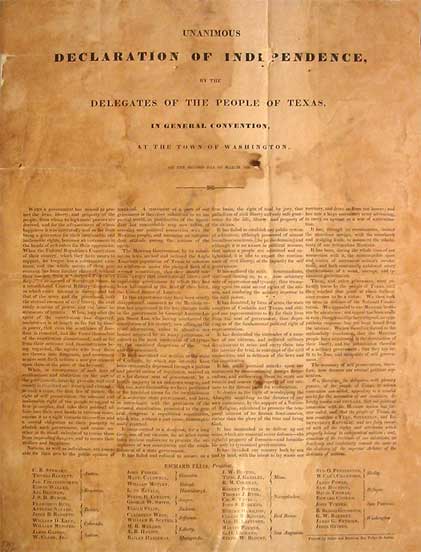
From the Annals of the Revolution – In 1836, Texas declared its independence from Mexico.  The previous day, delegates from the seventeen Mexican municipalities of Texas and the settlement of Pecan Point met at Washington-on-the-Brazos to consider independence from Mexico. George C. Childress presented a resolution calling for independence.  Richard Ellis, the president of the convention appointed Childress to head a committee of five  Edward Conrad, James Gaines, Bailey Hardeman, and Collin McKinney to draft a Declaration of Independence from Mexico.  Childress probably already had a draft version of the document with him when he arrived. As the delegates worked, they received regular reports on the ongoing siege on the Alamo by the forces of Santa Anna’s troops.  Childress and the committee drew heavily on the United States Declaration of Independence.   In the early morning hours of March 2, the convention voted unanimously to accept the resolution.

Red’s favorite passage:  “It has, through its emissaries, incited the merciless savage, with the tomahawk and scalping knife, to massacre the inhabitants of our defenseless frontiers.”

Vote!

It’s Super Tuesday and it may not be excessive hyperbole to suggest that the fate of the nation hangs in the balance.  The presidential primary races may be all but over by the end of the day.  So Red urges everyone – Democrat, Republican, Tea Party, Independent, or Other – to exercise your franchise and vote for the candidates of your choice – even if it includes Sen. Ted Cruz (TP-Texas).  We can’t all be right.