Today in Texas History – January 22

From the Annals of the Supreme Court –  In 1973, the U.S. Supreme Court issued its decision in Roe v. Wade, 410 U.S. 113 (1973), which declared that criminal laws against abortion were unconstitutional.  The case involved Norma L. McCorvey (using the alias Jane Roe) who discovered she was pregnant with her third child.  When she returned to Dallas, she first sought an illegal abortion at a site that had been closed by the police. Eventually, she was referred to Texas attorneys Linda Coffee and Sarah Weddington.   Coffee and Weddington filed suit in a U.S. District Court in Texas on behalf of McCorvey against Dallas County District Attorney Henry Wade who represented the State of Texas.  Although McCorvey would give birth before the case was finally decided, the Supreme ultimately invalidated laws criminalizing abortion.

The much hailed and criticized opinion expanded on the previous decision in Griswold v. Connecticut, 381 U.S. 479 (1965),in which the Court ruled that the U.S. Constitution protected a right to privacy.  That case overturned a Connecticut statute that prohibited use of contraceptive devices and drugs on the grounds that it violated the “right to marital privacy”.   Roe v. Wade was an expansion of the right to privacy into the area of the right of a woman to choose to terminate a pregnancy in the first two trimesters.

The U.S. has an interesting history when it comes to the legality of abortion. Roe did not mark the first time that abortion became a legal procedure.  Some historians point out that for much of the country’s early history, abortion was not a criminal offense and not generally thought to be immoral.  In the 1700s and early 1800s, the word “abortion” referred only to the termination of a pregnancy after “quickening,” the time when the fetus first began to make noticeable movements.  Before quickening, women had a variety of drugs available to end an unwanted pregnancy.

 The first state prohibition was passed In 1827 by Illinois.  That law made the use of abortion drugs or devices punishable by up to three years’ imprisonment.  Other states passed similar laws but “Female Monthly Pills,” as the abortifacients were known were commonly sold until the middle of the 19th century.

Abortion was widely criminalized between 1860 and 1880. But the practice was not outlawed because of widespread moral outrage over the practice.  Rather, the anti-abortion movement was an anti-competitive campaign waged by the recently established American Medical Association. Doctors viewed abortionists as unwanted competition.  When the Catholic Church, which had long accepted terminating pregnancies before quickening, joined the doctors in condemning the practice, the end of legal abortion quickly followed.

By 1900, abortion was illegal throughout all 50 states.  The prohibition did not stop abortion because the laws were rarely enforced and any women with enough money could terminate a pregnancy. Things changed by mid-century as law enforcement stepped up crack-downs on abortion providers.  This led to a reform movement that succeeded in lifting abortion restrictions in California and New York even before the Supreme Court decision in Roe v. Wade.

The controversy over Roe continues today as many states, including Texas, have attempted to legislate around the margins of Roe and restrict abortion as much as possible without running afoul of constitutional challenges.

Better Not Call Craig

 The Houston Press reports that the State Bar of Texas has suspended the law license of  former U.S. Representative Craig Washington for 18 months.  This is not former the Congressman’s first run-in with complaints about his law practice or the law.  He was previously sentenced to two years probation in a case where he shot at two teenagers who were looking for a parking spot in a midtown parking lot owned by Washington.  As for his current problem, the issues are much more prosaic, dealing with matters of client neglect.

“The case that ultimately got Washington suspended dates back to 2006. That year Michael Gobert hired Washington to represent him while he was fighting to keep his mother’s house from being transferred to her live-in boyfriend in a Montgomery County court. According to court records, Gobert paid Washington $10,000 for his services. In return, Washington failed to tell Gobert about a pre-trial hearing the week before his case was set to go to court. When the case was called, neither Gobert nor Washington showed up, and Gobert’s case was dismissed (Gobert’s had no luck on appeal).

Last month Washington’s disciplinary case, brought by the State Bar of Texas, went before a Bastrop County jury, which found that the former congressman had committed professional misconduct in Gobert’s case. The court also made Washington pay the state bar’s attorney’s fees, about $25,000.”

Red’s Winning Bar Bets – Bet No. 1

Everyone handles money almost every day.  Or they used to anyway.  But can you identify what image is on the back of each piece of common U.S. Currency – that is, the $1, $5, $10, $20, $50 and $100 bills?   Most people could probably identify the famous personage (not all of them dead Presidents) on the front of the bills.  Only a rarely observant person will be able to name what is depicted on the back of each bill.  See how you do.  And then try to win a free beer at your local pub.

Finally, We Agree on Something

The Associated Press reports that Ex-Governor Rick Perry skipped out on the inaugural festivities for his successor Greg Abbott.  Instead, Perry was spotted at Sandy’s enjoying one of their signature frozen custard cones.  A visit to Austin is not complete without a visit to Sandy’s which is not an “ice cream parlor” as incorrectly asserted in the AP Report.  Far from it, Sandy’s is an outstanding little burger joint on Barton Springs road, where you can also get a delicious frozen custard cone, malt or milkshake.

“Perry skipped Abbott’s inauguration. Hours later, though, his official Twitter feed showed a photo of him holding what looks like a cone of vanilla in front of Austin ice cream parlor Sandy’s. The caption reads, ‘Sandy’s, where you go to celebrate.’ It’s the same place Perry tweeted about visiting in August, after he was booked and smirked in his mug shot following being indicted on two felony abuse-of-power charges.”

Today in Texas History – January 21

From the Annals of the Civil War –   In 1863, Confederate forces recaptured Sabine Pass opening one of the last ports available to the Confederacy. Sabine Pass controlled access to the Sabine River which divides Texas and Louisiana.  In 1861, the Confederacy constructed a major fort to retain control of the river. Union troops captured the fort in September of 1862 and quickly seized control of the major port of Galveston giving the Union control of most of the Texas coast. In November, Confederate General John Bankhead Magruder was given the daunting assignment of expelling the Union forces from Sabine Pass and Galveston.

Magruder’s forces recaptured Galveston before turning their attention to Sabine Pass.  Magruder’s plan involved fortifying the decks of two Rebel ships, the Bell and the Uncle Ben, with cotton bales. Sharpshooters were placed behind the bales.  The ships approached the two Union ships at the Pass, the Morning Light and the Velocity.  The Rebel ships chased the Union vessels into open water while the sharpshooters injured many Union gunners. The Union ships quickly surrendered reopening the Texas coast for Confederate shipping.

Does $1,625,000 per win sound high?

The Texas Rangers have acquired Yovani Gallardo who is projected to be the No. 3 starter in their pitching rotation.  The Rangers gave up three minor leaguers to Milwaukee for Gallardo who is regarded as a durable slightly above-average pitcher.   Gallardo is 28 years old and a native of Fort Worth.  He went 8-11 with a 3.51 ERA for the Brewers last season. He has made at least 30 starts the past six seasons and pitched more than 180 innings in six of his eight big league seasons.

The Rangers are desperate to shore up a starting rotation behind Yu Darvish and Derek Holland.  Durability is a desirable trait in Arlington as the Rangers used 15 different starting pitchers last season due to a variety of injuries while losing 95 games.  At $13 million in 2015, Gallardo will cost the Rangers $1,625,000 per start if he wins 8 games again.  To be fair since the Brewers are picking up $4 million of the final year of Gallardo’s contract, the Rangers will be only out $1,125,000 per win if Gallardo pitches to expectations.

Sam’s Bible?

The Dallas Morning News reports that the Bible traditionally used to swear in a new Texas Governor may or may not have actually belonged to Sam Houston.  The evidence for the authenticity of the Houston Bible seems sketchy at best.  The Bible which is in the possession of the Texas Supreme Court cannot be definitively traced to Houston.

“Here are the undisputed facts: The publishing date inside is 1816. The binding is original, but the book was re-cased and is now more flexible. Souvenir-seekers would tear out pages and pocket them, then sheepishly hand them back after being chased down. Houston’s connection to the book is fuzzier, and big clue is long gone: The bible’s flyleaf reads ‘Supreme Court of the Republic of Texas,’ but the bottom half is torn away. A Texas Supreme Court justice told colleagues in the 1940s that he saw Houston’s signature on the now-missing half of the page. That recollection satisfied amateur historians for a long time. When Bush was inaugurated in 1995, he called it ‘Sam Houston’s own bible, simple and worn.’

But the story doesn’t quite add up, according to court archivist Tiffany Shropshire. The torn flyleaf was long blamed on a janitor, who in the 1970s stole thousands of pages of old Supreme Court archives. But the janitor is off the hook — Shropshire found a 1941 newspaper article that described the torn flyleaf. She also questions whether Houston ever signed the bible. In 2012, she asked three Houston historians to inspect the handwriting on the remaining portion of the flyleaf. Each said it looked like Houston’s. Her skepticism deepened, though. None was a handwriting expert. And letters found in state archives show the penmanship closely resembles that of John Hemphill, the court’s first chief justice, she said.”

Today in Texas History – January 20

From the Annals of the Vanishing Daily Paper –  In 1881, the first issue of the San Antonio Light was published. The Light was a daily except on Sundays.  The paper was originally described as the only Republican daily in Texas.  After the Light was purchased by Harrison L. Beach and Charles S. Diehl in 1911, the Light became liberal-Democratic in its political views. William Randolph Hearst bought the Light  in 1924.  By 1972 the Light, with a daily circulation of 122,292 and a Sunday circulation of 160,905, had the one of the largest readerships of any of the Hearst properties.  By 1987, however, it was operating on a deficit, and in October 1992 the Hearst corporation, after purchasing the rival San Antonio Express-News, closed the Light.

Today in Texas History – January 18

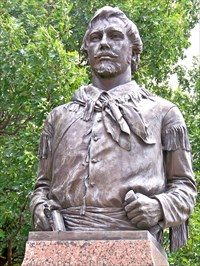
From the annals of the Empressarios  – In 1821 Spain granted Moses Austin of  Missouri a permit to settle 300 Anglo-American families in the state of Texas and Coahuila.  This was the beginning of the process that led to American colonization in Texas that l d to independence and annexation by the United States. The elder Austin (who was also the founder of the American lead industry) died before actual settlement could begin. His dying wish was for his son Stephen F. Austin to carry out the ambitious scheme. Stephen took the reins eventually becoming known as the “Father of Texas.” Austin’s plan was in doubt after the Mexican war for independence began, but Stephen F. Austin preservered and the plan to settle Austin’s Colony was approved in 1823.  The original settlers became known as the “Old 300”.