Tag Archives: Civil War

Today in Texas History – January 8

From the Annals of the Civil War – In 1864, the Boy Martyr of the Confederacy was hanged in Little Rock, Arkansas.  David Owen Dodd, a native of Victoria then living in Arkansas, had carried some letters to business associates of his father in Union held Little Rock.  He obtained a pass to return to his family in Camden, but a guard destroyed it when he  entered Confederate held ground.  After spending the night with his uncle, he wandered back into Union territory.  Union soldiers determined that he did not have a pass and upon a search found that he was carrying a notebook with Morse code annotations describing the location and strength of Union troops. He was arrested and tried by a military tribunal.  Dodd represented by attorneys T.D.W. Yonley and William Fishback, who was pro-Union and later became Governor of Arkansas. The defense consisted mostly of a plea for amnesty, which was rejected by the tribunal. Dodd was found guilty of spying and sentenced to death.  His hanging before a crowd estimated at 5000 was reportedly botched likely resulting in a slow death.  At the time, Union sympathies were strong in Arkansas and a constitutional convention was in session to enable the state to rejoin the Union.  Dodd’s execution renewed tensions between Union and Confederate factions. Dodd quickly became a folk hero and a force behind renewed support for the Confederacy.

Today in Texas History – December 16

From the Annals of the Civil War – In 1863, Confederate colonel Sul Ross assumed command of a brigade formed from the Third, Sixth, Ninth, and Twenty-seventh Texas Cavalry regiments which afterwards was known as Ross’s Brigade. Lawrence Sullivan Ross came to Texas at the age of one in 1839. He followed in his father, Shapley Ross’s footsteps and became an Indian fighter serving in campaigns with the Texas Rangers against the Comanches in 1858 and 1860.   When the Civil War began, he  joined Confederate forces and rose to command the Sixth Texas Cavalry. He was promoted to the rank of general soon after taking command of Ross’s Brigade.  The unit saw action in Atlanta and Franklin-Nashville campaigns.  Ross was on furlough in Texas when the brigade surrendered at the end of the war.  Ross was later elected to the Texas senate and served as Governor for 4 years.

Today in Texas History – December 7

From the Annals of the Colonists – In 1830, Texas pioneer and memoir writer Noah Smithwick was banished from Texas as “a bad citizen.” Smithwick came to Texas in 1827 as a young man settling in San Felipe. He came to the aid of a friend who was accused of murder and chained in leg irons.  Being a blacksmith, Smithwick furnished the prisoner with a file and a gun so he might escape.  Smithwick was tried and declared and banished from the colony. Smithwick returned to Matagorda in the fall of 1835 and reached Gonzales the day after the opening battle of the Revolution.  He served in the Texas Army and after the Revolution, tried cattle ranching before establishing a mill near Marble Falls.

Smithwick was an ardent Unionist and after receive receiving threats from secessionists he left Texas with a number of friends and moved to  southern California in 1861.  He dictated his memoirs to his daughter. After his death in 1899, she had the manuscript published by Karl H. P. N. Gammel as The Evolution of a State, or Recollections of Old Texas Days.

Today in Texas History – November 19

From the Annals of the Civil War – In 1863,  Pres. Abraham Lincoln delivered the Gettysburg Address at the dedication of a national cemetery for the soldiers who had fallen in the epic battle the previous July near the small Pennsylvania town.  Barely two weeks before the dedication, Lincoln was asked to make some appropriate dedicatory remarks.  His three minute address followed a two-hour stemwinder given by famed orator Edward Everett.  Lincoln considered the address to be a failure, but it has become recognized as the most forceful and eloquent defense of the democratic ideals of our country ever spoken.

“The world will little note, nor long remember what we say here, but it can never forget what they did here. It is for us the living, rather, to be dedicated here to the unfinished work which they who fought here have thus far so nobly advanced. It is rather for us to be here dedicated to the great task remaining before us—that from these honored dead we take increased devotion to that cause for which they gave the last full measure of devotion—that we here highly resolve that these dead shall not have died in vain—that this nation, under God, shall have a new birth of freedom—and that government of the people, by the people, for the people, shall not perish from the earth.”

Today in Texas History – October 23

From the Annals of the Loyal Unionists –  In 1863, the First Texas Cavalry left New Orleans as part of a campaign to occupy south Texas and interfere with trade between the Confederacy and Mexico.  The Rio Grande expedition landed on the south Texas coast on November 2 and occupied Brownsville four days later.  The First Texas Cavalry included 16 officers and 205 enlisted men, but grew quickly added more than 100 new soldiers within a month.  During this time the Second Texas Cavalry Regiment was formed at Brownsville. Both regiments left Texas in July 1864 for Louisiana. Two companies, however, of the First Texas Cavalry remained at Brownsville and did not rejoin their parent regiment until six months later.  The First Texas was part of a little known Texas effort to support the Union.   A total of 1,915 men from Texas served the Union.  The Texas Union soldiers were primarily of Mexican heritage, German Unionists from the Hill Country or first generation Irish immigrants – all of whom were opposed to slavery.

Today in Texas History – October 14

From the Annals of  Gun Safety (or Lack Thereof) – In 1867,  Lt. James Pike died during an Indian attack on his unit.  When Indians attacked Pike’s unit at dinner, the lieutenant seized his rifle and rushed to the defense. The rifle jammed, however, and in his frustration he smashed the barrel on a nearby rock, whereupon the gun discharged and killed him bringing an ignominious end to his rather distinguished career.  Pike was the son of an outspoken newspaper editor.  He arrived in Austin in 1859 and attempted to get a job as a printer.  When that failed, he joined John Henry Brown’s company of Texas Rangers at Belton. For the next two years he took part in a series of campaigns against the Comanches. When Texas seceded from the Union,  Pike left the Rangers and went north, where joined the Fourth Ohio Cavalry. Pike saw considerable action as a scout, spy, and courier in Gen. William T. Sherman’s army.  Pike was captured in 1864 and imprisoned in Charleston, South Carolina, then escaped and returned to Hillsboro, Ohio, where he wrote his memoirs of ranger and army service.  After the war, Pike obtained a commission as a second lieutenant in the First United States Cavalry and was later promoted to first lieutenant.

Pike’s memoirs were published in 1865 as The Scout and Ranger: Being the Personal Adventures of Corporal Pike, of the Fourth Ohio Cavalry.

Today in Texas History – September 29

From the Annals of Bravery – In 1864, Sgt. Milton Holland earned the Medal of Honor for action at Chaffin’s Farm and New Market Heights, Virginia.  Holland was born into slavery probably Austin in 1844.  He was the slave and perhaps son of Bird Holland who would later become Texas Secretary of State.  He was freed by Holland in the 1850’s and sent to the Albany Enterprise Academy in Ohio.  He enlisted in the United States Army in 1863 at the age of 19.  He joined the Fifth United States Colored Troops under the command of Gen. Benjamin Butler.   He quickly rose to the rank of regimental sergeant major.  During the engagements at Chaffin’s Farm and New Market Heights all of the white officers were killed or wounded.  Holland assumed command and led his regiment in action as it routed the Confederates.  He was wounded in the battle and for his actions received the Medal of Honor on April 6, 1865.  His commendation contained the following quote regarding his action after the regiment suffered heavy losses in the battle:

 “But, with a courage that knew no bounds, the men stood like granite figures. They routed the enemy and captured the breastworks. The courage displayed by young Holland’s regiment on this occasion called for the highest praise from Gen. Grant, who personally rode over the battlefield in company with Generals Butler and Draper.”

Butler promoted Holland to Captain for his service, but the War Department refused the commission because of his race.  After mustering out of the army on September 20, 1865, Holland lived in Washington, D.C., where he worked in the Auditor Office of the United States government.  He later became chief of collections for the Sixth District. He also established the Alpha Insurance Company, one of the first African-American-owned insurance companies. He died in 1910, at his farm near Silver Springs, Maryland, and was buried at Arlington National Cemetery.

Photo from the National Park Service.

Today in Texas History – September 17

From the Annals of the Civil War – In 1862, the Battle of Antietam was fought near Sharpsburg, Maryland.  The day was the bloodiest day in American military history with over 23,000 casualties on both sides.  The battle of Antietam was particularly hard on Texans fighting for the Confederacy. Over a thousand miles from their homes, the Confederate soldiers of Hood’s Texas Brigade would suffer the second-highest casualty rate of any unit during the Civil War. On the morning of September 17, the men of the First, Fourth, and Fifth Texas Infantry regiments were attempting to cook breakfast as the fighting opened. The meal was interrupted when the Federal army launched an assault on the Confederate left flank. Hood’s Brigade quickly formed and marched north, passing wounded and terrified Rebels streaming to the rear.  They entered the fighting in the vicinity of the Dunker Church where they were ordered forward in a counterattack. The Texans attacked the Union soldiers in a cornfield with initial success. But the attack was repulsed by intense artillery and musket fire.  The Texans attempted to continue their advance, but after suffering massive casualties Hood was forced to withdraw.  Over 550 of the brigade’s 850 soldiers had been killed, wounded, or captured. The First Texas Infantry suffered a casualty rate of 82% and lost their colors as well.

The technical victory for the Union at Antietam allowed President Lincoln to finally issue the Emancipation Proclamation which freed all slaves in Texas and the other Confederate states.

Photo of Antietam Cornfield from the National Park Service.

Today in Texas History – September 1

From the Annals of the Civil War –  In 1863,  Major Santos Benavides led 79 men in the Thirty-third Texas Cavalry across the Rio Grande in pursuit of the bandit Octaviano Zapata.  Zapata had been an associate of Juan Cortina.  During the Civil War he was recruited by Union forces to aid them in military action in south Texas seeking to prevent the Confederacy from exporting cotton to Matamoros.  Zapata’s raids also kept Rebel forces occupied in Texas.  Zapata’s force often flew the American flag during their raids – leading Texans to refer to the group as the “First Regiment of Union Troops.” The Cavalry caught up to Zapata near Mier, Tamaulipas the following day.  The confrontation ended with Zapata and 9 others were dead.  The remnants of the bandit gang dispersed.

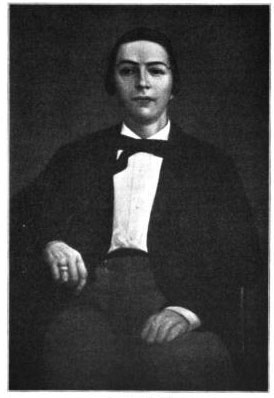
Photo of Santos Benavides from http://www.forttours.com

Bye Bye Jeff – UT Puts a Traitor in His Place

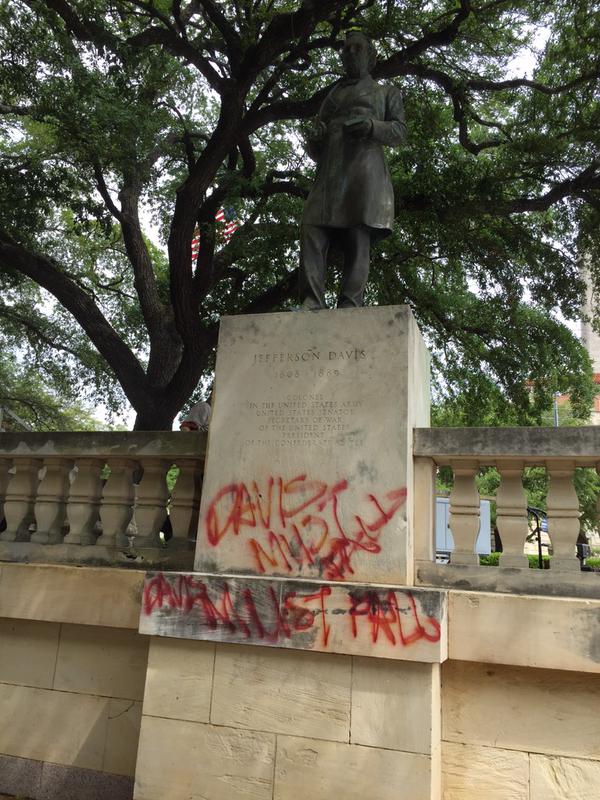
According to numerous reports, a state district judge has removed any legal impediments to UT-Austin’s plan to remove the statute of CSA President Jefferson Davis from its place of prominence on the South Mall of the main campus.  Kudos to UT for removing this monument to slavery, segregation and racism from daily viewing.  Predictably, the Confederate apologizers and historical revisionists expressed outrage that UT would no longer seek to honor a traitor who was dedicated to preserving slavery.  KSAT has the story.

A judge on Thursday cleared the way for the University of Texas to move a statue of Confederate President Jefferson Davis away from the main area of campus, despite objections from a Southern heritage group that called uprooting the monument a “cultural atrocity” and compared it to the Islamic State destroying ancient artifacts in the Middle East.

Civil rights activists say the nearly century-old bronze likeness of Davis highlights the university’s racist past and the statue had been targeted by vandals. New school President Greg Fenves recently ordered it moved to a campus museum, but allowed other Confederate symbols to remain.

The Sons of Confederate Veterans, which earlier this year lost a U.S. Supreme Court decision over rejected Confederate license plates, had sued to prevent moving Davis’ statue.

But state District Judge Karin Crump said state law allows the school to determine where to place statuary on its campus. And she noted the original will of benefactor George Littlefield, who commissioned the statue of Davis and others, stated that it be placed in a position of prominence.

Texas will move Davis to the campus Briscoe Center history museum, which also houses one of the nation’s largest archives on slavery.

“Putting it in the Briscoe Center, far from whitewashing or erasing history, but puts it in the proper historical context,” said Gregory Vincent, Texas vice president for diversity and community engagement.

Vincent said the school would move the Davis statue within the next few days.

Photo from http://www.insidehighered.com