Tag Archives: Texas History

Today in Texas History – August 13

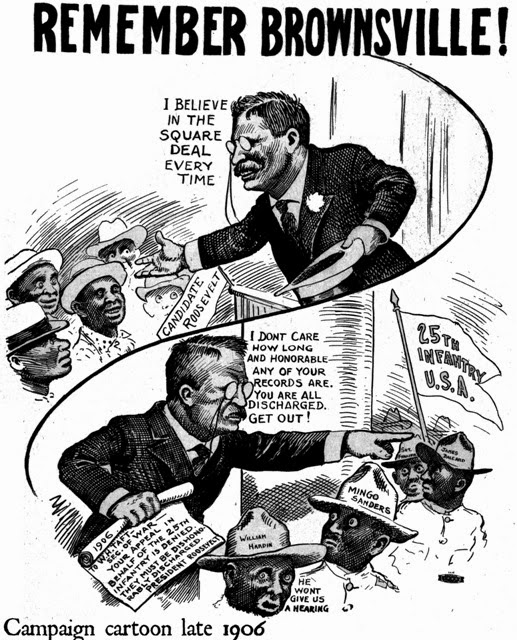
From the Annals of Discrimination –  In 1906, an alleged attack by soldiers from the  black  25th Infantry Division stationed at Fort Brown resulted in the largest summary dismissals US Army history.  The troops fresh from duty in the Phillippines arrived in Brownsville on July 28.  . The First Battalion, minus Headquarters and Company A, arrived at Brownsville.  The town greeted them racial hostility and discrimination with many local businesses refusing to serve them.  After reports of an attack on a white woman on the night of August 12,  Maj. Charles W. Penrose, after consultation with Mayor Frederick Combe, declared an early curfew the following day to avoid trouble with the increasing tension.  Sometime around midnight, a locol bartender was killed in a shootout that also critically wounded a police officer.   Some townspeople blamed the troops and made unverified claims that the soldiers were running through the streets shooting.

A series of investigations followed, but no individual soldiers were ever identified as having committed criminal acts.  Maj. Augustus P. Blocksom, of the army’s Southwestern Division, found that the soldiers were uncooperative and recommended dismissal. The troops for their part denied any knowledge of the shooting. Texas Ranger Cap. William J. McDonald arrested 12 men but none were ever indicted. Inspector General Ernest A. Garlington claimed there was a “conspiracy of silence”  and urged dismissal of the men. On November 5 President Theodore Roosevelt summarily discharged “without honor” all 167 enlisted men who had been stationed at Fort Brown.

A Senate investigation of the matter instigated by Roosevelt rival Sen. Joseph B. Foraker (R-Ohio) resulted in conflicting majority and minority reports and no action for the men who had been summarily dismissed.   When some of the men reapplied for enlistment, Roosevelt was forced to appoint a board of retired army officers to review the applications. After interviewing about half the applicants, the Court of Military Inquiry approved only fourteen of the men for re-enlistment.

The matter lay dormant until 1972,  when  Rep. Augustus Hawkins (D-California) took up the cause of the wrongly dismissed soldiers. The Nixon administration concurred and awarded honorable discharges without back pay. Dorsie Willis, the only surviving veteran, received a $25,000 pension.

Today in Texas History – August 12

From the Annals of the Indian Wars –   In 1840, the Battle of Plum Creek was fought between a Texas army comprised of militia, Rangers and Tonkawa Indians and several allied bands of Comanches.  The battle occurred in the aftermath of the Council House Fight.  The CHF had resulted in the deaths of several Comanche chiefs who had met with Texans under a flag of truce to exchange white prisoners.  The Comanches felt betrayed and Chief Buffalo Hump organized a retaliatory raid through the Guadalupe River valley east and south of Gonzales. Hump had several hundred warriors and a band of almost one thousand including families who followed the fighting to tend to the fighters and seize plunder.  In a series of raids, the Comanches moved through the Gonzales area killing settlers, stealing horses, and making off with whatever they could carry.  One raid sacked the town of Linnville.  The Texans were led by  Gen. Felix Huston, Col. Edward Burleson and Ben McCulloch.  Much of the fight was a running battle with the Comanches.  However, when the Texans finally caught up with the Comanches on Plum Creek a showdown finally occurred.  The Comanches likely would never have been caught except for the tremendous success of the raid.  They were bogged down by attempting to herd several hundred horses and plunder laden mules back to the Llano Estacado.  The actual battle took place near present-day Lockhart and reportedly resulted in the deaths of 80 Comanches – an unusually large number for such fights.

Image from texasbeyondhistory.net.

Today in Texas History – August 11

From the Annals of Labor Relations –  In 1994, Major League Baseball players went on strike beginning the longest work stoppage in major league history.  The strike resulting in the cancellation of the World Series – the first time the baseball season did not end with a champion in 89 years.

Major League owners had the most enduring control over their players of any American sports league.  Until 1975, the reserve clause had effectively killed any notion of free agency in baseball and kept player salaries artificially low.  By 1994, the main source of conflict was the owners’ plan  to institute a cap on player salaries.  Making unproven claims of financial hardship, owners argued that player salaries had become unsustainable.  The players, led by union head Donald Fehr, refused to agree to a cap.

The level of distrust had been exacerbated by the 1985 secret agreement of the owners to not sign one another’s players.  The pact was remarkably successful in practice as all 28 major league teams sat tight for three seasons.  When the illegal conspiracy was discovered, the players’ union sued and won a $280 million judgment. Consequently, when the collective bargaining agreement between MLB and the Players Association expired in 1994 negotiations for a new deal were difficult. On August 12, the petulant and peeved owners locked the players out, and cancelled the rest of the 1994 season.

No progress during the off-season and on the eve of the new baseball season, 28 of 30 owners voted to field replacement teams.  On March 31, Judge Sonia Sontomayor stepped in, issuing an injunction against the owners. On April 2, 1995, the players returned to work.

Astros fans have long claimed that the strike robbed Jeff Bagwell of a landmark season.  Bagwell was hitting .368 with 39 home runs through the date of the strike.  But he had broken his hand on August 10 when he was hit by an Andy Benes pitch in the top of the third inning.  The real losers were the Montreal Expos who were 74-40 and cruising through the NL East at the time of the strike.  The franchise never recovered.

Today in Texas History – August 10

From the Annals of War Crimes –  In 1862, the Battle of the Nueces took place in Kinney County.  A force of mostly German immigrant Unionists from the Hill Country led by Fritz Tegener were attempting to escape to Mexico and then onto Union controlled New Orleans.   They were camped on the west bank of the Nueces River about twenty miles from Fort Clark when they were attacked by mounted Confederate soldiers. The Unionists had camped without choosing a defensive position or posting a strong guard. The Confederates, led by Lt. C. D. McRae, came upon the camp on the afternoon of August 9. Firing began an hour before sunlight the next morning; nineteen of the sixty-odd Unionists were killed, and nine were wounded. The nine wounded were executed a few hours after the battle. Two Confederates were killed and eighteen wounded, including McRae.  McRae only had authority to arrest the civilians for avoiding service in the Confederate Army, but instead he chose to massacre sleeping civilians and then allowed the execution of unarmed wounded men.   Question for the supporters of the so-called “noble cause” – Was it noble to execute wounded prisoners?

Print of the Nueces Massacre from lifeofthecivilwar.blogspot.com.

Today in Texas History – August 6

From the Annals of Anglo-American Relations – In 1842, Charles Elliot arrived in Galveston as the newly appointed British charge d’affaires to the Republic of Texas.  Elliot, a British knight and retired naval officer, was a veteran of the Colonial Service previously serving in Guiana and China. In 1842 he was reassigned to hardly desirable duties in the Republic of Texas.  But Elliot made the best of the situation.  While in  Texas he worked for the abolition of slavery, free trade and peace with Mexico. He was friends with Sam Houston and Anson Jones, and worked with the British ambassador to Mexico for an armistice between Texas and Mexico in 1843. He was instrumental in negotiating the release of prisoners from the ill-fated Mier expedition. He opposed Texas annexation by the United States.  When Texans voted for annexation he was recalled.

Today in Texas History – August 3

From the Annals of the Feud – In 1898, the Colorado County Feud began.  The Feud was ignited by the County’ Sheriff’s race and involved a series of gun battles between members of the Townsend family of Columbus. The actual election was between incumbent sheriff Sam Reese and a former deputy Larkin Hope. Former state senator and power broker Mark Townsend dropped his backing of Reese and endorsed Hope. The move indicated victory for Hope since Townsend typically backed the winner.  It was not to be, as Hope was gunned down Columbus.  Hope’s backers suspected Jim Coleman, a close friend of Sam Reese’s sons, Walter and Herbert, was behind the killing. Townsend picked a new candidate, Will Burford, and, with feeling running high against the Reeses, Burford won the election. Less than a year later, on March 16, 1899, Sam Reese was killed in a gun battle on the street near where Hope died. Will Clements, Marion Hope, and Mark Townsend were among those shooting. Stray bullets killed Charles Boehme, a bystander, and wounded a boy named Johnny Williams. Even though the best evidence suggests that Reese had provoked the fight in which he was killed, his sons vowed to get revenge. In five more gunfights five more men were killed and several others wounded. The dead included Reese’s brother Dick, Burford’s son Arthur, Will Clements’s brother Hiram, and Jim Coleman. No one was ever convicted of any of the murders. Those accused included Mark Townsend, Jim Townsend, Step Yates, Will Clements, Walter Reese, Joe Lessing, Frank Burford, and Marion Hope.  Perhaps not so curiously, the Townsends, Reeses, Burfords, Clementses, Hopes, and Lessings were all related to each other.

The End of the Line for the Confederacy

Only 150 years after the surrender at Appomattox Court House, we may finally be witnessing the last dying throes of the Confederate States of America.  And it is about time.  Red has studied the Civil War for over 40 years and visited many of the great National Battlefield Parks and several of the lesser-known Civil War sites.  It is a fascinating, tragic and yet somehow uplifting story of how a nation engaged an deadly struggle for its soul and to bring meaning to the founding words that “all men are created equal.”  But it nearly destroyed our nation and in any understandable sense of the word, supporters of the Confederacy were traitors to our country.  Yes, there was much battlefield courage and heroism on both sides of the conflict.  But clearly the Confederacy was on the wrong side of history.

The apologists will continually tell you that the Civil War had nothing to do with slavery and that it was an honorable fight for “States Rights.”  Bullcrap.  Ask yourself this, would there have been a war if there had been no slavery? Of course not.  If you have any doubt about that, simply read the Texas Ordinance of Secession resolution that preceded Texas’ entry into the Confederacy.  It is clear, that Texas seceded for only one reason – to preserve the right to enslave fellow humans forever.  Read these excerpts from this vile racist screed, and then tell me that the Confederacy and the Civil War was about something other than slavery.

Texas abandoned her separate national existence and consented to become one of the Confederated States to promote her welfare, insure domestic tranquillity and secure more substantially the blessings of peace and liberty to her people. She was received into the confederacy with her own constitution under the guarantee of the federal constitution and the compact of annexation, that she should enjoy these blessings. She was received as a commonwealth holding, maintaining and protecting the institution known as negro slavery–the servitude of the African to the white race within her limits–a relation that had existed from the first settlement of her wilderness by the white race, and which her people intended should exist in all future time.

In all the non-slave-holding States, in violation of that good faith and comity which should exist between entirely distinct nations, the people have formed themselves into a great sectional party, now strong enough in numbers to control the affairs of each of those States, based upon the unnatural feeling of hostility to these Southern States and their beneficent and patriarchal system of African slavery, proclaiming the debasing doctrine of the equality of all men, irrespective of race or color–a doctrine at war with nature, in opposition to the experience of mankind, and in violation of the plainest revelations of the Divine Law. They demand the abolition of negro slavery throughout the confederacy, the recognition of political equality between the white and the negro races, and avow their determination to press on their crusade against us, so long as a negro slave remains in these States.

We hold as undeniable truths that the governments of the various States, and of the confederacy itself, were established exclusively by the white race, for themselves and their posterity; that the African race had no agency in their establishment; that they were rightfully held and regarded as an inferior and dependent race, and in that condition only could their existence in this country be rendered beneficial or tolerable.

That in this free government all white men are and of right ought to be entitled to equal civil and political rights; that the servitude of the African race, as existing in these States, is mutually beneficial to both bond and free, and is abundantly authorized and justified by the experience of mankind, and the revealed will of the Almighty Creator, as recognized by all Christian nations; while the destruction of the existing relations between the two races, as advocated by our sectional enemies, would bring inevitable calamities upon both and desolation upon the fifteen slave-holding States. By the secession of six of the slave-holding States, and the certainty that others will speedily do likewise, Texas has no alternative but to remain in an isolated connection with the North, or unite her destinies with the South.

The majority of rebel soldiers who died honorable deaths in an ignoble cause were essentially duped into fighting a war to preserve an institution that benefitted almost none of them.   They were led to the slaughter to preserve a dying institution and way of life based on a disgusting lie that the color of your skin meant something.  They may deserve honor for the reason of their service, but the ideals of the Confederacy deserve to be place on the ash heap of history and burned beyond recognition.

Today in Texas History – June 20

From the annals of the US Army –  In 1852 Fort Clark was established at Las Moras Springs in Kinney County. Originally named Fort Riley, the post was renamed in honor of Major John B. Clark, a Mexican- American War veteran. Fort Clark was the southern anchor of the line of frontier forts protecting the western frontier. The land was leased from Samuel Maverick. Oscar Brackett established a supply village for the fort at Las Moras, later called Brackettville.  In 1884 Mary Maverick was paid $80,000 for the 3,965-acre tract. From 1872 until 1914 the fort was the home of the Black Seminole scouts and the Fourth United States Cavalry. Later Fort Clark was the garrison for the Tenth United State Cavalry and the Twenty-fourth and Twenty-fifth United States Infantry which were mounted regiments known as the “Buffalo Soldiers.”  In June 1944, after full mechanization of the cavalry, Fort Clark, one of the last horse-cavalry posts in the country, was ordered closed.  Legend has it that the wife of one of the commanders wanted to create a swimming pool using the water from Las Moras  Springs. When the requisition was denied, it was resubmitted as a horse watering trough and granted – which is the only reason the incredible pool exists today. If you love great swimming holes this is a must pilgrimage.  In 1971 the property was purchased by North American Towns of Texas and turned into a private recreation and retirement community.

Today in Texas History – June 15

From the Annals of the Race Riots –  In 1943, an estimated 3,000 people marched on Beaumont City Hall after workers at the Pennsylvania Shipyard learned that a white woman had accused a black man of rape.  Some 2000 workers and another 1000 hangers on surrounded City Hall. The woman involved could not identify the suspect among the black men held in the city jail.  That did not deter the mob which dispersed into smaller bands and began breaking into stores in the black section of downtown Beaumont and terrorizing black neighborhoods in central and north Beaumont.  Many in the mob carried guns, knives, axes and other weapons which they used to assault any black they could find.  Several restaurants and stores were pillaged, a number of buildings were burned, and more than 100 homes were ransacked.  Authorities arrested more than 200 people.  Another fifty persons were injured, and three–two blacks and one white–were killed.  Ultimately, martial law was declared with troops entering the city after most of the rioting had ceased.

The riot was the result of increasing racial tension caused by the rapid expansion of the city’s population during the World War II boom.  The city was unprepared for the influx of workers and the strict segregation of the races had broken down because of inadequate housing, transportation and the need for workers in the wartime industries.  Blacks were being put into to skilled labor positions which aggravated the white racists.

In addition to these factors, southeast Texas was a hotbed of Ku Klux Klan activity and the local chapter was planning to host a regional convention on June 29.  It was expected that they would attract 15,000 to 20,000 of their fellow racist scum from all over the South to hear Imperial Wizard William J. Simmons speak. The Klan meeting was widely reported and aggravated existing racial tensions.  And at the same time, the black community was preparing for its annual Juneteenth celebration, scheduled for Saturday, June 19, when hundreds of East Texas blacks were expected to come to Beaumont.

Yes, not all race riots were started by minorities.

Photo from beaumontenterprise.com.

Today in Texas History – June 12

From the Annals of Killing – In 1901, Gregorio Lira Cortez shot and killed Karnes County sheriff W. T. Morris.  Morris was investigating a horse theft and learned that Cortez had recently acquired a horse.  He confronted Cortez and his brother Ronaldo and their tenant farm.  Problems with translation led to Morris shooting and wounding Ronaldo.  Cortez then shot and killed Morris escaping to a nearby farm.  When the Gonzales County attempted to arrest Cortez at the farm, both he and the owner were killed in a shoot out.  Cortez then walked 100 miles to a friend’s home where he obtained a horse and made out for Laredo.  The ensuing manhunt involved over 300 men, but Cortez was only captured when he was betrayed by a friend.  With many newspapers  covering the massive manhunt, Cortez became a hero to many Hispanics and some Anglos.  After his arrest and first trial, a mob attempted to lynch Cortez while his case was on appeal.  The lynching failed but the appeal was successful.  Cortez was tried again and sentenced to life.  Cortez was finally granted a conditional pardon by Gov. Oscar Colquitt and released in 1913. Cortez’s escape, the massive manhunt and capture and trials made Cortez something of a folk hero. His exploits are celebrated in many variants of El Corrido de Gregorio Cortez, a popular ballad that has inspired books and at least one movie.