Category Archives: Today in Texas History

Today in Texas History – May 18

From the Annals of the Comanche – In 1871, a war party of more than 100 Kiowas, Comanches, Kiowa-Apaches, Arapahoes, and Cheyennes from the Fort Sill Reservation in Oklahoma attacked Henry Warren’s wagon train on the Butterfield Overland Mail route.  The raiders killed the wagon master and six teamsters, but five others escaped.  The raiders lost one dead and five wounded and returned to the reservation. One of the survivors reached Fort Richardson.  When General Sherman and Colonel Ranald Mackenzie heard his first hand account, the Army moved to arrest the leaders of the raid, Chiefs Satank, Satanta, and Big Tree. Satank was killed while trying to escape.  Chief Satanta and Big Tree were tried by civil courts in Texas (the first time Indians had been tried in civil courts), found guilty, and sentenced to hang. Governor Edmund Davis commuted the Indians’ sentences to life imprisonment. The raid caused General Sherman to change his opinion about conditions on the Texas frontier, thus ending his own defensive policy and the Quaker peace policy as well. Sherman ordered soldiers to begin offensive operations against all Indians found off the reservation, a policy that culminated in the Red River War of 1874-75 and the resulting end of Indian raids in North Texas.

Today in Texas History – May 17

From the Annals of the Outlaws –  In 2015, a deadly biker gang brawl broke out at the Twin Peaks restaurant in Waco.   The planned gathering of so-called motorcycle enthusiasts started peacefully but escalated into full-fledged gallegedang warfare after a member of the Cossacks ran over the foot of a Bandidos gang member.  The two rival gangs had been fighting over the very important issue of whether the Cossacks could wear the “Texas” rocker on bottom of their motorcycle jackets and vests.  The Waco fight was apparently the culmination of months of increasing hostility and random beatings of gang members.  Six Cossacks, two Bandidos, one Scimitar and one unaffiliated biker were killed, with it being likely that several were shot by police officers who had been monitoring the scene.  Another  18 were injured and at least 170 gang members and others were arrested at the scene.

Bail for most of those charged was set at $1 million.   McClennan County  prosecutor Michael Jarrett said videotape of the shootout shows “Bandidos executing Cossacks, and Cossacks executing Bandidos”. Arguing in favor of the high bonds, Jarrett said, “The facts and circumstances of this case are so extraordinary and so different from anything we have ever dealt with, we believe adequate bonds need to be in place to ensure the safety of this community.” Most of the bikers have since been released, and it seems likely that some innocent people were swept up in the hysteria following the shootout which received world-wide publicity.   And the criminal prosecutions have been on a slow track.  The Waco DA’s office seems overwhelmed and not up to the task of sorting out who actually was killed by who.

Today in Texas History – May 13

From the Annals of Senseless Combat –  In 1865, the last battle of the Civil War was fought near Brownsville at Palmito Ranch.  Union and Confederate commanders had previously reached a local truce thinking that a confrontation in the what appeared to be the waning days of the war over non-strategic ground in south Texas would be a waste of time, ammunition and most importantly lives.  Despite this on May 11, Col. Theo. H Barrett sent 300 mostly Black troops to take possession of Brownsville.  The Union force surprised about 150 Confederate cavalrymen and quickly routed them.  However, later in the afternoon the Confederates engaged the Union in a skirmish.  The Union commanders assumed that the Confederates had received reinforcements and quickly withdrew.  On May 13, Col. John “Rip” Ford arrived with artillery and assumed command.  The Confederates opened up with the cannons and an ensuing cavalry charge.  The Union troops were quickly routed and fell back to Brazos Island.  Approximately 30 unfortunate Union soldiers were killed in the meaningless and unnecessary battle.  After capturing some Union troops, the Confederates learned of the surrender of Lee and Johnston.  This small battle is only remembered because it was the last actual battle of the Civil War.

Today in Texas History – May 12

CAM-3

From the Annals of Aviation –   In 1926, the first commercial air mail service (known as CAM-3) to and from Texas was begun.  The initial route was between Dallas and Chicago.  The initial CAM-3 service was awarded to National Air Transport, Inc.  which had been founded in 1925 by Clement M. Keys.  CAM-3 air service was inaugurated with both north and south flights between Chicago and Dallas with interim stops in Moline Illinois, Saint Joseph & Kansas City Missouri, Wichita Kansas, Oklahoma City Oklahoma and Fort Worth.  NAT used Curtiss Carrier Pigeon bi-planes with Curtiss engines for this initial CAM-3 service. The Carrier Pigeon bi-planes were built by the Curtiss Aeroplane Company founded by Glenn Curtiss and now controlled by Clement Keys.   Postal mail covers carried on the inaugural flight between each point of landing and take-off are collectible and are known as CAM-3 covers.

Photo from http://www.aerodacious.com.

Today in Texas History – May 11

From the Annals of the Twisters –  In 1953, a massive tornado killed 114 people in Waco.   The tornado was the strongest (F5 on the Fujita scale) and deadliest of a series of at least 33 tornados that struck central Texas over a three day period. The tornado’s winds reached speeds of 300 mph and destroyed or damaged over 600 houses, 1000 other buildings and 2000 vehicles.  In addition to those killed another 597 were injured.

According to an old Huaco Native American legend, tornadoes could not touch down in Waco.   There was some truth to the legend as most storms in the area travel from west to east and split around the Waco area due to the bluffs around the Brazos River, making tornadoes relatively rare in the city. The 1953 storm, however, traveled against the prevailing winds, and the tornado approached Waco from the North-Northeast.

Over half the victims were killed in a single city block bounded by 4th and 5th streets and Austin and Franklin avenues.   Due to a heavy thunderstorm, many people were seeking shelter in downtown buildings.  One such building was the five-story Dennis Building which was directly in the path of the twister.   The building was practically destroyed in seconds when the tornado struck leaving dozens of people trapped beneath its ruins.  Twenty-two people died in the Dennis Building alone. 

Before and after photo from http://www.ustornados.com

Today in Texas History – May 10

From the Annals of the Small Towns –  In1937, Life magazine featured Mary Lucy Kyle Hartson as the only woman mayor in Texas. The 72-year-old great-grandmother was elected mayor of Kyle by a write-in vote that year. She held office from 1937 until 1941 and again from 1944 until 1946 and was part of the celebrated “all-woman” city council elected in 1944.  As mayor, Hartson oversaw the building of a municipal water system, installed street lights and updated the fire department.  According to Hartson, “We balanced the budget, and cleaned up the town. Then when everything was under control, I retired.”

Today in Texas History – May 9

page header

From the Annals of Folk Art – In 1979, The Orange Show on 2401 Munger Street in Houston was opened to the public.  TOS was conceived and built over a period of twenty-five years by Houston postman Jefferson D. McKissack.  1979. McKissack’s interest in oranges began while working as truck driver during the Depression.  He developed a strong belief  in the benefits of oranges and good nutrition and privately published How You Can Live 100 Years And Still Be Spry in 1960.  Beginning in the mid-1950’s, McKissack built the exterior walls of what became TOS as part of his plant nursery on two vacant lots across the street from his bungalow.  The real work began in 1962 when McKissack began work on his decades long project to create a folk art masterpiece around the orange theme.  McKissack primarily used found objects and relics purchased from junk stores for his creations.   Numerous signs and displays convey McKissack’s messages about the miraculous powers of the orange as a pure form of energy that “grows right out of the bloom, protected by the rind.”

McKissack believed that his creation would be a major tourist attractions because it “represents the entire multi-billion dollar orange industry.”  He predicted that some 90 percent of the population of the U.S. would want to visit TOS.   He was disappointed by the initial lack of enthusiasm and died of a stroke just seven months after the opening.  Some of the earliest visitors, however, were members of Houston’s art community who became determined to preserve McKissack’s creation.  In 1981 a group of twenty-two concerned citizens led by Marilyn Lubetkin, former president of CAM established the Orange Show Foundation and purchased McKissack’s creation from his heir.  TOSF extensively restored and “improved” the site.  The Orange Show is open to the public on weekends and holidays from March through December.

Image from orangeshow.org.

Today in Texas History – May 6

From the Annals of Hamburgers –   In 1999, Whataburger opened “Whataburger by the Bay” in Corpus Christi.  The restaurant is a tribute to founder Harmon Dobson featuring  – not surprisingly – views of Corpus Christi Bay and and a life-size bronze statue of Dobson by the entrance.  Dobson began in 1950 with a humble stand located on Ayers Street in Corpus Christi.  Dobson was killed in a plane crash in 1967 but his family continued the business.  Whataburger now has more than 700 locations from Arizona to Florida.  Red still remembers the first time his Dad took him to a Whataburger in Victoria. Dad had long talked about what a great hamburger they served and Red was pleased to confirm those reports for himself.

Today in Texas History – May 5

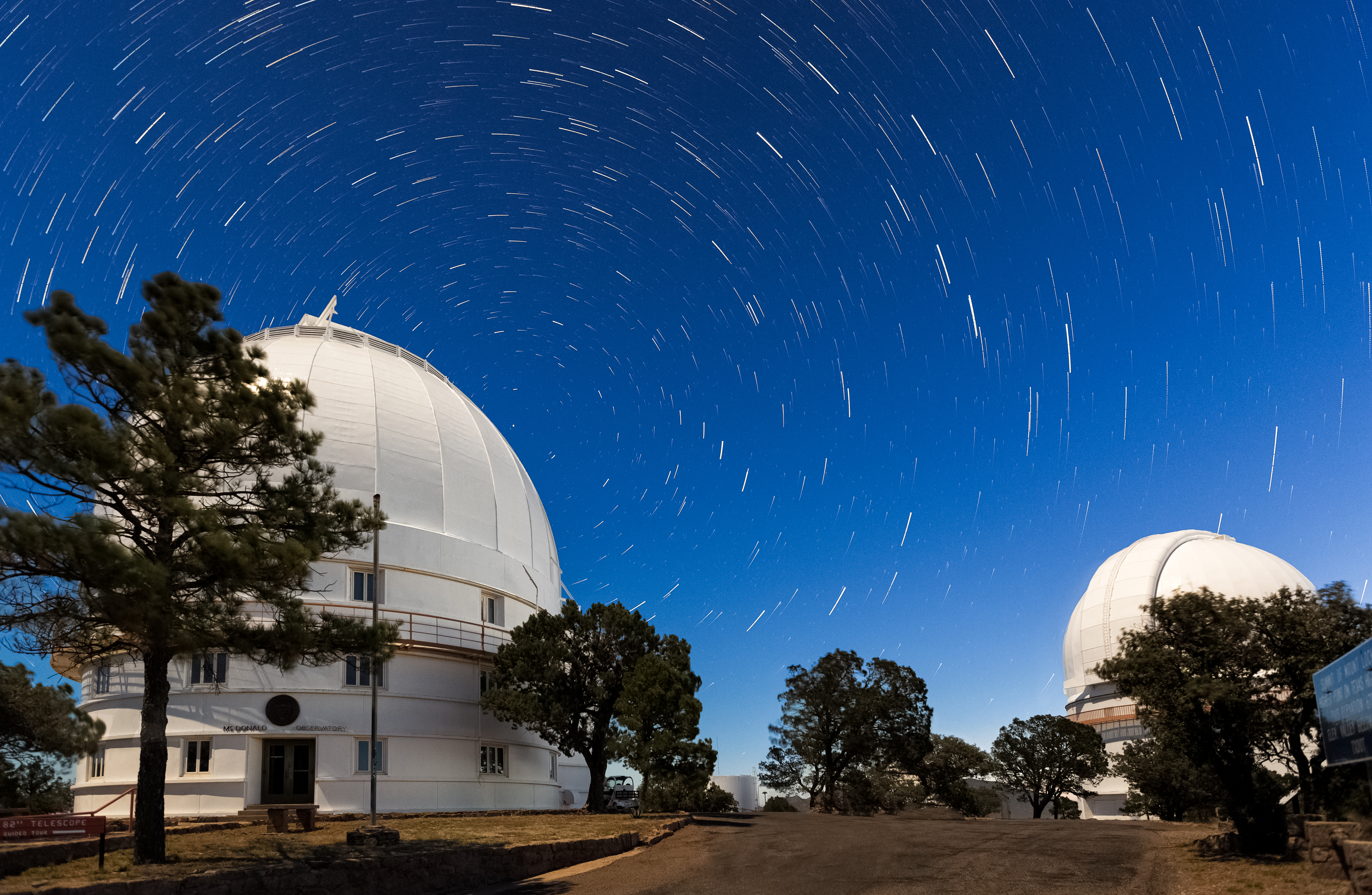
domes with star trails

From the Annals of the Skywatchers – In 1939, the Otto Struve telescope at the  McDonald Observatory was dedicated.  The Struve Telescope was the first major telescope to be built at McDonald Observatory. Its 2.1-meter (82-inch) mirror was the second largest in the world at the time. The telescope is still in use today. The popular observatory is located on Mount Locke  and Mount Fowlkes in the Davis Mountains and is a unit of The University of Texas at Austin featuring astronomical research, teaching, and public education and outreach.   The Davis Mountains offer some of the darkest night skies in the continental United States.

Today in Texas History – May 3

From the Annals of the Surgeons –  In 1968, surgeon Dr. Denton Cooley and associates at performed the first heart transplant in the United States.  Dr. Christian Barnard had conducted the first heart transplant six months earlier in Cape Town, South Africa.  The first American surgery was conducted at St. Luke’s Hospital.  Everett Thomas received a heart donated from a 15 year old girl and lived for 204 days after the surgery.   The landmark surgery was the first of many contributions that Texas physicians and scientists have made to the field of human heart transplantation.   Dr. Cooley and another Houston heart surgeon Dr. Michael E. DeBakey were the leaders in the field of heart surgery and heart transplantation.  Their work was the subject of “Hearts” – a book by journalist Tommy Thompson which chronicled their rivalry at the beginning of the heart-transplant era.