Tag Archives: Lyndon B. Johnson

Today in Texas History – June 1

From the Annals of the State Parks –  in 1969, the Lyndon B. Johnson State Historical Park opened to the public.  The state park is directly across the Pedernales River from the LBJ National Historical Park which encompasses much of the LBJ Ranch.  The two parks operate largely in tandem and feature numerous sites including the family cemetery where LBJ and Lady Bird are laid to rest.

Today in Texas History – February 9

From the Annals of LBJ –  In 1965, President Lyndon B. Johnson deployed a Marine Corps Hawk air defense missile battalion to Da Nang.  LBJ sent the troops to provide protection for a U.S. airbase.  This was the first commitment of American combat troops in South Vietnam and there was considerable reaction around the world to the new stage of U.S. involvement in the war.  Red China and the Soviet Union threatened to intervene if the U.S. became further involved in propping up the South Vietnamese regime. In Moscow, some 2,000 demonstrators, led by Vietnamese and Chinese students, attacked the U.S. Embassy. Britain and Australia supported the U.S. action, but France called for negotiations.

Today in Texas History – January 22

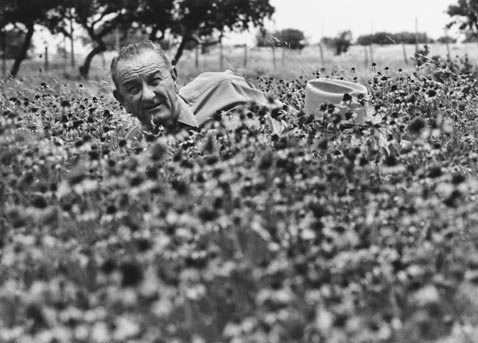
From the Annals of the Presidency –  In 1973, former President Lyndon Baines Johnson passed away in Johnson City at the age of 64.  After deciding to not stand for re-election, LBJ went back his ranch in Central Texas.  According to many, LBJ worked as hard at ranching as he had as a politician.  The presidential biographer, Doris Kearns, observed Johnson working on the ranch with the same level of intensity he had tackled work in the Oval Office. Each morning, Johnson would instruct his ranch hands to make a “solemn pledge that you will not go to bed tonight until you are sure that every steer has everything he needs. We’ve got a chance of producing some of the finest beef in this country if we work at it.  And if we treat those hens with loving care we should be able to produce the finest eggs in the country.” He ordered daily reports on the production of eggs. To Kearns, Johnson’s frustration with his hens’ egg production echoed the frustration he experienced in failing to conclude an un-winnable war in Vietnam.

The ranch work could not conceal the fact that LBJ was, in his own words, miserable.  His legacy of accomplishment as the creator of a “Great Society” and in passing the landmark Civil Rights Act of 1964 was being overshadowed by the floundering war in Vietnam and the anti-war movement.

On the day of Richard M. Nixon’s inauguration, Johnson watched sullenly as Nixon announced the dismantling of many of Johnson’s Great Society social programs.  The next day, Nixon announced that he had achieved the ceasefire in Vietnam that had eluded Johnson. Johnson had reportedly predicted that he would die if his vision of the Great Society died. The following day, while Lady Bird and their daughters were in Austin, Johnson suffered a fatal heart attack.  He is buried in a family cemetery at the ranch.  One can only imagine what he would think about the likes of Trump and Cruz.

Photo from the LBJ Library

Today In Texas History – November 10

From the Annals of LBJ –  In 1967, the President’s Ranch Trail was dedicated in Wimberley. The 90  mile route includes places in Hays, Blanco and Gillespie counties that were important in the life of Pres.  Lyndon B. Johnson.  It extends from the LBJ Ranch, located on Ranch Road 1 near Stonewall, to San Marcos. From the ranch two approaches are possible to Blanco, from which the main route extends to San Marcos: one, referred to as the north branch, proceeds from Ranch Road 1 via U.S. Highway 290 through Hye to Johnson City, then to Blanco via U.S. Highway 281; the other approach, referred to as the south branch, leads from the ranch to Stonewall and reaches Blanco by means of Albert on Ranch Road 1623. The route from Blanco to San Marcos leads via Ranch roads 165 and 2325 through Wimberley, where Ranch Road 12 leads to San Marcos.

Photo of the Western White Houston from the National Park Service.

Today in Texas History – September 9

From the Annals of Big Government –  In1966, President Lyndon B, Johnson signed the National Traffic and Motor Vehicle Safety Act and the Highway Safety Act. The two bills made the federal government responsible for setting and enforcing safety standards for cars and roads. “In this century,” Johnson said before he signed the bills, “more than 1,500,000 of our fellow citizens have died on our streets and highways; nearly three times as many Americans as we have lost in all our wars.”  Detroit’s refusal to make safer cars was notorious and consumers had little choice at the time as foreign cars were almost non-existent on US roads.   “Safety is no luxury item,” the President declared, “no optional extra; it must be a normal cost of doing business.”

Detroit managed to eliminate some of the safety standards in the original bill.  Older readers will recall the decades long fight car makers put up against installing air bags.   However, the impact of the NTMVSA was noticeable.  All cars now had seat belts for every passenger, impact-absorbing steering wheels, rupture-resistant fuel tanks, door latches that stayed latched in crashes, side-view mirrors, shatter-resistant windshields,  windshield defrosters, lights on the sides of cars and other protections.   It is almost impossible to estimate the number of lives that was saved by these acts.

The Acts passed without a single negative vote in Congress – something that is unimaginable in today’s world.

Today in Texas History – August 27

From the Annals of Texas Presidents –  In 1908, Lyndon Baines Johnson (LBJ) was born at his family’s home near Stonewall.   He was the first truly Texas son to become President.  Dwight Eisenhower was born in Denison but otherwise had little connection to the state.  LBJ rose to power representing Texas in the House of Representative and Senate.  But, he probably never would have become President but for the assassination of John F. Kennedy in Dallas in 1963.  LBJ’s legacy of tremendous accomplishment in civil rights and attempts to eliminate poverty were overwhelmed by the Vietnam War.

Today in Texas History – August 4

From the Annals of the Governor’s Office – In 1941 Lt. Gov. Coke Stevenson became Governor when W. Lee “Pappy” O’Daniel was installed as U.S. Senator following a special election.  Known as “Mr. Texas”, Stevenson was a no-nonsense conservative whose remarkable life story appealed to most Texans.  He had basically educated himself rising from mule team freight hauler, to bank custodian, to bank cashier, to lawyer.  Stevenson’s political career began with election as county attorney of Kimble County.  He later served as County Judge. Before being elected as Lt. Gov. he served several terms in the House and was selected as Speaker of the House.  Stevenson’s approach was so low-key that his critics accused him of doing nothing. He served two more full terms as governor stepping down in 1947 at which time he was the longest serving governor in Texas history.  Unfortunately, Stevenson is perhaps best known for his loss in the 1948 Senate race to Lyndon B. Johnson.  Stevenson is portrayed heroically in Robert Caro’s Means of Ascent.  Critics have complained that Caro’s portrait of Stevenson was influenced by his growing disgust with LBJ as his research progressed.  Nonetheless, Stevenson’s rise from poor country boy to Governor is a remarkable story in itself.

Photo from http://www.texashistory.unt.edu