Tag Archives: Mexico

Today in Texas History – October 16

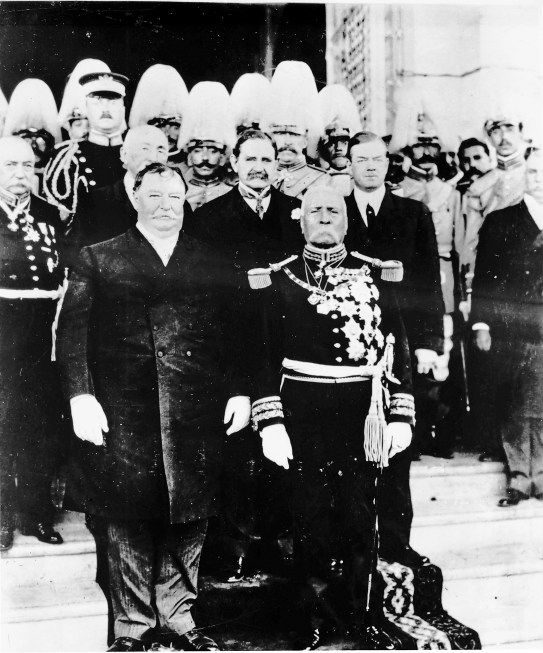
From the Annals of the Fat Presidents –  In 1909, Pres. William Howard Taft met with Mexican Pres. Porfirio Diazo.  This first ever meeting between U.S. and Mexican presidents was part of a planned summit that took place in  both El Paso and Ciudad Juarez.  The initial meeting was at the Chamber of Commerce building in El Paso, but continued later at the Custom House in Juarez. When Taft crossed the Rio Grande, it was the first time an American president entered Mexico, and only the second international trip by a sitting president.  Diaz requested the meeting as a build up to his eighth campaign for president, and Taft agreed to support Diaz to protect American business interests that had invested heavily in Mexico.  The meeting has been described as a “veritable pageant of military splendor, social brilliance, courtly formality, official protocol, and patriotic fervor.”

Today in Texas History – August 24

From the Annals of Independence –  In 1821, the long Mexican fight for independence from Spain came to an end with the signing of the Treaty of Cordoba.   The treaty was signed by Juan O’Donoju, Captain General of New Spain and  met Agustín de Iturbide, General of the Mexican Army of the Three Guarantees.  The war had begun on September 16, 1810 when Father Miguel Hidalgo y Costilla issued the famous “El Grito” from the steps of his parish church in Dolores, a small town east of Guanajuato.  Spain’s attempt to control Mexico was doomed after former royalist Iturbide came to terms with independence leader Vicente Guerrero in 1820.   After 10 years of turmoil and incredible bloodshed from mostly local revolts and guerrilla actions, the unification of the factions effectively ended Spanish control.  At the time of the treaty, Spain only controlled Mexico City and Veracruz and the end of colonial rule was inevitable.

Today in Texas History – July 28

From the Annals of the Toreros – In 1908, James Harper Gillett made his first appearance as a novillero  at Plaza de Toros in  Guadalajara. Gillett was born in Ysleta in 1884. His parents divorced in 1889, after which he had no contact with his father for twenty-four years.  His mother married Guadalajara resident Samuel M. Lee in 1895. The family lived in Guadalajara and Gillett began calling himself Harper Baylor Lee.  Lee learned the art from his friend Francisco Gómez, El Chiclanero, a retired matador from Spain.  Lee determined to see if he could make it as a as a professional torero. In 1910 he became the first American to attain the rank of matador de toros.  He appeared in fifty-two corridas and killed 100 bulls. His career was cut short by the chaos of the Mexican Revolution. After reconciling with his father in 1914, he changed his name to Harper Baylor Gillett.

Today in Texas History – July 7

From the Annals of Short-Lived Promises –  In 1835, the town of Gonzales passed resolutions of loyalty to Mexico.  The resolutions were passed based in part on the influence of the mysterious Edward Gritten. Gritten was reputed to be an Englishman and a long-time resident of Mexico.  He came to Texas in 1834 as secretary to Juan N. Almonte.  He was reported to have worked in the summer of 1835 to repair the fraying connections between the Texas colonists and the Mexican government. He urged the Mexican government to adopt conciliatory measures, assuring them that most Texans were law-abiding Mexican citizens. He was engaged to plead with Martín Perfecto de Cos to avoid any further confrontations and demonstrate that the Texian colonists were peaceful and did not want war or revolution.  However, on the way to Matamoros, Gritten encountered a courier who had orders from Domingo Urgatechea to arrest William B. Travis and others. Gritten returned to San Antonio in a failed attempt to persuade Ugartechea to revoke the orders. Gritten continued his attempts to mediate the disputes between Ugartechea and the colonists. His only official post never came to fruition.  Although, Gritten was elected as collector of the port of Copano, Governor Henry Smith refused to sign the commission because he considered Gritten a spy.  Gritten disappeared from history.  The last information found concerning Gritten is a receipt for money paid him by the government in October 1836 for his services as a translator.

Image of Domingo Urgatechea

Today in Texas History – May 14

From the Annals of the Revolution – In 1836, Mexican General Antonio López de Santa Anna and Republic of Texas provisional president David Burnett signed two Treaties of Velasco ending the Texas Revolution.  The public treaty, signed not surprisingly at Velasco (now Surfside Beach), ceased the fighting, called for withdrawal of Mexican troops and exchanges of prisoners, but Mexico did not formally recognize Texas’ independence.  The self-styled “secret treaty” had provisions for normalization of relations after the terms of the public treaty had been met.  The still vastly superior Mexican forces in the field honored the treaty and withdrew to Mexico.  In effect, the treaty was a venal effort by Santa Anna to save his own skin as it provided for his immediate transport to Veracruz. The story of Texas might have been vastly different if Gens. Urea and Filasola had decided to ignore Santa Anna’s command to stand down.

Despite the treaties, disputes over whether the Texas/Mexico boundary was on the Rio Grande or the Nueces continued and ultimately was the provocation that started the Mexican-American War that John Polk desperately wanted.  As a result, Texas’ boundary was never finally resolved during the days of the Republic.  It was not determined until the Treaty of Guadalupe Hidalgo was signed in 1848 at the end of the Mexican-American War.

Today in Texas History – May 7

From the Annals of Old Mexico –   In 1824, Mexico adopted a new constitution which created the new state of Coahuila y Tejas.  The two provinces were combined into one state – an act which foretold many of the problems which would ultimately result in the Texas revolution.  The newly created state was plagued with political turmoil as factions battled over even the location of the state capital.  The original capital was Saltillo but the government soon moved to Monclova.  At one point competing state legislatures were operating in both Saltillo and Monclova.  There was even a rump movement to relocate the capital to Bexar (San Antonio). The dictatorship of Santa Anna and the deteriorating situation of the state government led to the so-called Consultation declaring Texas a separate state in 1835 complete with the formation of a provisional government – an act which presaged the ultimate independence of Texas.