Tag Archives: Texas History

Today in Texas History – February 17

From the Annals of Art – In 1930, the El Paso Museum of Art was chartered under its original name, El Paso International Museum.  The EPMA is now operated by the City of El Paso.  The  museum features the Kress collection of Italian Renaissance and Spanish Baroque works, and a collection of Pre-Columbian and modern Mexican art. In addition, the collection includes works by recognized early Texas artists such as Jerry Bywaters, Otis Dozier, Merrit Mauzey, Julian Onderdonk, Everett Spruce and Frank Reaugh, and early El Paso artists such as Manuel Acosta, José Cisneros, Berla Emeree, Tom Lea, Audley Dean Nicols, Urbici Soler and Eugene Thurston. The Museum’s Tom Lea collection includes significant examples from every decade, genre and media of the artist’s working life, which are rotated in the Tom Lea Gallery.

Today in Texas History – February 16

From the Annals of Rome -In 1927, Arthur Jerome Drossaerts was consecrated as the first archbishop of the Catholic Archdiocese of San Antonio in San Fernando de Béxar Cathedral. Drossaerts, a native of Holland, was ordained in 1889 and posted to Louisiana.  He served as a pastor in New Orleans, Broussard, and Baton Rouge. In 1918, Drossaerts was consecrated bishop of San Antonio. Drossaerts built more than sixty churches and fifty schools, the most significant of which was St. John’s Seminary. When the Diocese of San Antonio was made an archdiocese, Drossaerts became its first archbishop.   One of his significant contributions to Texas History was his work to keep the old San Antonio missions alive.

Today in Texas History – February 12

From the Annals of Incompetence – In 1869, sixty-one men, women, and children died when the sidewheel steamboat Mittie Stephens caught fire on Caddo Lake.  The MS had been running the New Orleans-Red River route since 1866. At that time Jefferson was the head of navigation via Caddo Lake due to the great log raft that obstructed traffic on the Red River. The MS left New Orleans on February 5 with 107 passengers and crew and a cargo that included 274 bales of hay.  The boat caught fire when a breeze blew a spark to the hay stacks from torch baskets that lighted the bows of the boat.  The blaze quickly spread and the boat headed for the shore only 300 yards away.  The boat grounded in three feet of water near Swanson’s Landing. Most of the passengers were killed by the incompetence of the pilot.  He kept the paddlewheels turning in an attempt to make the shore but ended up killing most of those lost when they were struck by the wheels while in the water.

Today in Texas History – February 9

From the Annals of LBJ –  In 1965, President Lyndon B. Johnson deployed a Marine Corps Hawk air defense missile battalion to Da Nang.  LBJ sent the troops to provide protection for a U.S. airbase.  This was the first commitment of American combat troops in South Vietnam and there was considerable reaction around the world to the new stage of U.S. involvement in the war.  Red China and the Soviet Union threatened to intervene if the U.S. became further involved in propping up the South Vietnamese regime. In Moscow, some 2,000 demonstrators, led by Vietnamese and Chinese students, attacked the U.S. Embassy. Britain and Australia supported the U.S. action, but France called for negotiations.

Today in Texas History – February 8

From the Annals of the Old West –  In 1887, “Longhair Jim” Courtright was killed in a gunfight with Luke Short.  This particular violent episode actually matched the largely inaccurate movie legends which typically involve a face-to-face showdown at high noon in the middle of the street.  Most such shootouts were more of the ambush or hide behind the water trough while taking potshots variety.  However, this famous gunfight lived up to the classic Hollywood image.

Courtright had been at various times a jailer, Fort Worth City Marshal, deputy sheriff, deputy U.S. Marshal, hired killer, private detective and racketeer.  What was not disputed was Courtright’s ability with a gun and willingness to use it with deadly results.  After losing a race for another term as City Marshal he decamped to New Mexico where he participated in the killing of two men in a range war.  He escaped back to Texas where he had friends and resisted extradition ending up back in Fort Worth.

Luke Short was a gunfighter, gambler and bar owner who came to Fort Worth from Dodge City where he had dabbled in gambling, and befriended such legends as Bat Masterson and Wyatt Earp who were also friends of Courtright. In Fort Worth, he managed the White Elephant, a saloon and gambling house in the area around the Fort Worth Stockyards known as Hell’s Half Acre.  HHA contained numerous bars and whorehouses and was largely left alone by law enforcement.

Most historians believe the gunfight arose from Courtright’s protection racket.  When Short refused to pay for protection for his saloon, Courtright apparently felt the need to make him an example.  Short also had a reputation as a gunfighter mostly due to an 1881 gunfight with gunslinger Charlie Storms at the Oriental Saloon in Tombstone.  At 8:00 in the evening, Courtright called Short out of the White Elephant.   Short came out and confronted Courtright in front of a bar and brothel appropriately called the Shooting Gallery.   Few words were exchanged until the men faced off.  Courtright, who was probably drunk, said something about Short having a gun. Short claimed he was unarmed – a flat lie.  Probably for the benefit of future witnesses,  Courtright loudly exclaimed, “Don’t you pull a gun on me,” while drawing his own pistol.   Courtright’s gun hung for a second on his watch chain allowing Short to draw.  Short’s first shot blew off the thumb on Courtright’s shooting hand. As he attempted to shift the pistol to his other hand, Short fired four more shots in quick succession killing the notorious Courtright.

Two weeks later a prostitute named Sally was murdered and combined with the earlier gunfight, efforts to clean up the area gained irresistible momentum.  HHA would remain a rather wild spot for many more years but its days of abject lawlessness were coming to an end.

Today in Texas History – February 2

From the Annals of the Mystics –  In 1620, María Coronel took her religious vows to join an order in Spain known as the Blue Nuns.  The Blue Nuns wore an outer cloak of coarse blue cloth over the traditional brown habit.   Taking the name Sister María de Jesús de Agreda, she had more than 500 mystic experiences in which she envisioned visiting an unknown land. Franciscan authorities somehow decided that the mysterious land was in New Mexico and West Tejas.  In her visitations, Sister María contacted several Indian cultures, including the Jumanos, and instructed them to seek out the isolated Spanish missions.  In July 1629, fifty Jumano Indians appeared at the Franciscan convent of old Isleta near Albuquerque.   The Jumanos claimed they had been sent to find religious teachers. They apparently had some basic knowledge of the Christian tenants that they had learned from the “Woman in Blue.”  Fray Juan de Salas led a mission to find more Jumanos and encountered a large group of Indians in Texas who also claimed to have been visited by the Woman in Blue who told them they would be met by Christian missionaries.  When interviewed by church authorities, Sister Maria acknowledged that she was the Woman in Blue.

Today in Texas History – February 1

From the Annals of Granite – In 1882, building commissioners Nimrod Norton and Joseph Lee dug the ceremonial first hole for the Texas Capitol.  The cost of construction was financed by the sale of three million acres of public land in the Panhandle – which became the famed XIT Ranch. The Capitol was built from red granite from Marble Mountain near Marble Falls.   The Nations Capitol was the model for the Renaissance Revival structure.  Construction took over six years and cost approximately $3.75 million.  The Capitol was the tallest building in Texas until the building of the San Jacinto Monument.

Today in Texas History – January 29

From the Annals of Stupidity – In 1861, the Secession Convention of the state of Texas voted overwhelmingly to secede from the United States.  Support for a convention to consider the issue began to swell in October 1860, when it became apparent that Abraham Lincoln would be elected to the presidency. Only the governor could call the legislature into special session and only the legislature could call a convention. Sam Houston who was strongly opposed to secession refused to act hoping that the secessionist furor would die down.  In a blatantly illegal and unconstitutional act, Oran M. Roberts, chief justice of the Texas Supreme Court and several other prominent Texans took the law into their own hands and called a convention.

Once it was clear that some sort of secession convention would meet, Houston called the legislature into session hoping that it would declare the convention illegal.  Houston was rebuffed and the legislature validated the calling of a convention, turned over the House chambers to the convention, and adjourned.

The result was almost a foregone conclusion because of the election process for the delegates.  Delegates were often elected by voice votes at public meetings at which Unionists were not welcomed.  Other Unionists ignored what they viewed to be as an illegal process.  As a result the delegates disproportionally favored secession and the vote of 166 to 8 clearly did not represent the substantial opposition to secession.

The Texas Ordinance of Secession passed by the Convention is certainly one of the most vile racist screeds ever enacted by a representative body in the history of the United States.  It is a direct rebuff to revisionists who claim that the Civil War was not about slavery.

In all the non-slave-holding States, in violation of that good faith and comity which should exist between entirely distinct nations, the people have formed themselves into a great sectional party, now strong enough in numbers to control the affairs of each of those States, based upon the unnatural feeling of hostility to these Southern States and their beneficent and patriarchal system of African slavery, proclaiming the debasing doctrine of the equality of all men, irrespective of race or color–a doctrine at war with nature, in opposition to the experience of mankind, and in violation of the plainest revelations of the Divine Law. They demand the abolition of negro slavery throughout the confederacy, the recognition of political equality between the white and the negro races, and avow their determination to press on their crusade against us, so long as a negro slave remains in these States.

We hold as undeniable truths that the governments of the various States, and of the confederacy itself, were established exclusively by the white race, for themselves and their posterity; that the African race had no agency in their establishment; that they were rightfully held and regarded as an inferior and dependent race, and in that condition only could their existence in this country be rendered beneficial or tolerable.

That in this free government all white men are and of right ought to be entitled to equal civil and political rights; that the servitude of the African race, as existing in these States, is mutually beneficial to both bond and free, and is abundantly authorized and justified by the experience of mankind, and the revealed will of the Almighty Creator, as recognized by all Christian nations; while the destruction of the existing relations between the two races, as advocated by our sectional enemies, would bring inevitable calamities upon both and desolation upon the fifteen slave-holding States. By the secession of six of the slave-holding States, and the certainty that others will speedily do likewise, Texas has no alternative but to remain in an isolated connection with the North, or unite her destinies with the South.

While Texas was largely spared the ravages of the Civil War by virtue of geography, the defense of slavery cost the lives of thousands of Texans in a cause doomed to failure.

Today in Texas History – January 28

From the Annals of Cool Comfort – In 1912, philanthropist Frances Lutcher dedicated the First Presbyterian Church in Orange in honor of the family of her husband, lumberman Henry J. Lutcher.  The imposing marble building is reputed to be the first structure west of the Mississippi River to have air conditioning.

Today in Texas History – January 27

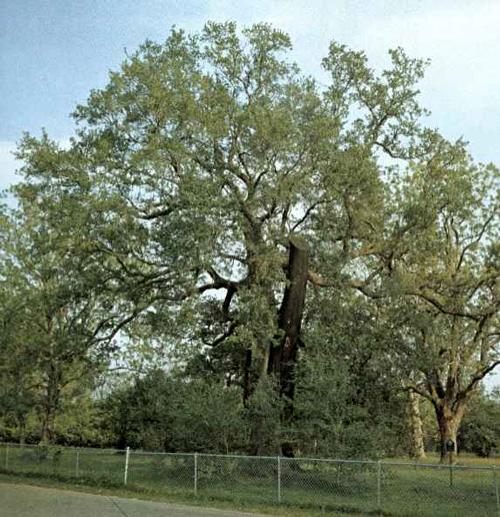
From the Annals of Fraternal Orders –   The first Masonic lodge in Texas was chartered.  The Masonic movement in Texas when six Masons met under an oak tree near the town of Brazoria.   They applied to the Grand Lodge of Louisiana for a dispensation to form and open a Lodge.   A dispensation was issued and later a charter.   This first Texas lodge was called Holland Lodge No. 36.   It was named after the Louisiana Grand Master of Masons John Henry Holland.   Anson Jones was the first Worshipful Master of Holland Lodge No. 36, which is now Holland Lodge No. 1.   The charter was brought by John M. Allen and given to Anson Jones just prior to the battle of San Jacinto.

Photo of the Masonic Oak from Texas Forest Service.