Tag Archives: Texas History

Today in Texas History – December 4

From the Annals of the Ships of the Line –  In 2010, the USS Fort Worth was launched.  The FW is a Freedom-class littoral combat ship.  She is the first ship to be named after Fort Worth, the 16th-largest city in the United States.   The FW is currently on a 16-month rotational deployment to Singapore in support of the U.S. Navy’s “strategic rebalance” to the Pacific. She is first LCS to use the “3-2-1” manning concept, swapping fully trained crews roughly every four months.  FW also deploys with an aviation detachment from Helicopter Maritime Strike Squadron 35 (HSM-35) “Magicians”, the U.S. Navy’s first composite expeditionary helicopter squadron.

Photo from en.Wikipedia.org

Today in Texas History – December 3

From the Annals of the Cold War – In 1989, Presidents George Bush and Mikhail Gorbachev indicated that the Cold War era was closing at a meeting in Malta.  The Malta meeting was the first-ever summit held between the two leaders.  Bush was optimistic about the summit and expressed his desire to continue arms control negotiations begun by the preceding Reagan administration. Gorbachev was more effusive about his desire for better relations with the United States and clearly indicated that the talks marked an important first step toward ending the Cold War.  “The characteristics of the Cold War should be abandoned,” he declared.  Gorbachev went on to suggest that, “The arms race, mistrust, psychological and ideological struggle, all those should be things of the past.” Bush’s statement was less direct. “With reform underway in the Soviet Union, we stand at the threshold of a brand-new era of U.S.-Soviet relations. It is within our grasp to contribute each in our own way to overcoming the division of Europe and ending the military confrontation there.”

Today in Texas History – December 2

From the Annals of the Boomtowns – In 1907, citizens of Peck renamed their community Tomball in honor of former U.S. Congressman Thomas Henry Ball. Ball was strong supporter of the development of the Houston Ship Channel and a renown prohibition advocate. Tomball later rose to prominence in 1933 when drillers struck oil. The population of Tomball tripled as numerous oil and gas operators moved in and set up worker camps, and built new housing and recreation facilities.   In 1935, Humble Oil and Refining Company granted free water and natural gas to Tomball residents in exchange for drilling rights within the city limits.   Ball’s influence is still seen today as parts of the town remain dry.

Photo of Thomas Ball Statue from tripddvisor.co.uk.

Today in Texas History – December 1

From the Annals of Broadway – In 1913, Mary Martin, star of stage and screen,  was born in Weatherford, Texas.  Martin was encouraged to perform in local theater as a child and began voice lessons at age twelve. Her first success was on Broadway in Cole Porter’s Leave It To Me . Martin sang the show-stopper “My Heart Belongs to Daddy” and was an instant hit with Broadway audiences. Although she appeared in at least 10 films, Martin’s greatest success came in musical theatre – starring in productions of South Pacific , Peter Pan , The Sound of Music, and I Do, I Do among many others.

Today in Texas History – November 30

From the Annals of Lawlessness –  In 1890, Texas pioneer and author John H. Jenkins was killed in a gunfight in Bastrop.  Jenkins was attempting to save his son, the County Sheriff, from an ambush when he was shot down.  Jenkins had moved to Texas as a young boy with his family eventually settling on the banks of the Colorado near present-day Bastrop.  After his father was mysteriously killed while working his fields, Jenkins became the ward of Edward Burleson.  Jenkins joined the Texas revolution at age 13 fighting in Burleson’s First Regiment of the Texas Volunteers.  He is reputed to have been the youngest Texian soldier in the San Jacinto campaign although he was not present at the battle having been dispatched to aid his mother and siblings escape from the advancing Mexican armies.  He later served in the Texas Rangers and with the Confederate Army in the Civil War.  Jenkins is best known for his well-written and colorful memoir – Recollections of Early Texas – published by the University of Texas Press in 1958.

Today in Texas History – November 24

From the Annals of Law Enforcement – In 1835, the Republic of Texas authorized a special law enforcement unit known as the Texas Rangers. Stephen F. Austin had hired ten experienced frontiersmen as “rangers” as early as 1823, but the 1835 legislation formalized the organization.  The Rangers have a mixed history at best.  They were instrumental in securing the early Republic, but at the expense of various Indian tribes who had claims to the land and not all of whom were aggressive warriors like the Comanche and Kiowa.   The Rangers  were also employed to restore order during various blood feuds, border disturbances, and civic upheavals. In the early twentieth century, however, certain renegade Rangers abused their positions of authority predated on Hispanics, African-Americans and other powerless groups.  The force was decimated in 1933 when Gov. Ma Ferguson dismissed the entire squad in an overt act of political retaliation for the Rangers open support of her opponent Ross Sterling.  When the Department of Public Safety was created in 1935, the Rangers took on a new role.  Today they are recognized as an elite unit of 150 commissioned officers drawn from the ranks of DPS officers with at least 8 years of law enforcement experience.  Prospective Rangers undergo rigorous selection, testing and the position requires specialized training.  Their responsibilities include major incident crime investigations, unsolved crime/serial crime investigations, public corruption investigations, officer involved shooting investigations, and border security operations.


Today in Texas History – November 20

From the Annals of Journalism – In 1941, writer Hubert Renfro Knickerbocker gave a speech at Southern Methodist University in which he advocated for United States entry into World War II.  After his address, HRK engaged in a heated debate with students who opposed his views.  Knickerbocker was born in Yoakum, Texas and graduated from Southwestern University in Georgetown.  He moved to New York and began a distinguished career in journalism. HRK later relocated to Munich, Germany, with the intention of studying psychiatry, but witnessed Adolf Hitler’s Beer Hall Putsch in November 1923.  He resumed his journalism career becoming chief Berlin correspondent for the New York Evening Post and the Philadelphia Public Ledger. In 1931 Knickerbocker won the Pulitzer Prize for his articles describing and analyzing the Soviet Five-Year Plan. With the Nazi takeover in 1933, however, due to his strong opposition to Hitler, he was expelled from Germany.  He forecast the coming conflagration in his book Will War Come to Europe and after the outbreak spent much of his energy attempting to convince Americans that the U.S. should join in the fight against Nazism.

Today in Texas History – November 18

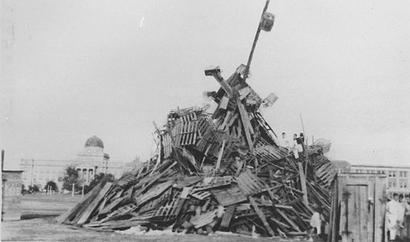
From the Annals of Texas A&M –  In 1999, 11 Texas A&M students were killed, one former student was killed and another 28 injured during construction of the annual bonfire for the UT (or TU as the Aggies would have it) game.  The bonfire had been a tradition at A&M for almost 90 years.  Early Bonfires were just that – piles of trash. But over the years, the Bonfire grew exponentially, setting the world record in 1969.  By the time of the 1999 Bonfire collapse, the Bonfire ritual had become a months long endeavor producing what ultimately proved to be a precarious 90 foot tall six tiered structure centered around two telephone poles affixed end to end.   The ensuing investigation revealed that there were no exact plans for the Bonfire, the structure had never been approved by an engineer, and that drinking and hazing were prevalent.  None of that took away from the tragedy of the event and the dedication of those who died in the construction accident.   The tragedy led A&M to declare a hiatus on an official Bonfire. However, since 2002, a student-sponsored coalition has constructed an annual unsanctioned, off-campus “Student Bonfire” in the spirit of its predecessor.

Photo of the 1928 Bonfire.

Today in Texas History – November 17

From the Annals of Houston –  In 1981, Kathryn Whitmire was elected as the first female mayor of Houston.  Whitmire was first elected as City Controller for two terms and then to five consecutive terms as mayor. She also served as the president of the U.S. Conference of Mayors and Texas Municipal League. As mayor she appointed Lee P. Brown as the first African American to serve as police chief. Brown later would become mayor.  Whitmire was defeated in 1991 by political power-broker Bob Lanier in an election that turned largely on Lanier’s opposition to Whitmire’s plan to bring mono-rail to Houston.  Whitmire moved to Hawaii in 2001.

Today in Texas History – November 16

From the Annals of the Republic –  In 1845, the Republic of Texas concluded its last Indian treaty.  The agreement was the culmination of the Tehuacana Creek Councils, which began in the spring of 1843.  Jesse Chisholm has worked to convince a number of Indian groups, including the Caddos, Tawakonis, Delawares, Lipan Apaches, and Tonkawas, to meet on Tehuacana Creek near the Torrey Brothers trading post south of present Waco. A second council met at Fort Bird on the Trinity River in the fall of 1843.  These councils resulted in a peace treaty between the Republic and the Wacos, Caddos, and others.  However, the Comanches were not represented.  President Sam Houston called another council meeting at Tehuacana in April 1844. The Comanches were yet again absent, but by October 9, 1844, Houston had negotiated a treaty with a part of the southern Comanches, Kichais, Wacos, Caddos, Anadarkos, Hainais, Delawares, Shawnees, Cherokees, Lipan Apaches, and Tawakonis. At the November 1845 council the Wacos, Tawakonis, Kichais, and Wichitas agreed to the treaty of October 9, 1844.