Tag Archives: Texas Revolution

Today in Texas History – November 4

From the Annals of the Little Known Battles – In 1835,  one of the smaller engagements of the Texas Revolution occurred. The battle of Lipantitlán was fought on the east bank of the Nueces River in San Patricio County, directly across from Fort Lipantitlán.   The Fort was one of the last two garrisons of Mexican troops remaining after the initial engagements of the revolution.  Most of the Mexican forces had left the fort for operations in the field.  While they were engaged elsewhere a Texian force of around seventy men from Goliad under the command of Capt.Ira J. Westover seized and dismantled the fort.  The  Mexican force of about ninety men under the command of Capt. Nicolás Rodríguez encountered the Texians as they were attempting to cross the rain-swollen Nueces River on their return to Goliad.  The short battle lasted only about 30 minutes, but the Texian long rifles proved decisive in a longer distance fight against Mexican troops armed with close range muskets.  The Mexican troops were forced to retreat with between 3 and 5 soldiers reportedly killed in action.  The Texans reported only one relatively minor casualty.

Today in Texas History – October 2

From the Annals of the Revolution – In 1835, fighting broke out at Gonzales between Mexican soldiers and Texian militiamen.  Gen. Domingo de Ugartechea learned that the colonists of Gonzales refused to surrender a small cannon that had been given that settlement in 1831 as a defense against the Indians, he dispatched Francisco de Castañeda and 100 dragoons to retrieve it on September 27. Though Castañeda attempted to avoid conflict, on the morning of October 2 his force clashed with local Texan militia led by John Henry Moore in the first battle of the Texas Revolution. The colonists motto of “Come and Take It” became a rallying cry.  The actual skirmish for the cannon was brief  and ended with the retreat of Castañeda and his force, but it also marked a clear break between the American colonists and the Mexican government.

From the Annals of the Republic –  In 1839, the last mention of the steamship Cayuga was recorded and the notable vessel passed from history.  The Cayuga, an eighty-eight-ton side-wheeler built in 1832, had been the first commercially successful steamboat in Texas and was critical to the Texian war effort during the Revolution.  She carried army supplies, messages, and transported government officials and refugees. Most curiously, she was the floating capitol of Texas.  Pres. David G. Burnett impressed her for public service.  When the government was forced to evacuate Harrisburg ahead of Santa Anna’s army, Burnet and his cabinet used the steamer as their temporary capitol for about a week.

After the revolution ended, the vessel was sold at auction on December 15, 1836 at Lynch’s Ferry. The new owners refitted the vessel and renamed her the Branch T. Archer. The last mention of the  former Cayuga was a Liberty County sheriff’s sale on this date in 1839, advertising the sale of the historic vessel.

Today in Texas History – August 17

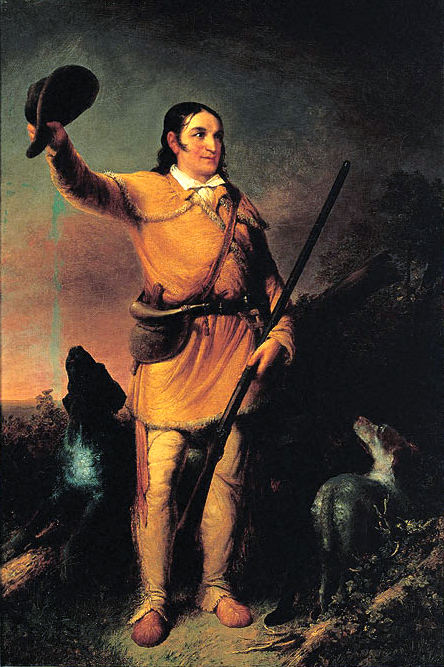
From the Annals of Bad Luck –   David Crockett was born in what is now Greene County, Tennessee (technically a part of N. Carolina at the time of his birth).  Crockett’s family traversed Tennessee in a series of failed attempts to establish businesses.  Crockett himself was first employed as a drover in a cattle drive from Tennessee to Virginia and was also indentured at various times to pay off his father’s debts.  Crockett’s political career began with his appointment as a justice of the peace in 1817.  From there he sought and won office to the Tennessee state assembly in 1821 and served several terms representing different districts.  He lost in his first run for Congress in 1825, but after being encouraged to try again, he won election in 1827.  Crockett was a consistent champion for the rights of poor settlers whose property rights were endangered by a complicated system of land grants. He introduced a bill to abolish West Point which he viewed as providing free education for sons of the wealthy.   He served two terms before being voted out for his opposition to the Indian Removal Act.  He was returned to Congress 2 years later and served 2 more terms before being defeated in 1835.  Crockett arguably was the best known American of his day – especially after publishing his autobiography.

His decision to go to Texas was likely motivated by a desire to continue his political career.  Crockett was 49 and his military service had been largely limited to work as a scout and hunter finding food for the troops.  Some have speculated that he believed his fame would translate into the presidency of a newly formed Texas nation.   The details of his death at the Alamo have been hotly debated.  More on that on another Today in Texas History.

Today in Texas History – July 7

From the Annals of Short-Lived Promises –  In 1835, the town of Gonzales passed resolutions of loyalty to Mexico.  The resolutions were passed based in part on the influence of the mysterious Edward Gritten. Gritten was reputed to be an Englishman and a long-time resident of Mexico.  He came to Texas in 1834 as secretary to Juan N. Almonte.  He was reported to have worked in the summer of 1835 to repair the fraying connections between the Texas colonists and the Mexican government. He urged the Mexican government to adopt conciliatory measures, assuring them that most Texans were law-abiding Mexican citizens. He was engaged to plead with Martín Perfecto de Cos to avoid any further confrontations and demonstrate that the Texian colonists were peaceful and did not want war or revolution.  However, on the way to Matamoros, Gritten encountered a courier who had orders from Domingo Urgatechea to arrest William B. Travis and others. Gritten returned to San Antonio in a failed attempt to persuade Ugartechea to revoke the orders. Gritten continued his attempts to mediate the disputes between Ugartechea and the colonists. His only official post never came to fruition.  Although, Gritten was elected as collector of the port of Copano, Governor Henry Smith refused to sign the commission because he considered Gritten a spy.  Gritten disappeared from history.  The last information found concerning Gritten is a receipt for money paid him by the government in October 1836 for his services as a translator.

Image of Domingo Urgatechea

Today in Texas History – June 10

From the Annals of the Revolution –  In 1832,  a rebel force attacked Anahuac in the first armed clash between Anglo-Texians and Mexican troops. Juan Davis Bradburn, formerly an American citizen, was commander of the Mexican post at Anahuac on Galveston Bay.  He was an ardent opponent of slavery which was illegal under the Mexican Constitution of 1824.  Bradburn was unpopular with the Anglo-Texians in the area for his opposition to slavery and enforcement of Mexican law.   When he granted asylum to 3 escaped slaves from Louisiana, tensions began to heat up.  Attorney William B. Travis was hired by the slaves owner to attempt to regain control of the slaves.  Travis was probably involved in writing a letter to Bradburn claiming that 100 men were coming from Louisiana to reclaim the slaves.  When Bradburn realized it was a hoax, he arrested Travis.  Patrick Jack, a ringleader of the Texians opposed to Bradburn confronted Bradburn about Travis’ arrest and was himself arrested.  The arrests provoked Jack’s brother to bring a contingent of men from Brazoria and other towns to secure the release of the prisoners.  Bradburn agreed to exchange Travis and the other Anglos for nineteen cavalrymen held by the insurgents. The cavalrymen were released, but when Bradburn discovered that a number of rebels had remained in town overnight, he refused to free his prisoners and began firing on the town. The insurgents withdrew to Turtle Bayou, where they drew up a series of resolutions explaining their action. Bradburn appealed for help from other military commanders in Texas. Col. José de las Piedras marched from Nacogdoches, but met with Anglo insurgents near Liberty and agreed to remove Bradburn from command and free Travis and the others.

Today in Texas History – June 3

From the Annals of the Horse Marines – In 1836, a Texas mounted ranger company captured a Mexican ship.  Maj. Isaac Watts Burton’s unit was keeping watch over a stretch of the Gulf Coast south of San Antonio Bay. When they heard of a suspicious vessel in Copano Bay, the rangers hid on the shore and sent up distress signals. The ship responded first by hoisting American and Texan signals, which were ignored. Only when the ship raised Mexican signals did the rangers respond. Thus tricked into thinking the supposedly distressed soldiers were Mexican, the captain came ashore and was captured. With him as hostage, sixteen rangers rowed out, boarded the Watchman, and seized its cargo of provisions for the Mexican army.   The mounted rangers were dubbed “Horse Marines.”

Today in Texas History – May 26

From the Annals of Slavery –  In 1837, the executor of William Barret Travis’s estate placed a notice in the Telegraph and Texas Register for an escaped slave named Joe.  Joe had been one of the few survivors of the battle of the Alamo the year before. The notice ran for three months before it was discontinued.

During the final battle for the Alamo, Joe was armed and defended with others before retreating to an interior room.  After the battle, Joe answered the call of the Mexican troops for any slaves to reveal themselves. Joe came out was immediately shot and suffered a bayonet thrust. A Mexican captain prevented his death.  He was taken by the Mexican Army and later interrogated by Santa Anna regarding Texas and the Texas Army.  He was apparently released and on March 20, Joe was questioned by the Texas Cabinet at Groce’s Retreat about the siege and final battle at the Alamo. William F. Gray reported that Joe impressed those present with the modesty, candor, and clarity of his account. Joe was then returned to Travis’s property near Columbia.  On the first anniversary of the battle of San Jacinto, Joe escaped with two fully equipped horses while accompanied by an unidentified Mexican man.  Joe was never returned to slavery and was last reported in Austin in 1875.

Today in Texas History – May 14

From the Annals of the Revolution – In 1836, Mexican General Antonio López de Santa Anna and Republic of Texas provisional president David Burnett signed two Treaties of Velasco ending the Texas Revolution.  The public treaty, signed not surprisingly at Velasco (now Surfside Beach), ceased the fighting, called for withdrawal of Mexican troops and exchanges of prisoners, but Mexico did not formally recognize Texas’ independence.  The self-styled “secret treaty” had provisions for normalization of relations after the terms of the public treaty had been met.  The still vastly superior Mexican forces in the field honored the treaty and withdrew to Mexico.  In effect, the treaty was a venal effort by Santa Anna to save his own skin as it provided for his immediate transport to Veracruz. The story of Texas might have been vastly different if Gens. Urea and Filasola had decided to ignore Santa Anna’s command to stand down.

Despite the treaties, disputes over whether the Texas/Mexico boundary was on the Rio Grande or the Nueces continued and ultimately was the provocation that started the Mexican-American War that John Polk desperately wanted.  As a result, Texas’ boundary was never finally resolved during the days of the Republic.  It was not determined until the Treaty of Guadalupe Hidalgo was signed in 1848 at the end of the Mexican-American War.

Texas Rising to Premiere on Memorial Day

The History Channel will premier a new series Texas Rising over Memorial Day Weekend.  The initial episode will air on May 25 at 8:00 pm (CDT).  Texas Rising  will be 10-hour series based on the Texas Revolution and the rise of the Texas Rangers.

Texas Rising has a large cast with notable names such as Bill Paxton, Brendan Fraser, Ray Liotta, Jeffrey Dean Morgan, Olivier Martinez, Thomas Jane, Crispin Glover, Jeremy Davies, Christopher McDonald, Max Thieriot, Chad Michael Murray, Trevor Donovan, Robert Knepper, Jeff Fahey, Rob Morrow and Kris Kristofferson.  The series is directed by Roland Joffé.   It might be worth watching just to see how badly Kris Kristofferson butchers his role as Andrew Jackson.