Category Archives: Today in Texas History

Today in Texas History – January 26

From the Annals of Crockery –  In 1893, the new McDade Pottery plant produced its first wares. The McDade plant was the successor to a “jug shop” begun in 1853 near present-day Bastrop State Park.  The plant moved to McDade in the late 1870s. Robert L. Williams, an experience ceramicist, recognized the potential for McDade clay, bought the business in 1890. He built a new plant with two brick beehive kilns, clay-grinding equipment, and a railroad siding. He continued production of garden pottery, specialty items and kitchen ware. Williams invented an extrusion press with assorted sizes of dies for the rapid production of flowerpots and other hollowware. The business flourished until Williams’ death in 1924.  By the forties mass produced plastic ware and other developments led to the demise of the pottery business.

Photo of early McDade potters from the McDade Historical Museum.

Today in Texas History – January 25

From the Annals of Heraldry –  In 1839, the Congress of the Republic of Texas adopted the Texas coat of arms.  The herald is a circular shield with a white five-pointed star on an azure ground surrounded by olive and live oak branches.  Upon statehood in 1845, the designation was altered from the Republic of Texas to the State of Texas.

Red understands the live oak branch and realizes that some now claim to make Texas olive oil, but it seems like a strange choice at the time.

Today in Texas History – January 22

From the Annals of the Presidency –  In 1973, former President Lyndon Baines Johnson passed away in Johnson City at the age of 64.  After deciding to not stand for re-election, LBJ went back his ranch in Central Texas.  According to many, LBJ worked as hard at ranching as he had as a politician.  The presidential biographer, Doris Kearns, observed Johnson working on the ranch with the same level of intensity he had tackled work in the Oval Office. Each morning, Johnson would instruct his ranch hands to make a “solemn pledge that you will not go to bed tonight until you are sure that every steer has everything he needs. We’ve got a chance of producing some of the finest beef in this country if we work at it.  And if we treat those hens with loving care we should be able to produce the finest eggs in the country.” He ordered daily reports on the production of eggs. To Kearns, Johnson’s frustration with his hens’ egg production echoed the frustration he experienced in failing to conclude an un-winnable war in Vietnam.

The ranch work could not conceal the fact that LBJ was, in his own words, miserable.  His legacy of accomplishment as the creator of a “Great Society” and in passing the landmark Civil Rights Act of 1964 was being overshadowed by the floundering war in Vietnam and the anti-war movement.

On the day of Richard M. Nixon’s inauguration, Johnson watched sullenly as Nixon announced the dismantling of many of Johnson’s Great Society social programs.  The next day, Nixon announced that he had achieved the ceasefire in Vietnam that had eluded Johnson. Johnson had reportedly predicted that he would die if his vision of the Great Society died. The following day, while Lady Bird and their daughters were in Austin, Johnson suffered a fatal heart attack.  He is buried in a family cemetery at the ranch.  One can only imagine what he would think about the likes of Trump and Cruz.

Photo from the LBJ Library

Today in Texas History – January 21

From the Annals of Stupidity –  In 1856, the American or Know-Nothing party of Texas came out of the closet and met for the first time in open convention in Austin. The party was formed by the members of the xenophobic, racist and anti-Catholic secret society known as the American Order. The origin of the “Know Nothing” term was in the semi-secret organization of the party. When a member was asked about its activities, he was supposed to reply, “I know nothing.” Outsiders called them “Know-Nothings”, and the name stuck. In 1855, the Know-Nothings first entered politics as the American Party.  The Texas Know-Nothings, led by Lieutenant Governor David C. Dickson – a former Democrat, attempted to gain control of the State.   Dickson was the candidate for governor.  Most members and Know-Nothing candidates continued to deny that they were members of the American Order.  The campaign was helped by Sam Houston who drafted a public letter endorsing the principles of the American Order. In the August election, incumbent Democratic governor Elisha M. Pease defeated Dickson.  However, the Know-Nothings had other successes.  The voters elected Lemuel D. Evans to Congress and won several seats in the state house.  The party was short-lived coming apart over the issue of slavery.  By 1857, the Know-Nothings had virtually ceased to exist in Texas.

Image of David Catchings Dickson.

Today in Texas History – January 20

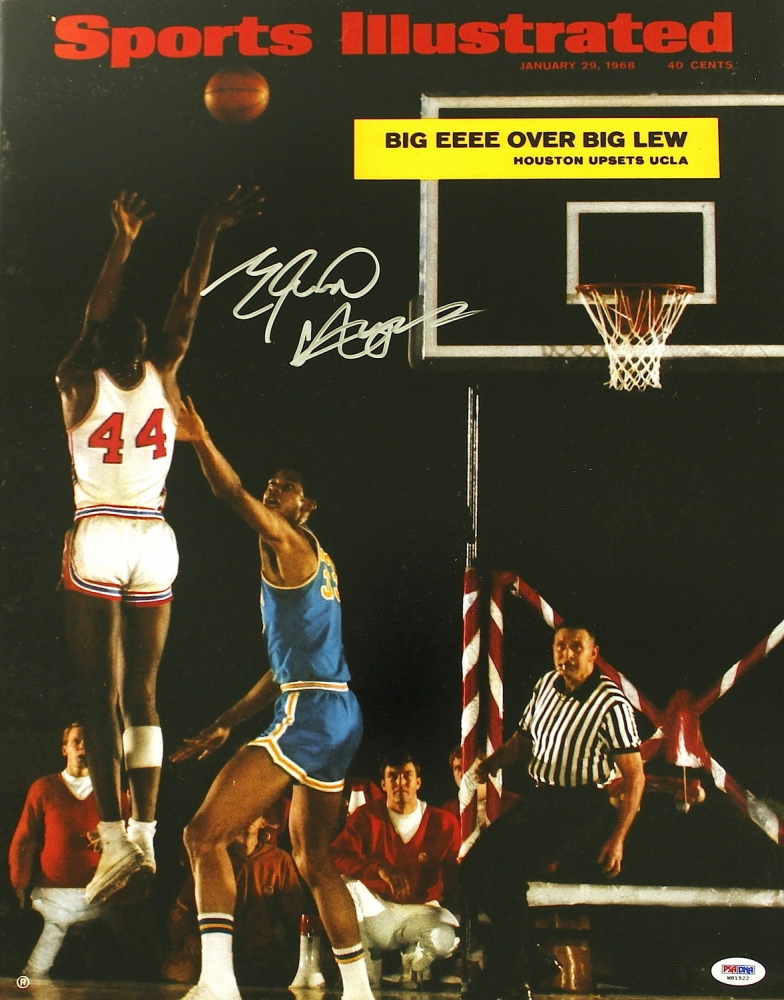
From the Annals of Roundball – In 1968, Houston ended UCLA’s 47-game winning streak with a 71-69 victory at the Astrodome before 52,693 fans. The so-called “Game of the Century” was the first basketball game played in the Eighth Wonder of the World and set a NCAA attendance record. It was also the first NCAA regular season game broadcast nationwide in prime time through a syndication package.

Houston and UCLA had met the previous season in the semifinals of the 1967 tournament with the Bruins winning 73–58 and moving on to win the national championship for the third time in four years.  Houston Coach Guy Lewis wanted a rematch and sold the game to UCLA’s John Wooden as something that would be good for all of college basketball.

The biggest match-up of the game featured Center Kareem Abdul-Jabbar (then Lew Alcindor) for the Bruins against Forward Elvin Hayes of the Cougars.  Although they did not play directly against each other, Hayes did block 3 of KAJ’s shots bringing cries of “E” from the crowd.  KAJ had suffered an eye injury the week before and turned in the worst performance of his college career.  The two teams would meet again in the NCAA tournament semi-final.  UCLA exacted revenge stomping the Cougars 101 to 69 and going on to beat North Carolina in the final.

Sports Illustrated cover from Pristine Auctions.

Today in Texas History – January 19

From the Annals of the Halls of Power –  In 1999, Rick Perry took office as Texas’ first Republican lieutenant governor since Reconstruction.  Perry’s long career in public office began in 1984 when he was elected to the Texas House of Representatives as a Democrat from District 64, which included Haskell County where his father had served as a County Commissioner.   Perry was well regarded as a Representative and served three terms.  He supported Al Gore for President in 1988.  But when George H.W. Bush won the Presidency, Perry was clearly attune to the direction the political winds were blowing in Texas, and he changed his party affiliation to the GOP.  In 1990, he narrowly defeated the popular incumbent Jim Hightower for Agriculture Commissioner.  With the help of Karl Rove he raised over $3 million and tarnished Hightower’s name – aided by a corruption scandal that enveloped 3 of Hightower’s aides.  Perry’s narrow win by about 20,000 votes pushed him into statewide prominence.   After serving two terms, Perry chose to run for Lieutenant Governor to succeed the retiring Democrat Bob Bullock.  Perry had a notable falling out with his previous top political strategist Karl Rove leading to the much-reported rivalry between the  Bush and Perry camps.  In the 1998 election, Perry eked out another narrow win with 1,858,837 votes (50.04 percent) to the 1,790,106 (48.19 percent) cast for Democrat John Sharp.

Today in Texas History – January 15

From the Annals of the Musicians – In 1972, Don McLean’s song “American Pie” hit No. 1 on the Billboard Pop Charts.  The  rambling lyrics have evoked numerous interpretations but what is not in doubt is that “the Day the Music Died” refers to February 3, 1959, the date of the tragic deaths of Buddy Holly, Richie Valens and J.P. “the Big Bopper” Richardson all of whom were  from Texas. The song became something of an anthem for a whole generation of high school and college students.  Perhaps no one was more surprised by the success of the song than McLean himself who claims he did not write the song intending it to be a generation-defining epic.  McLean states that it was simply written to capture his view of “America as I was seeing it and how I was fantasizing it might become.”  McLean’s greatest hope was that he might make a few thousand dollars and be able to keep performing for another year.  Instead, when asked about the meaning of the song, McLean remarked “it means I don’t ever have to work again if I don’t want to.”

Today in Texas History – January 14

From the Annals of the Constitution –  In 1860, the U.S. House of Representatives’ Committee of Thirty-Three submitted a proposed constitutional amendment protecting slavery in all areas where it already existed. The proposed amendment was intended to stop states from seceding.   Following the election of Abraham Lincoln, the secession fury picked up in the South.  The Republican Party was committed to restricting slavery in the Western territories, and Southerners were dead set on protecting their right to own other human beings.  The House of Representatives appointed the Committee of Thirty-Three, consisting of one member from each state, to investigate avenues of compromise that would keep the South from seceding.

Most of the floated plans involved an expansion of slavery into the Western territories, but that fight was what had killed off the Whigs and given rise to the Republican party, and Northern states were opposed to any further slave states entering the Union.  The only plan to make it out of the committee was submitted by Thomas Corwin of Ohio and called for an amendment to protect slavery, enforce the fugitive slave laws, and repeal state personal liberty laws.  The South was increasingly concerned faced with numbers of slaves escaping to the North and the personal liberty laws made it difficult to return persons to the condition of chattel slavery.  South Carolina, Florida, Mississippi, and Alabama had already seceded by the time Corwin made his proposal. The plan went no where and the issue of slavery was only resolved with a long and bloody civil war.

And this is why floating absurd plans to amend the Constitution to fundamentally alter our federal system are a stupid idea Governor Abbott.

Today in Texas History – January 12

From the Annals of Print Journalism –   In 1886, editor Simeon Newman published the last edition of the El Paso Lone Star.  Newman had learned the trade in Las Vegas, NM.  After teaching school for several years, Newman signed on in 1871 as an apprentice newspaperman for the Las Vegas Weekly Mail. A quick learner apparently, he bought the paper six weeks later.  The Weekly Mail regularly attacked the “Santa Fe Ring” for corruption.  After a ten year fight, Newman was enticed to move his paper to  El Paso and renamed it the Lone Star.  Newman continued his crusading ways in El Paso.  A staunch, Methodist, Democrat and reformer, Newman  chose “Hew to the line, let the chips fall where they may” as the Lone Star’s motto.  He attacked gamblers, saloon keepers, gunmen, and the criminal element, but also directed his diatribes at anyone he believed guilty of corruption.  This approach left Newman with few friends or supporters.  He was ultimately forced to close the Lone Star.

Today in Texas History – January 11

From the Annals of the Civil War – In 1863, the last remaining soldiers of the Fourth Brigade of Walker’s Texas Division were captured at Arkansas Post. The Texas Division was reputed to be the only division in the Confederate Army made up entirely of troops from a single state.  Organized in October 1862, the Division was named after Maj. Gen. John George Walker, who took command on January 1, 1863.   It was nicknamed the “Greyhound Division,” or “Walker’s Greyhounds” as a testament to the troops ability to endure long marches during the conflict to reinforce troops at critical junctures.  Initially, the division was made up of four brigades. The Fourth Brigade, under the command of Col. James Deshler, was stationed at the Arkansas post until it was captured intact and ceased to be an active force for the remainder of the war.

Image of John G. Walker from maritimetexas.net.