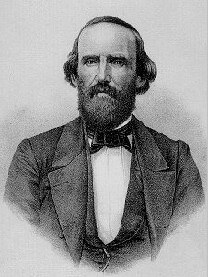
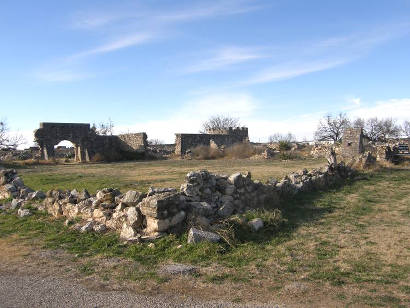
From the Annals of Reconstruction – In 1871, Governor Edmund J. Davis declared martial law in Freestone County. There had been extensive reports of coercion and fraudulent voting in Fairfield, the county seat during the election of October 3-6. Freestone County had been a hotbed of slave ownership and a strong supporter of secession having voted 585 to 3 in favor of secession at a county convention. Racial troubles continued after the war and well into the 20th Century with Klan activity and violence against Blacks. Martial law was lifted a month later, on November 10. Freestone County was one of four Texas counties in which martial law was declared during Reconstruction.
Category Archives: Today in Texas History
Today in Texas History – October 8

From the Annals of the Filibusters – In 1821, James Long and his filibuster forces to Mexican Army troops commanded by Colonel Juan Ignacio Pérez at La Bahia. Long was a former U.S. Army surgeon with dreams of conquest. The Long expedition was one of the first Anglo-Americans attempts to seize control of Texas from Spain. The expedition was formed in the Natchez, Mississippi area by elements who were opposed to the boundary of the Louisiana Purchase as set up in the Adams-Onís Treaty. In 1819, Long had some initial success in taking Nacogdoches and declaring a new Republic of Texas with Long as President. But the filibusters were quickly driven out by Pérez and the nascent Republic lasted less than a month. Undeterred, Long regrouped and joined forces with José Félix Trespalacios, who was organizing an expedition in New Orleans to support the Mexican liberals. Long established his headquarters at Fort Las Casas near Point Bolivar. There he was joined by his wife, Jane Long, the “Mother of Texas.” He later broke with Trespalacios, and sailed with his wife and an uncertain number of men to the coast south of La Bahia. The group easily took the presidio but was just as easily routed again by Perez days later. Long’s filibustering career was over. He was captured taken to Mexico where he died in prison six months later after being shot by a guard.
Photo of La Bahia from Texas Parks & Wildlife
Today in Texas History – October 7

From the Annals of the Red River – in 1759, a Spanish troop led by Diego Ortiz Parrilla was defeated by a group of Native Americans at a fortified Taovaya (Wichita) village near Spanish Fort. Parrilla’s expedition was intended to punish the Norteños (in this case the Tawakonis, Tonkawas, and Wichitas) for their destruction of Santa Cruz de San Sabá Mission in1758. Parrilla’s force consisted of 400 troops from the provinces of northeastern Mexico and the Texas presidios and 176 mission Indians and Apaches. The need for retribution was reinforced by continuing attacks. In December 1758, a Comanche band accompanied by members of eleven other groups surprised a group of Apaches near the presidio and killed twenty-one. In March a native force reportedly made up of the same tribes responsible for the mission attack massacred nineteen men guarding the presidio’s horse herd, leaving only one survivor.
On October 7, the troop was attacked by sixty or seventy warriors who led the Spaniards into a well-laid trap. In pursuit, the troop was led to a sandbank at the edge of the Red River, before the fortified Taovaya village. The Spaniards attempted to withdraw to regroup but found the road cut off by mounted Indians firing muskets. The Spaniards were trapped in the sand with horses sinking up to their knees. The resulting 4 hour battle went badly for the force. Facing a superior force of Comanches, Yaceales, and Tawakonis, and Taovayas, the Spaniards were attacked from the fort and the field. The troop eventually unlimbered two cannons but they did not affect the course of the engagement. The Apaches, Mission Indians and a number of Spaniards deserted. As darkness fell, Ortiz Parrilla managed an orderly withdrawal, leaving the cannons on the field but with losses of nineteen men killed, fourteen wounded, and nineteen by desertion.
Ruins of San Saba Mission from Texas Escapes.
Today in Texas History – October 6

From the Annals of the Code Duello – In 1839, Reuben Ross and Ben McColluch fought a duel in a field north of Gonzales. The dispute was actually between McColluch and Alonzo B. Sweitzer and arose during their 1839 race for a seat in the Texas House of Representatives and came to a head during their subsequent involvement in the pursuit of Indians who had raided Gonzales County. Following a lengthy exchange of insults, Sweitzer’s friend Ross delivered a formal challenge to McCulloch, who refused to accept on the grounds that Sweitzer was not a gentleman. Ross, however, was an acceptable substitute. Ross, an trained and experienced duelist, seriously wounded Ben McCulloch in the rifle duel. A shot to his right arm left McCulloch permanently crippled. Ross sent his personal surgeon to attend to McCulloch and expressed regret at having to have engaged “so brave a man in a private encounter.” McCulloch was indicted for accepting the challenge but was not prosecuted. Ross himself was later killed by McCulloch’s brother Henry in an alcohol fueled confrontation. And Sweitzer died in a duel in 1841. The encounter was one of many foolish examples of code duello tradition that persisted in Texas despite the antidueling law passed by the Congress of the republic in 1836.
Today in Texas History – October 5
From the Annals of the Governors – In 1907, Allan Shivers was born in Lufkin. Shivers was the youngest Senator in Texas history when he was elected to the state senate in 1937. He had been a force in the Texas Senate. After serving in Europe in World War II, he sought the position of Lt. Governor in 1946. He became Governor upon the death of Gov. Beauford Jester. He served as Governor for 7.5 years. Shivers was initially very popular, but his sway on the public and influence in the Democratic Party declined when he supported Dwight Eisenhower for President. Texas supporters of Eisenhower were known as Shivercrats. Shivers did accomplish much in politics including establishing Texas Southern University, putting women on juries for the first time, and creating the Legislative Budget Board.
Today in Texas History – October 2
From the Annals of the Revolution – In 1835, fighting broke out at Gonzales between Mexican soldiers and Texian militiamen. Gen. Domingo de Ugartechea learned that the colonists of Gonzales refused to surrender a small cannon that had been given that settlement in 1831 as a defense against the Indians, he dispatched Francisco de Castañeda and 100 dragoons to retrieve it on September 27. Though Castañeda attempted to avoid conflict, on the morning of October 2 his force clashed with local Texan militia led by John Henry Moore in the first battle of the Texas Revolution. The colonists motto of “Come and Take It” became a rallying cry. The actual skirmish for the cannon was brief and ended with the retreat of Castañeda and his force, but it also marked a clear break between the American colonists and the Mexican government.
Today in Texas History – October 1

From the Annals of the Early Republic – In 1837, John P. Borden opened the General Land Office in Houston. Borden was a veteran of the Texas Revolution and was appointed by Sam Houston to be the first commissioner of the new land office. His most daunting task was to catalogue and preserve the many Spanish and Mexican land titles issued before the republic. Borden worked alone as he had no funding or employees to assist him. Within months, Borden had successfully acquired documents from all over Texas. He also registered and surveyed new grants. When the General Land Office moved to Austin in 1839, Borden transported almost 5,000 pounds of documents by wagon.
Image from the General Land Office.
Today in Texas History – September 29

From the Annals of Bravery – In 1864, Sgt. Milton Holland earned the Medal of Honor for action at Chaffin’s Farm and New Market Heights, Virginia. Holland was born into slavery probably Austin in 1844. He was the slave and perhaps son of Bird Holland who would later become Texas Secretary of State. He was freed by Holland in the 1850’s and sent to the Albany Enterprise Academy in Ohio. He enlisted in the United States Army in 1863 at the age of 19. He joined the Fifth United States Colored Troops under the command of Gen. Benjamin Butler. He quickly rose to the rank of regimental sergeant major. During the engagements at Chaffin’s Farm and New Market Heights all of the white officers were killed or wounded. Holland assumed command and led his regiment in action as it routed the Confederates. He was wounded in the battle and for his actions received the Medal of Honor on April 6, 1865. His commendation contained the following quote regarding his action after the regiment suffered heavy losses in the battle:
“But, with a courage that knew no bounds, the men stood like granite figures. They routed the enemy and captured the breastworks. The courage displayed by young Holland’s regiment on this occasion called for the highest praise from Gen. Grant, who personally rode over the battlefield in company with Generals Butler and Draper.”
Butler promoted Holland to Captain for his service, but the War Department refused the commission because of his race. After mustering out of the army on September 20, 1865, Holland lived in Washington, D.C., where he worked in the Auditor Office of the United States government. He later became chief of collections for the Sixth District. He also established the Alpha Insurance Company, one of the first African-American-owned insurance companies. He died in 1910, at his farm near Silver Springs, Maryland, and was buried at Arlington National Cemetery.
Photo from the National Park Service.
Today in Texas History – September 28
From the Annals of the Border – In 1859, Mexican rancher, politician, military commander and at times outlaw Juan Cortina rode into Brownsville with a band of 80 men and seized control of the town. Cortina had a long running feud with the Anglos in south Texas who were attempting to oust him from his family’s extensive holdings on the north side of the Rio Grande in the aftermath of the Mexican-American War. For his efforts, Cortina was viewed as a champion of Mexicans living along the border in the years after the War. The first “Cortina War” arose from an incident on July 13, 1859, when Cortina saw the Brownsville city marshall, Robert Shears, arrest and brutally beat a Mexican who had once been employed by Cortina. Cortina shot the marshall in the shoulder and rode out of town with the prisoner. Early on the morning of September 28, 1859, he rode into Brownsville again, and seized control of the town. Five men, including the city jailer, were shot during the raid. Cortina’s hold on Brownsville was short-lived as residents of Matamoros convinced him to return to Mexico which he did on September 30.
Today in Texas History – September 24

From the Annals of Assassination – In 1964, the Warren Commission, headed by Chief Justice Earl Warren, delivered its report on the assassination of President John F. Kennedy, which had occurred on November 22, 1963, in Dallas. The task was made difficult by the sheer incompetence of the Dallas Police Department. The DPD had failed to protect, the alleged assassin, Lee Harvey Oswald, who was in turn murdered by Jack Ruby, before any real investigation could be started. The resulting turmoil and speculation, led LBJ to form the President’s Commission on the Assassination of President Kennedy to investigate Kennedy’s death – which became known as the Warren Commission. The WC concluded that Oswald had acted alone and that the Secret Service had failed to adequately protect the President.
The WC’s findings which were riddled with inconsistencies did little to stop the numerous conspiracy theories as to who was actually responsible. The WC’s conclusion that Oswald was a “lone gunman” was disputed by many who witnessed the attack and others whose research found conflicting details in the commission’s report. To many, the assassination of JFK remains the great unsolved mystery of our time. For his part, Red is particularly fond of the Joe DiMaggio theory.