Category Archives: Today in Texas History

Today in Texas History – October 26

From the Annals of the State Fair –  In 1930, the first football game was played at the Cotton Bowl at the Fair Park in Dallas.  SMU beat Indiana 27-0 to record the first win in the newly constructed stadium.  The 46,000-seat stadium was on the site of the former 15,000 seat Fair Park Football Stadium.  For more than 75 years, the stadium was the site of its namesake Cotton Bowl Classic which pitted the Southwest Conference champion against another highly ranked team on New Year’s Day.  The Cotton Bowl was the site of several of the “mythical” national championship games including UT’s victory over Notre Dame to claim the title in 1969.  The stadium was renovated extensively in 1949 increasing seating to 75,504. The Cotton Bowl was home to the short-lived Dallas Texans of the NFL in 1952, the Dallas Texans (now the Kansas City Chiefs) of the AFL from 1960 to 1962, and the Dallas Cowboys from 1960 to 1970. The stadium was renovated again in 1994 in preparation for World Cup games.  The venerable stadium was renovated again in the last decade to further increase its capacity.  The Cotton Bowl still hosts the annual Texas-OU game and the Ticket City Bowl.

Today in Texas History – October 23

From the Annals of the Loyal Unionists –  In 1863, the First Texas Cavalry left New Orleans as part of a campaign to occupy south Texas and interfere with trade between the Confederacy and Mexico.  The Rio Grande expedition landed on the south Texas coast on November 2 and occupied Brownsville four days later.  The First Texas Cavalry included 16 officers and 205 enlisted men, but grew quickly added more than 100 new soldiers within a month.  During this time the Second Texas Cavalry Regiment was formed at Brownsville. Both regiments left Texas in July 1864 for Louisiana. Two companies, however, of the First Texas Cavalry remained at Brownsville and did not rejoin their parent regiment until six months later.  The First Texas was part of a little known Texas effort to support the Union.   A total of 1,915 men from Texas served the Union.  The Texas Union soldiers were primarily of Mexican heritage, German Unionists from the Hill Country or first generation Irish immigrants – all of whom were opposed to slavery.

Today in Texas History – October 22

F

rom the Annals of the Republic – In 1836, Sam Houston was inaugurated as the first constitutionally elected President of the Republic of Texas.  Among the most pressing issues facing the new President were relations with the Native Americans who still dominated much of the claimed national territory. Houston’s years living with the Cherokees and actually becoming a Cherokee citizen gave him a different perspective than most.  During his first term, Houston held conferences with tribal leaders in an attempt to address past grievances and establish new trust. He appointed agents to deal with the tribes and to run government trading houses.  Houston attempted to limit further settlement by pulling back surveyors and military companies from the frontier.  He did recognize that Anglos needed some protection.  He created a force of 280 mounted riflemen to enforce the trade laws and deal fairly with both sides, removing white trespassers and arresting Indian raiders.  But there was to be no peace between whites and Indians. Many Texans refused to wait for Houston’s policy to work and demanded that the Indians be removed from Texas and violence inevitably resulted – instigated by both sides.  By the end of Houston’s term in 1838, a change in policy was inevitable.

Today in Texas History – October 21

From the Annals of Money –  In 1822, the first Texas bank was established by Governor José Félix Trespalacios. The Banco Nacional de Texas, or Texas National Bank, is reputed to be the first charted bank west of the Mississippi in what is now the United States.  The initial officers were members of local government and the bank was created primarily to provide funds to pay Mexican officials and soldiers.  The bank was short-lived but issued approximately 12,000 pesos in two installments on November 1 and December 1, 1822 to be backed by the specie due from the central government. The bank’s notes were declared legal tender for public and private debts, but trust in the currency was lacking. Citizens readily paid their taxes to the municipality in the notes, but many individuals had to be forced to accept the paper money.  After which the bank was suspended, most noteholders refused to accept Mexican paper currency in exchange and held out for payment in specie.  Finally, in 1830 the bank notes were finally exchanged in Saltillo for coin provided by the customhouses of Matamoros and Tampico.

Image of José Félix Trespalacios from http://www.snipview.com.

Today in Texas History – October 20

From the Annals of Treason – In 1807, former Vice-President Aaron Burr was acquitted on charges of treason.  Burr’s treason trial arose from his ambitious plan for the United States to seize the Spanish colonies in the Southwest and establish a great American empire. After leaving the vice presidency in disgrace in 1804, he toured the west as part of a conspiracy aimed towards invading Texas.  Burr made no real secret of his plan, as in 1805 he announced in Kentucky and New Orleans that he planned to overthrow the Spanish empire in America.

In 1806, he negotiated for the purchase of land near Natchitoches, Louisiana. From there he planned to establish a colony that would be a launching point for his projected invasion of Mexico.  His treason trial was based on a supposed plan to begin a western rebellion against the United States and form a break-away republic in the west. Gen. James Wilkinson, American military commander in New Orleans, however, informed President Thomas Jefferson that he had received a coded letter from Burr disclosing a plan to seize control of the Mississippi valley.  When his party of colonists set sail from Nashville in December 1808, Jefferson ordered Burr arrested for treason and high misdemeanors.   When Burr arrived at Bayou Pierre, LA on January 10, he learned that he had been betrayed. On January 17 he surrendered to the governor of Mississippi Territory. After an attempt to escape from the authorities he was tried in Richmond, Virginia. After a prolonged trial Justice John Marshall ruled that Burr was not guilty of treason but was guilty of contemplating an invasion of Spanish territory. He was placed under $3,000 bond.

Today in Texas History – October 19

From the Annals of Democracy –  In 1919, the League of Women Voters of Texas, a nonpartisan political organization, was formed at San Antonio.  The LWV-Texas was created by the members of the Texas Equal Suffrage Association which was made irrelevant by the passage of the 19th Amendment guaranteeing women the right to vote.  The LWV-Texas selected Jessie Daniel Ames of Georgetown as its first president.  The group focused its early efforts on educating the newly enfranchised women voters of the state.   The LWV-Texas now works to encourage active participation in government, increase understanding of major public policy issues, influence public policy through education and advocacy, and inform citizens about the voting process and positions of the candidates.

Photo from lwvhouston.org

Today in Texas History – October 16

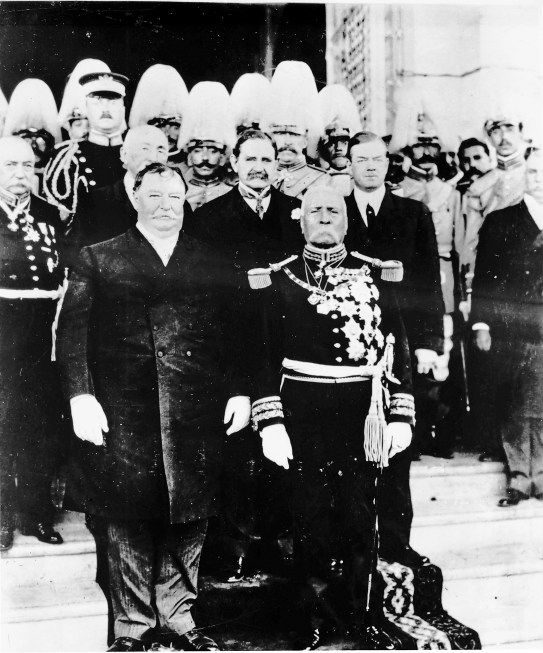
From the Annals of the Fat Presidents –  In 1909, Pres. William Howard Taft met with Mexican Pres. Porfirio Diazo.  This first ever meeting between U.S. and Mexican presidents was part of a planned summit that took place in  both El Paso and Ciudad Juarez.  The initial meeting was at the Chamber of Commerce building in El Paso, but continued later at the Custom House in Juarez. When Taft crossed the Rio Grande, it was the first time an American president entered Mexico, and only the second international trip by a sitting president.  Diaz requested the meeting as a build up to his eighth campaign for president, and Taft agreed to support Diaz to protect American business interests that had invested heavily in Mexico.  The meeting has been described as a “veritable pageant of military splendor, social brilliance, courtly formality, official protocol, and patriotic fervor.”

Today in Texas History – October 15

Davy Crockett portal sign.

From the Annals of the Piney Woods – In 1936, President Franklin D. Roosevelt proclaimed the establishment of the Davy Crockett National Forest.    The national forests in Texas were initiated by an act of the Texas legislature in 1933 authorizing the purchase of lands for the national forest system.  The DCNF is administered by the United States Department of Agriculture Forest Service local headquarters in Lufkin.  It contains a total of 161,842 acres, with 94,481 acres in Houston County and 67,361 acres in Trinity County. The national forests are managed on a multiple-use philosophy and are used for lumbering, grazing, oil production, hunting, and recreation. DCNF which is bordered on the northeast by the Neches River, includes the 45-acre Ratliff Lake. The area is pine-hardwood woodlands with flat to gently rolling terrain. Recreational facilities at this national forest include a bathhouse, camping and picnicking areas, boat ramps, and hiking trails.

Today in Texas History – October 14

From the Annals of  Gun Safety (or Lack Thereof) – In 1867,  Lt. James Pike died during an Indian attack on his unit.  When Indians attacked Pike’s unit at dinner, the lieutenant seized his rifle and rushed to the defense. The rifle jammed, however, and in his frustration he smashed the barrel on a nearby rock, whereupon the gun discharged and killed him bringing an ignominious end to his rather distinguished career.  Pike was the son of an outspoken newspaper editor.  He arrived in Austin in 1859 and attempted to get a job as a printer.  When that failed, he joined John Henry Brown’s company of Texas Rangers at Belton. For the next two years he took part in a series of campaigns against the Comanches. When Texas seceded from the Union,  Pike left the Rangers and went north, where joined the Fourth Ohio Cavalry. Pike saw considerable action as a scout, spy, and courier in Gen. William T. Sherman’s army.  Pike was captured in 1864 and imprisoned in Charleston, South Carolina, then escaped and returned to Hillsboro, Ohio, where he wrote his memoirs of ranger and army service.  After the war, Pike obtained a commission as a second lieutenant in the First United States Cavalry and was later promoted to first lieutenant.

Pike’s memoirs were published in 1865 as The Scout and Ranger: Being the Personal Adventures of Corporal Pike, of the Fourth Ohio Cavalry.

Today in Texas History

From the Annals of Flight – In 2014, the Wright Amendment expired.  The amendment was passed in 1979 and named after former House Speaker Jim Wright.  It was intended to protect the newly opened DFW International Airport from competition fueled by flights from upstart Southwest Airlines at Dallas Love Field.  The Wright Amendment restricted flights from Love Field to neighboring states.  Southwest and other airlines were prohibited from flying out of Love Field to anywhere other than New Mexico, Oklahoma, Arkansas and Louisiana.  The restriction prevented any substantial investment in the facilities at Love Field and while convenient the airport remained mired in the 1960’s.  That will soon change with the Love Field Modernization Project.