Category Archives: Texas History

Today in Texas History – July 22

From the Annals of Discrimination – In 1944, Lawrence Aaron Nixon, black physician and voting-rights advocate, was given a ballot to vote in the Democratic Party primary.  In that day, the Democratic nominee was all but assured of election and thus, the Democratic primary was the “real” election.  Nixon had become involved in the civil rights movement after seeing the disgusting number of lynchings of black men in Texas, one of which occurred in Cameron where Nixon was practicing at the time.   He moved to El Paso, established a successful medical practice, helped organize a Methodist congregation, voted in Democratic primary and general elections, and in 1914 helped to organize the local chapter of the NAACP.  But in 1923 the Texas legislature passed a law prohibiting blacks from voting in Democratic primaries. In 1924, with the sponsorship of the NAACP, Nixon took his poll-tax receipt to a Democratic primary polling place and was refused a ballot. This began a twenty-year legal fight.  Nixon and his attorney, Fred C. Knollenberg, twice prevailed at the U.S. Supreme Court in their quest to secure voting rights for blacks. The Nixon decisions were major steps toward voting rights, but Texas and the dominant Democratic Party employed a number of legal maneuvers to continue to deny primary votes to blacks.  Only after the decision in Smith v. Allwright ended the white primary system, did blacks have a clear right to vote.

Photo from http://www.blackpast.org

Today in Texas History – July 21

From the Annals of the Civil War –  In 1861, Gen. Irwin McDowell began a premature offensive into northern Virginia.  The overconfident McDowell let 34,000 largely inexperienced and poorly trained troops in a search for the main body of the Army of Northern Virginia.  Learning of the Union advance, General P.G.T. Beauregard massed some 20,000 troops at Manassas where he was joined by General Joseph Johnston’s 9,000 troops.

McDowell had initial success when three Union divisions crossed the Bull Run stream driving the  Confederate flank back to Henry House Hill. Beauregard had established a strong defensive line at the hill anchored by a brigade of Virginia infantry under General Thomas J. Jackson whose men repulsed a series of Federal charges.  Gen. Barnard Elliot Bee, Jr. allegedly shouted an order to his men to “Rally behind the Virginians! There stands Jackson like a stone wall!” No-one knows if this was meant to be complimentary or an insult regarding Jackson’s men not advancing. Bee then began to advance at the head of his brigade and fell mortally wounded. He died the next day 22nd July 1861.

The battle turned when Confederate cavalry under J.E.B. Stuart captured the Union artillery.  Beauregard ordered a counterattack. With the soon to be famous “rebel yell” the confederate charged down Henry House Hill breaking the Union line and forcing a retreat across Bull Run. The retreat quickly disintegrated into an unorganized flight back to D.C.

Union forces endured a loss of 3,000 men killed, wounded, or missing in action while the Confederates suffered 2,000 casualties.  Such casualties were unheard of in previous American combat and foreshadowed the long violent struggle to come.

Photo of B.E. Bee from http://www.nps.gov

Today in Texas History – July 17

From the Annals of the Civil War –   In 1864,  CSA President Jefferson Davis appointed Gen. John Bell Hood as commander of the Army of Tennessee.  Hood, a West Point graduate, had been stationed in Texas before the war and offered his services to his adopted state.

Davis was frustrated by Gen. Joseph Johnston who employed a defensive strategy in the Atlanta campaign waged by Union Gen. William T. Sherman.  Johnston and Sherman had maneuvered and skirmished throughout the rugged landscape between Chattanooga and Atlanta but had not met in a full-fledged battle.  Sherman’s efforts to outflank Johnston were blocked, but even though Johnson minimized his losses his army was pushed inexorably back towards Atlanta. By July 17, 1864, Johnston’s army was in the outskirts of Atlanta. As a result, Davis removed Johnston and replaced him with the 33 year-old Hood. Hood had a reputation as a fighting general and he quickly took the offensive by attacking at Peachtree Creek on July 20.  His army was routed.  Undeterred, Hood attacked Sherman two more times with equally disastrous results.  The Army of Tennessee was effectively through as an offensive unit and Hood was forced to evacuate Atlanta.

Today in Texas History – July 16

From the Annals of the Border Wars –  In 1931, the “Red River Bridge War” reached a new level of confrontation when Gov. Ross Sterling ordered a detachment of Texas Rangers to prevent use of a newly constructed free bridge over the Red River.  The bridge which had been built by Texas and Oklahoma connected Denison and Durant, Oklahoma.  The problem arose when the Red River Bridge Company, which operating a toll bridge running next to the new bridge, filed suit in U.S. District Court seeking an injunction preventing the Texas Highway Commission from opening the bridge. The RRBC claimed breach of an agreement by the THC to purchase the toll bridge and damages for its unexpired contract as a condition for opening the new bridge.  The court granted a temporary injunction Sterling had barricades erected preventing access to the bridge from the Texas side.  Oklahoma Governor William (Alfalfa Bill) Murray claimed that Oklahoma’s “half” of the bridge ran lengthwise north and south across the Red River, that Oklahoma held title to both sides of the river from the Louisiana Purchase treaty of 1803, and that the state of Oklahoma was not named in the injunction. On July 16, Oklahoma highway crews crossed the bridge and took down the Texas barricades.  Sterling responded by ordering The Texas Rangers to rebuild the barricades and protect Texas Highway Department employees charged with enforcing the injunction.  In response, Murray ordered Oklahoma highway crews to tear up the northern approaches to the still-operating toll bridge closing traffic over the river.   The Texas Legislature resolved the controversy by  passing a bill granting the RRBC permission to sue the state in order to recover its damages.   This allowed the injunction to be dissolved and  the free bridge was opened to traffic, but not before some additional grandstanding by Murray who had declared martial law on both sides of the bridge.  The controversy ended with no shots fired and no injuries.

Photo from heralddemocrat.com

Today in Texas History – July 15

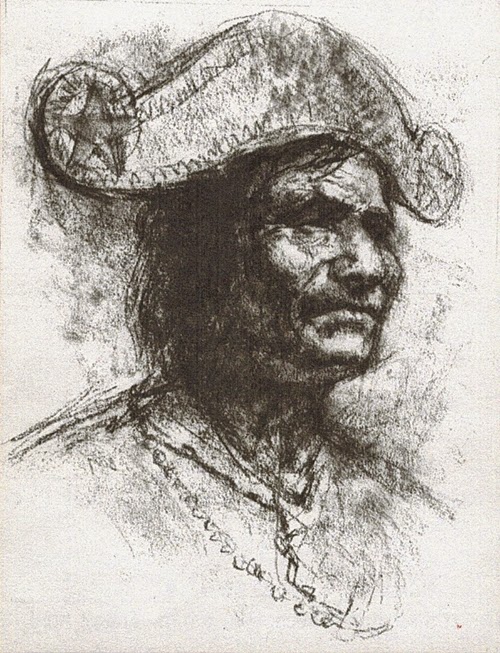
From the Annals of the Indian Wars –   In 1839, the main battle of the Cherokee War was fought a few miles west of Tyler.  The Battle of the Neches was the culmination of a genocidal campaign that began when President Mirabeau B. Lamar announced that the time had come for an “exterminating war” on Texas Indians. Lamar and his administration refused to recognize earlier treaties with the Cherokees in East Texas.  To foment war, Lamar accused Cherokees and their the Kickapoos, Delawares and Shawnee of planning to join Mexico in an insurrection.  Texan troops under the command of General Thomas Rusk were sent to remove the Indians from their recognized lands. Under pressure, Chief Duwali (aka Chief Bowl or Bowles) led an evacuation of their main town.  But that did not satisfy the Texans who attacked the Indians at dusk on July 15. The first day’s battle proved indecisive, but on July 16, Texas troops led by Rusk and Edward Burleson routed the Cherokees and their allies near the headwaters of the Neches River in Van Zandt County. Chief Duwali was on horseback but was dismounted and wounded.  He continued the fight on foot but was hit again. As he sat wounded on the battlefield a Texan soldier executed him with a shot to the head. Reports were that 100 Indians were killed in the attack.  Texans claimed only 5 dead and 28 wounded.  The survivors fled to the Indian Territory. This was the end of any major Indian presence in East Texas.

Drawing of Chief Duwali from http://texas-history-page.blogspot.com/2015_03_01_archive.html

Today in Texas History – July 14

From the Annals of the Aviation Pioneers – In 1938, Howard Hughes and a four-man crew landed their specially equipped Lockheed 14 in New York City, having circled the globe in three days, nineteen hours, and seventeen minutes. Hughes, a Houston native, was wealthy from the age of 18 as he inherited a fortune when orphaned.  He first sought fame in Hollywood in the 1920s producing and then directing movies such as Hell’s Angels (1930) and Scarface (1932).  Hughes had been fascinated with flying since his youth and used part of his incredible fortune to form the Hughes Aircraft Company in the 1930s as a division of Hughes Tool Company.  Hughes was a talented and daring pilot and set two speed records. In the 1940s, Hughes Aircraft landed several contracts to produce military aircraft, but with mixed results, as in the case of the famous HK-1 flying boat (the “Spruce Goose”).

Today in Texas History – July 13

From the Annals of Unclaimed Prizes – In 1903, the Texas legislature chose to offer a $50,000 prize for discovery of a way to rid Texas of the boll weevil. The proclamation was made from the steps of the Capitol in Austin.  A Boll Weevil Commission was appointed by Gov. S.W.T. Lanham to evaluate the claims and claimants to the prize.  The prize offered by the legislature made both themselves and the boll weevil a figure of fun for newspapers throughout the nation, and this episode is sometimes found in civics or government texts as an illustration of the foolishness of lawmaking bodies.  No one ever came forth to make a claim for the prize – an enormous sum in its day.

Today in Texas History – July 10

From the Annals of the Conquistadors –   In 1520, Hernan Cortes, his army and Tlaxcalan allies were forced to flee Tenochtitlan in what became known at the Noche Triste.  The population of Tenochtitlan had risen against them after Pedro Alvarado had slaughtered many Aztec nobles in a brutal and senseless massacre that occurred while Cortes was away quelling a rebellion of Spanish troops on the coast.  Upon his return to Tenochtitlan, Cortes quickly realized that their position was untenable and ordered an evacuation from the island capital.

Under cover of darkness, the Spaniards and their allies set out for the mainland via the causeway to Tlacopan. The retreat was hampered by the fact that the Aztecs had removed the bridges over the gaps in the causeways that linked the city to the mainland.  However, Cortés’ men constructed a portable bridge with which to cross the openings.They placed the portable bridge in the first gap, but at that moment their movement was detected and Aztec forces attacked, both along the causeway and by means of canoes on the lake. The Spaniards had no choice but to continue to retreat down the narrow causeway.

The retreat quickly turned into a rout as Cortes’ men could not remove the portable bridge unit from the first gap. The bulk of the Spanish infantry, left behind by Cortés and the other horsemen, had to cut their way through the masses of Aztec warriors opposing them. Many of the Spaniards, weighed down by their armor and booty, drowned in the causeway gaps or were killed by the Aztecs. Much of the wealth the Spaniards had acquired in Tenochtitlan was lost.  More than two-thirds of the Spanish troops were killed or captured and the Spanish allies suffered heavy losses. Upon reaching the mainland at Tlacopan, Cortes wept over their losses.  The old tree (“El árbol de la noche triste”) where Cortés cried is still a monument in Mexico.

Today in Texas History – July 9

From the Annals of the Missions –  In 1716,  Nuestra Señora de Guadalupe de los Nacogdoches Mission was founded by the Domingo Ramon expedition in a village of the Nacogdoches Indians.  The well-traveled Father Antonio Margil de Jesus was placed in charge of the mission. The mission was abandoned temporarily in 1719 because of a French invasion of Texas, but it was the first Zacatecan mission to be restored when the Spanish reasserted control two years later. The mission was deemed a failure as the Nacogdoches tribe resisted conversion to Catholicism.  In 1773, it was permanently abandoned after the cession of Louisiana to Spain by the French.