Category Archives: Today in Texas History

Today in Texas History – December 19

Flag of Coahuila y Tejas

From the Annals of Remonstrances  –  In 1832, San Antonio de Bexar presented a list of grievances to the legislature of Coahuila y Tejas. The document known as the Bexar Remonstrance was signed by José Ángel Navarro, alcalde of San Antonio. It sought repeal of that part of the Law of April 6, 1830, banning immigration from the United States. It also sought the separation of Texas from Coahuila.

The flag of Coahuila y Tejas is shown.
Today in Texas History – December 15

From the Annals of the Cavalry –  In 1855, the Second United States Cavalry Regiment first came to Texas. The SUSCR  was organized specifically for service on the Texas frontier. Its officers were hand-picked by Secretary of War Jefferson Davis.  The regiment was known as “Jeff Davis’s Own.” The SUSCR stayed until the Civil War.  THE SUSCR engaged in 40 actions on the Texas frontier and along the Rio Grande fighting Apaches, Comanches, Kiowas, and Mexican marauders.  The regiment was home to future Confederate Generals Albert Sidney Johnston, Robert E. Lee, Edmund Kirby Smith, and John Bell Hood.

Today in Texas History – December 2

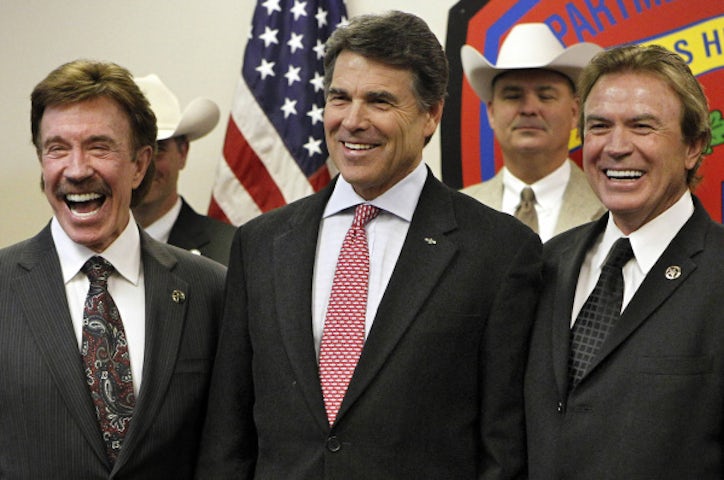
From the Annals of Faux Law Enforcement – In 2010, Our Poor Idiot Governor Rick Perry named Chuck Norris (of Walker- Texas Moron fame) and his brother Aaron as honorary members of the Texas Rangers law enforcement agency.  Criminals across the state trembled at the prospect and a couple of would be felons turned themselves in.  If only Red could know what the actual Texas Ranger in the background was thinking.

Today in Texas History – November 28

From the Annals of Screwing –  In 1882, the Screwmen’s Benevolent Association called a general holiday (actually a strike)  for its members in opposition to the appearance of black workers in the cotton-screwing trade.  The SBA was a trade union of specialized longshoremen who used screwjacks to stow and pack cotton bales into the holds of ships.  The screwmen were almost entirely whites of various European origins and opposed allowing blacks to practice their trade. The SBA used an apprenticeship system to exclude blacks and gain a virtual monopoly of the work at the port of Galveston. After the invention of the high density cotton compress in 1910, the need for screwmen was gone and the SBA faded into history.

Today in Texas History – November 23

aboutus-debakey-museum-orsurgery1 (320x240)

From the Annals of Overeating –  In 1964, Dr. Michael DeBakey and his team performed the world’s first successful coronary artery bypass graft surgery in Houston.  Debakey developed the concept behind the coronary bypass after noting that in many forms of arterial disease, the portions above and below a diseased or blocked segment of artery were normal.  He theorized that the damaged portion could be bypassed to restore blood flow and prevent a fatal heart attack.  In the first successful coronary bypass he used a  large vein from the patient’s leg to bypass the blocked or damaged area between the aorta and coronary arteries.  The surgery has now become common-place performed at hospitals around the world.

So enjoy your Thanksgiving meal.

Today in Texas History – November 17

From the Annals of Girl Power –  In 1981, Kathy Whitmire was elected as the first female mayor of Houston.  She defeated Sheriff Jack Heard  with 62% of the vote- who was never heard from again (Red just couldn’t resist that one). The unexpected rise of Whitmire put a temporary end to the good ‘ol boy network that had run Houston since – well forever.  Whitmire served five terms finally losing to Bob Lanier in 1991.  She has never run for office again.

Today in Texas History – November 15

Image result for George Fisher and José mexia

From the Annals of Revolution –  In 1835, an expedition led by George Fisher and José Antonio Mexía unsuccessfully assaulted the Mexican garrison at Tampico. The Tampico Expedition was launched in response to Antonio López de Santa Anna’s repudiation of the Constitution of 1824. The expedition sailed from New Orleans on the schooner Mary Jane on November 6. The Mary Jane ran aground off Tampico on November 14. Mexía attacked the city on November 15 and was soundly defeated. The remaining rebels retreated aboard the American schooner Halcyon , which arrived back in Texas on December 3. Thirty-one prisoners were left at Tampico. All either died from wounds or were executed.

Photo of George Fisher from Texas A&M.

Today in Texas History – November 8

Image result for mexican circus poster

From the Annals of the Big Top – In 1852, the San Antonio Ledger published the first recorded mention of a Mexican circus in Texas.  The Mexican tradition of circus type acts has been chronicled since Bernal Diaz del Castillo wrote about the Mexican flyers who spun around a pole on ropes during an Aztec religious ceremony.  The traveling carpa (tent circus)  later incorporated Spanish themes with acrobats, jugglers and clowns. By the time such acts reached Texas,  the big-top Mexican circuses had incorporated some aspects of the Italian, English, and United States circuses, most notably the English clown with baggy pants and red wig.

Today in Texas History – November 4

From the Annals of the Revolution –  In 1835,  Texians and a Mexican Army contingent met at the battle of Lipantitlán on the east bank of the Nueces River three miles above San Patricio in San Patricio County, directly across from Fort Lipantitlán. A Texas force of around seventy men under Adjutant Ira J. Westover engaged a Mexican force of about ninety men under Capt. Nicolás Rodríguez.  Reports were that the battle lasted thirty-two minutes, leaving twenty-eight Mexicans dead, including Lt. Marcellino García, second in command. The Texans suffered only one casualty, when a rifle ball cut off three of the fingers on William Bracken’s right hand.  Red always questions these lop-sided reports of results, but then again the victors write history.