Category Archives: Today in Texas History

Today in Texas History – March 7

From the Annals of the Temblors – In 1923, the only known fatality from a Texas earthquake occurred with a temblor shook El Paso causing an adobe house to collapse.  The house, however, was in Ciudad Juarez, Mexico and the fatality occurred on that side of the border.  There are still no known fatalities to have occurred in Texas from earthquakes which are not common in the state.  Even so, more than 100 earthquakes have been recorded since 1847 but most are of low magnitude causing some fright but little real damage.  Most of the recorded quakes have been in West Texas and the Panhandle.

Today in Texas History – March 6

Odessa – The Globe Theatre

From the Annals of the Theatre – In 1958, groundbreaking ceremonies were held for the Globe of the Great Southwest. The theater is located in Odessa and is a replica of the original Globe Theater in Southwark, London which was built in 1598 for William Shakespeare’s acting company.  Now called simply the Globe Theater and operated by Odessa College, the theatre is 410-seat venue featuring an authentic Elizabethan stage used for classical and modern plays as well as community theater, concerts and other community events.  The GT was built in response to a proposal from Odessa College Professor Marjorie Morris.  Shakespearean scholar Dr. Allardyce Nicoll has called the theater “the most nearly authentic replica of Shakespeare’s own Globe anywhere on Earth.”

Today in Texas History – March 2

Texas Independence Day - Wikipedia

From the Annals of the Revolution – In 1836, Texas declared its independence from Mexico.  Following a meeting on March 1 at Washington-on-the-Brazos of delegates from the seventeen Mexican municipalities of Texas and the settlement of Pecan Point, George C. Childress and a committee of five were tasked with preparing a resolution calling for independence.  In the early morning hours of March 2, the convention voted unanimously to accept the resolution prepared by the committee.  Fifty-eight members of the delegation signed the document announcing to the world that Texas had declared itself to be the independent Republic of Texas.   Less than two months later after the Battle of San Jacinto, actual independence was secured.  The Republic would last only about 10 years until Texas was annexed by the United States.

Today in Texas History – February 26

SWEATT, HEMAN MARION | The Handbook of Texas Online| Texas ...

From the Annals of Segregation –  In 1946, Heman Sweatt met with University of Texas President Theophilus S. Painter and other university officials to present a formal request for admission to the UT School of Law.  Sweatt was accompanied by representatives of the NAACP. Sweatt had already agreed to sue UT if he was denied admission and present a test case for the integration of higher education in Texas.   UT denied him admission. Painter informed him that although his credentials were adequate enough he could not allow him to enter UT.  As one court put it, “he possessed every essential qualification for admission, except that of race, upon which ground alone his application was denied.” The Texas Attorney General Grover Sellers backed up Painter’s decision.  Sweatt filed suit against Painter on May 16, 1946.  The trial court found that under the “separate but equal” doctrine, Texas had to build an equal law school within a six month time frame. After six months had passed the judge threw out the case because Texas A&M had planned a resolution to provide a legal education for blacks. Sweatt, with the backing of the NAACP, appealed.  The case finally reached the United States Supreme Court in June of 1950.  The Supreme Court held that black students were not offered an equal quality law education in the state of Texas, and as a result UT would have to admit qualified black applicants.  On September 19, 1950, Sweatt registered for classes at the UT School of Law. However, as a result of the tremendous amount of stress and emotional trauma from the long drawn out court cases Sweatt’s mental and physical health had taken a turn for the worse.  He later withdrew from the school.

Today in Texas History – February 22

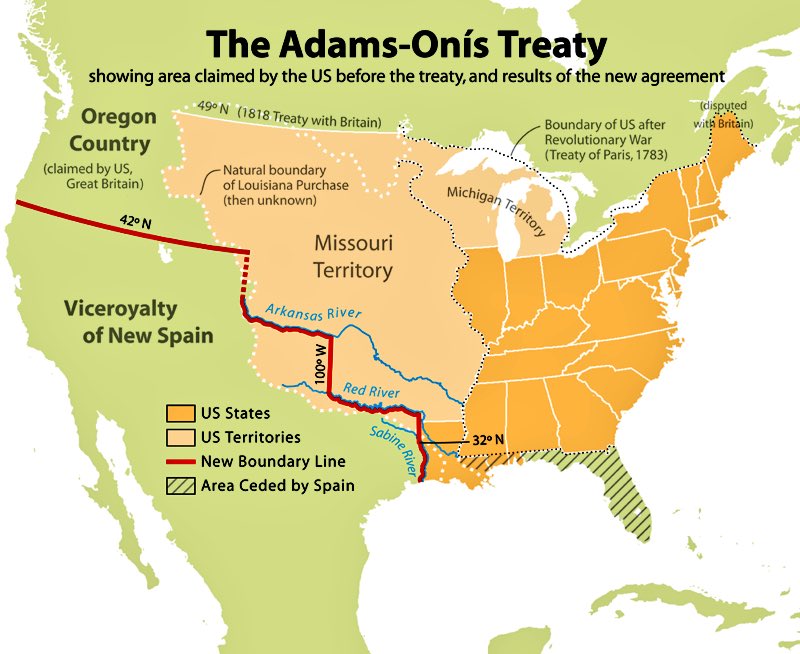
Image result for adams onis treaty

From the Annals of the Border – In 1819, U.S. Secretary of State John Quincy Adams and Spanish foreign minister Luis de Onis y Gonzalez-Vara signed the Adams-Onis Treaty also known as the Florida Treaty. Spain ceded Florida to the U.S. in exchange for settling the long simmering boundary dispute between the U.S. and New Spain.  Spain was frankly interested in jettisoning Florida as it was already overwhelmed with wars for independence in South America and periodic upheaval what was soon to be Mexico.  The treaty set the U.S./New Spain boundary at the Sabine River and on through the great plains and Rocky Mountains following the Red River and Arkansas River – basically according to the terms of the Louisiana Purchase –  and then on west to the Pacific Ocean along the 42nd Parallel.  The U.S. renounced any claims to Texas and agreed to pay residents’ claims against the Spanish government up to a total of $5,000,000.  The treaty was short-lived as Mexico was granted independence from Spain in 1821.  Mexico ratified the boundaries of AO Treaty by agreeing to the Treaty of Limits in 1828.  The boundary stood until the Texas Revolution and the later the Mexican-American War.

Today in Texas History – February 21

From the Annals of the County Seat – In 1902, Dalhart was recognized as the county seat of Dallam County. The name Dalhart is a portmanteau combining the name of the Dallam and Hartley counties as the town straddles the county line.  The town origins go back to the crossing of the Chicago, Rock Island and Pacific Railroad  and the Fort Worth and Denver line.  The settlement was first known as Twist Junction and later as Denrock derived from the names of the railroad lines.  However, when the postal service objected to the name, it was changed to Dalhart.

Photo from braggdavison.com.

Today in Texas History – February 19

Plummer, Rachel Biography

From the Annals of the Captives – In 1838, Rachel Plummer was reunited with her husband after spending over a year as a Comanche captive. She and her son and three others were kidnapped in a raid on Fort Parker at the headwaters of the Navasota River.  Plummer was taken along with the most famous Texas captive her cousin Cynthia Ann Parker.   Plummer wrote that “one minute the fields (in front of the fort) were clear, and the next moment, more Indians than I dreamed possible were in front of the fort.”  After being returned to her family, Plummer wrote a book about her experience entitled Rachael Plummer’s Narrative of Twenty One Months Servitude as a Prisoner Among the Commanchee Indians. Plummer’s book is considered one of the most insightful accounts of Comanche culture and mindset while still at the height of their powers.  Sadly, Plummer died shortly after her reunification with her family.

Today in Texas History – February 14

Bbbc Valentine Web 900X600

From the Annals of Love –  In 1882, the town of Valentine in Jeff Davis County was founded when crews building the Southern Pacific Railway reached the outpost on St. Valentine’s Day.  Valentine is the only incorporated municipality in Jeff Davis County.  The town capitalizes on its name with a Valentine’s Day Celebration hosted by the Big Bend Brewing Company at the Old Mercantile Building.  This year is Local’s Night with a lineup that includes Doug Moreland Band, The Doodlin’ Hogwallops, and Beebe & Carrasco.

Today in Texas History – February 13

Gen. Lee the last Confederate statue removed in New ...

From the Annals of Bad Decisions – In 1861, Gen. Winfield Scott ordered Col. Robert E. Lee to return to Washington from Texas to assume command of the Union Army. Instead, Lee resigned his post and was commissioned into the Rebel Army.  After a rather undistinguished campaign in western Virginia and a brief stint as military advisor to the Insurgent Leader Jefferson Davis, Lee succeeded Joseph Johnston as the Insurgent Commander in June of 1862.  Historians will never know and can only speculate as to how many lives were lost as a result of Lee’s decision. 

Photo of Lee’s statue being removed.