Category Archives: Today in Texas History

Today in Texas History – August 20

From the Annals of the Civil War – In 1866, the Civil War officially ended when President Andrew Johnson issued a proclamation of peace between the United States and Texas.  Johnson declared that “the insurrection in the State of Texas has been completely and everywhere suppressed and ended.” Johnson had previously declared a state of peace between the U.S. and the other ten Confederate states on April 2, 1866.  Being the most remote of the rebellious states, fighting in Texas did not end until May 13, 1866 when the last land battle of the war took place at Palmito Ranch near Brownsville.

Photo of Andrew Johnson from historyplace.com

Today in Texas History – August 19

From the Annals of the Methodists –  In 1837, Robert Alexander crossed the Sabine River and began preaching his way westward – the start of a ministry of forty-five years in Texas.  Alexander quickly formed the San Augustine circuit and by mid-October formed the first Methodist missionary society in Texas during a camp meeting held at Caney Creek.  The mission was later organized into the Texas Conference.  Alexander served as first presiding elder of the several districts including  Galveston, Huntsville, and Chappell Hill. His pastoral appointments included Belton, Chappell Hill, Galveston, and Waco.  When the Methodists split over slavery in 1844, Alexander’s colleagues elected him delegate to the Louisville Convention that organized the Methodist Episcopal Church, South, in 1845. They subsequently elected him to nine succeeding General Conferences.

Today in Texas History – August 18

From the Annals of Nascent Revolution –  In 1813, the Battle of Medina was fought.  The fight was between the Gutierrez-Magee Expedition and Spanish troops and took place some 20 miles south of San Antonio de Bexar.  The battle was the end of the effort led by Bernardo Gutierrez de Lara to break Texas away from Spain and declare and independent republic.  The expedition was an offshoot of the initial failure of the Mexican War for Independence that began with El Grito by Padred Hidalgo in September 16 , 1810.  After some initial success, the expedition was decimated at Medina losing some 1,300 men and effectively ending the revolutionary movement in Texas. 

Today in Texas History – August 17

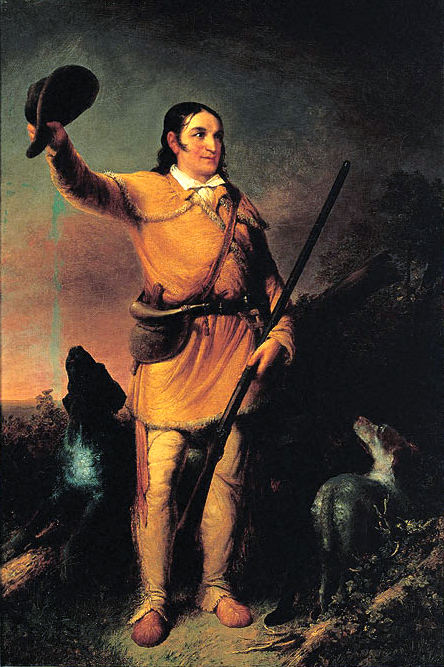
From the Annals of Bad Luck –   David Crockett was born in what is now Greene County, Tennessee (technically a part of N. Carolina at the time of his birth).  Crockett’s family traversed Tennessee in a series of failed attempts to establish businesses.  Crockett himself was first employed as a drover in a cattle drive from Tennessee to Virginia and was also indentured at various times to pay off his father’s debts.  Crockett’s political career began with his appointment as a justice of the peace in 1817.  From there he sought and won office to the Tennessee state assembly in 1821 and served several terms representing different districts.  He lost in his first run for Congress in 1825, but after being encouraged to try again, he won election in 1827.  Crockett was a consistent champion for the rights of poor settlers whose property rights were endangered by a complicated system of land grants. He introduced a bill to abolish West Point which he viewed as providing free education for sons of the wealthy.   He served two terms before being voted out for his opposition to the Indian Removal Act.  He was returned to Congress 2 years later and served 2 more terms before being defeated in 1835.  Crockett arguably was the best known American of his day – especially after publishing his autobiography.

His decision to go to Texas was likely motivated by a desire to continue his political career.  Crockett was 49 and his military service had been largely limited to work as a scout and hunter finding food for the troops.  Some have speculated that he believed his fame would translate into the presidency of a newly formed Texas nation.   The details of his death at the Alamo have been hotly debated.  More on that on another Today in Texas History.

Today in Texas History – August 14

From the Annals of Print Journalism –  In 1819, Eli Harris published the first edition of the Texas Republican  in Nacogdoches.  The paper is believed to be the earliest newspaper published in Texas for which records exist in contemporary St. Louis and New Orleans papers. It is unknown how many issues of the Republican were printed.  It was short-lived as  sources indicate that the Texas Republican  had discontinued publication by September 1819.

Today in Texas History – August 13

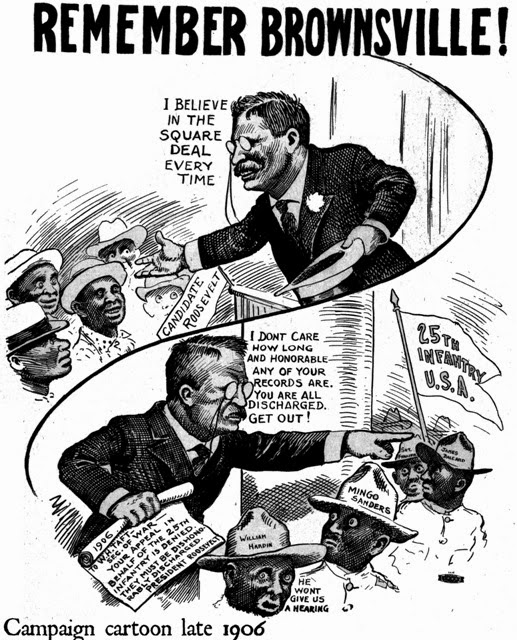
From the Annals of Discrimination –  In 1906, an alleged attack by soldiers from the  black  25th Infantry Division stationed at Fort Brown resulted in the largest summary dismissals US Army history.  The troops fresh from duty in the Phillippines arrived in Brownsville on July 28.  . The First Battalion, minus Headquarters and Company A, arrived at Brownsville.  The town greeted them racial hostility and discrimination with many local businesses refusing to serve them.  After reports of an attack on a white woman on the night of August 12,  Maj. Charles W. Penrose, after consultation with Mayor Frederick Combe, declared an early curfew the following day to avoid trouble with the increasing tension.  Sometime around midnight, a locol bartender was killed in a shootout that also critically wounded a police officer.   Some townspeople blamed the troops and made unverified claims that the soldiers were running through the streets shooting.

A series of investigations followed, but no individual soldiers were ever identified as having committed criminal acts.  Maj. Augustus P. Blocksom, of the army’s Southwestern Division, found that the soldiers were uncooperative and recommended dismissal. The troops for their part denied any knowledge of the shooting. Texas Ranger Cap. William J. McDonald arrested 12 men but none were ever indicted. Inspector General Ernest A. Garlington claimed there was a “conspiracy of silence”  and urged dismissal of the men. On November 5 President Theodore Roosevelt summarily discharged “without honor” all 167 enlisted men who had been stationed at Fort Brown.

A Senate investigation of the matter instigated by Roosevelt rival Sen. Joseph B. Foraker (R-Ohio) resulted in conflicting majority and minority reports and no action for the men who had been summarily dismissed.   When some of the men reapplied for enlistment, Roosevelt was forced to appoint a board of retired army officers to review the applications. After interviewing about half the applicants, the Court of Military Inquiry approved only fourteen of the men for re-enlistment.

The matter lay dormant until 1972,  when  Rep. Augustus Hawkins (D-California) took up the cause of the wrongly dismissed soldiers. The Nixon administration concurred and awarded honorable discharges without back pay. Dorsie Willis, the only surviving veteran, received a $25,000 pension.

Today in Texas History – August 12

From the Annals of the Indian Wars –   In 1840, the Battle of Plum Creek was fought between a Texas army comprised of militia, Rangers and Tonkawa Indians and several allied bands of Comanches.  The battle occurred in the aftermath of the Council House Fight.  The CHF had resulted in the deaths of several Comanche chiefs who had met with Texans under a flag of truce to exchange white prisoners.  The Comanches felt betrayed and Chief Buffalo Hump organized a retaliatory raid through the Guadalupe River valley east and south of Gonzales. Hump had several hundred warriors and a band of almost one thousand including families who followed the fighting to tend to the fighters and seize plunder.  In a series of raids, the Comanches moved through the Gonzales area killing settlers, stealing horses, and making off with whatever they could carry.  One raid sacked the town of Linnville.  The Texans were led by  Gen. Felix Huston, Col. Edward Burleson and Ben McCulloch.  Much of the fight was a running battle with the Comanches.  However, when the Texans finally caught up with the Comanches on Plum Creek a showdown finally occurred.  The Comanches likely would never have been caught except for the tremendous success of the raid.  They were bogged down by attempting to herd several hundred horses and plunder laden mules back to the Llano Estacado.  The actual battle took place near present-day Lockhart and reportedly resulted in the deaths of 80 Comanches – an unusually large number for such fights.

Image from texasbeyondhistory.net.

Today in Texas History – August 11

From the Annals of Labor Relations –  In 1994, Major League Baseball players went on strike beginning the longest work stoppage in major league history.  The strike resulting in the cancellation of the World Series – the first time the baseball season did not end with a champion in 89 years.

Major League owners had the most enduring control over their players of any American sports league.  Until 1975, the reserve clause had effectively killed any notion of free agency in baseball and kept player salaries artificially low.  By 1994, the main source of conflict was the owners’ plan  to institute a cap on player salaries.  Making unproven claims of financial hardship, owners argued that player salaries had become unsustainable.  The players, led by union head Donald Fehr, refused to agree to a cap.

The level of distrust had been exacerbated by the 1985 secret agreement of the owners to not sign one another’s players.  The pact was remarkably successful in practice as all 28 major league teams sat tight for three seasons.  When the illegal conspiracy was discovered, the players’ union sued and won a $280 million judgment. Consequently, when the collective bargaining agreement between MLB and the Players Association expired in 1994 negotiations for a new deal were difficult. On August 12, the petulant and peeved owners locked the players out, and cancelled the rest of the 1994 season.

No progress during the off-season and on the eve of the new baseball season, 28 of 30 owners voted to field replacement teams.  On March 31, Judge Sonia Sontomayor stepped in, issuing an injunction against the owners. On April 2, 1995, the players returned to work.

Astros fans have long claimed that the strike robbed Jeff Bagwell of a landmark season.  Bagwell was hitting .368 with 39 home runs through the date of the strike.  But he had broken his hand on August 10 when he was hit by an Andy Benes pitch in the top of the third inning.  The real losers were the Montreal Expos who were 74-40 and cruising through the NL East at the time of the strike.  The franchise never recovered.

Today in Texas History – August 10

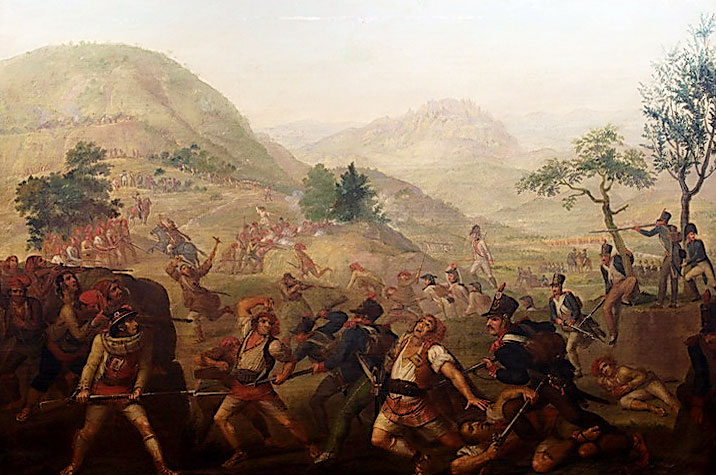
From the Annals of War Crimes –  In 1862, the Battle of the Nueces took place in Kinney County.  A force of mostly German immigrant Unionists from the Hill Country led by Fritz Tegener were attempting to escape to Mexico and then onto Union controlled New Orleans.   They were camped on the west bank of the Nueces River about twenty miles from Fort Clark when they were attacked by mounted Confederate soldiers. The Unionists had camped without choosing a defensive position or posting a strong guard. The Confederates, led by Lt. C. D. McRae, came upon the camp on the afternoon of August 9. Firing began an hour before sunlight the next morning; nineteen of the sixty-odd Unionists were killed, and nine were wounded. The nine wounded were executed a few hours after the battle. Two Confederates were killed and eighteen wounded, including McRae.  McRae only had authority to arrest the civilians for avoiding service in the Confederate Army, but instead he chose to massacre sleeping civilians and then allowed the execution of unarmed wounded men.   Question for the supporters of the so-called “noble cause” – Was it noble to execute wounded prisoners?

Print of the Nueces Massacre from lifeofthecivilwar.blogspot.com.

Today in Texas History – August 6

From the Annals of Anglo-American Relations – In 1842, Charles Elliot arrived in Galveston as the newly appointed British charge d’affaires to the Republic of Texas.  Elliot, a British knight and retired naval officer, was a veteran of the Colonial Service previously serving in Guiana and China. In 1842 he was reassigned to hardly desirable duties in the Republic of Texas.  But Elliot made the best of the situation.  While in  Texas he worked for the abolition of slavery, free trade and peace with Mexico. He was friends with Sam Houston and Anson Jones, and worked with the British ambassador to Mexico for an armistice between Texas and Mexico in 1843. He was instrumental in negotiating the release of prisoners from the ill-fated Mier expedition. He opposed Texas annexation by the United States.  When Texans voted for annexation he was recalled.