Category Archives: Today in Texas History

From the Annals of the Republic –  In 1839, the last mention of the steamship Cayuga was recorded and the notable vessel passed from history.  The Cayuga, an eighty-eight-ton side-wheeler built in 1832, had been the first commercially successful steamboat in Texas and was critical to the Texian war effort during the Revolution.  She carried army supplies, messages, and transported government officials and refugees. Most curiously, she was the floating capitol of Texas.  Pres. David G. Burnett impressed her for public service.  When the government was forced to evacuate Harrisburg ahead of Santa Anna’s army, Burnet and his cabinet used the steamer as their temporary capitol for about a week.

After the revolution ended, the vessel was sold at auction on December 15, 1836 at Lynch’s Ferry. The new owners refitted the vessel and renamed her the Branch T. Archer. The last mention of the  former Cayuga was a Liberty County sheriff’s sale on this date in 1839, advertising the sale of the historic vessel.

Today in Texas History – September 2

From the Annals of World War II – In 1945, Fleet Admiral Chester Nimitz signed the Instrument of Surrender with Japan that ended World War II. Nimitz, who was from Fredericksburg, was named commander in chief of the Pacific Fleet shortly after Japan’s 1941 attack on Pearl Harbor and ultimately had command over all of the Pacific Theater with the exception of Gen. Douglas MacArthur’s Southwest Pacific sector.  Nimitz was responsible for implementing the offensive that eventually brought the Japanese to unconditional surrender. Nimitz and the representatives of Emperor Hirohito (who did not later commit seppuku) signed the peace treaty aboard the battleship USS Missouri in Tokyo Bay.

In 1964, Fredericksburg initiated a plan to honor its most famous son.  A  local group established the Fleet Admiral Chester W. Nimitz Memorial Naval Museum in the old Nimitz Hotel on Main Street in Fredericksburg. From this humble beginning arose the excellent National Museum of the Pacific War.  If you have not been there, you need to go.

Today in Texas History – September 1

From the Annals of the Civil War –  In 1863,  Major Santos Benavides led 79 men in the Thirty-third Texas Cavalry across the Rio Grande in pursuit of the bandit Octaviano Zapata.  Zapata had been an associate of Juan Cortina.  During the Civil War he was recruited by Union forces to aid them in military action in south Texas seeking to prevent the Confederacy from exporting cotton to Matamoros.  Zapata’s raids also kept Rebel forces occupied in Texas.  Zapata’s force often flew the American flag during their raids – leading Texans to refer to the group as the “First Regiment of Union Troops.” The Cavalry caught up to Zapata near Mier, Tamaulipas the following day.  The confrontation ended with Zapata and 9 others were dead.  The remnants of the bandit gang dispersed.

Photo of Santos Benavides from http://www.forttours.com

Today in Texas History – August 31

From the Annals of Murder –  In 1934, Hutchinson County Treasurer Arthur Huey killed Asa (Ace) Borger in the town that was named after him. Huey was angry after the failure of the Borger State Bank and after Borger failed to post bail when Huey was arrested for embezzlement. Huey pled self-defense, claiming that Borger was after him.  He was acquitted but failed to stay out of trouble.  In 1937, Huey was convicted for theft of county funds and sentenced to the State Pen.  Until his tragic end, Borger had been a relatively successful businessman.   As young man, he had promoted several boomtowns in Oklahoma.  His greatest success came in 1926 when he purchased 240 acres in the Panhandle and organized the Borger Townsite Company. The company began selling lots and grossed between $60,000 and $100,000 on the first day. Later that year,  Borger sold out completely netting more than a million dollars. His house in Borger is a Texas historical landmark.

Photo of Borger in 1927 from http://www.legendsofamerica.com

Today in Texas History – August 28

From the Annals of Nueva Espana –  In 1767, Hugo Oconór was appointed as governor ad interim of the Spanish province of Texas.  Oconor, who was of Irish descent, had flaming red hair and was called the “Red Captain” by the Native Americans.  He was inspector general of the Provincias Internas in 1765, when he traveled to Texas to investigate trouble between Governor Ángel de Martos y Navarrete and Rafael Martinez Pacheco  concerning San Agustín de Ahumada Presidio. With the removal of Martos y Navarrete on August 28, 1767, Oconór became governor ad interim of Texas.  The province was troubled by attacks from numerous Native American tribes. In particular, the Apaches were regularly raiding San Antonio de Bexar. Oconór reinforced San Antonio and was so generally highly regarded for his leadership that his return to Mexico in 1770 was greatly lamented by the soldiers and citizens of the province.

Painting of Don Hugo Oconor from the Joel D. Valdez Library, Pima County, Tuscon, Arizona

Today in Texas History – August 27

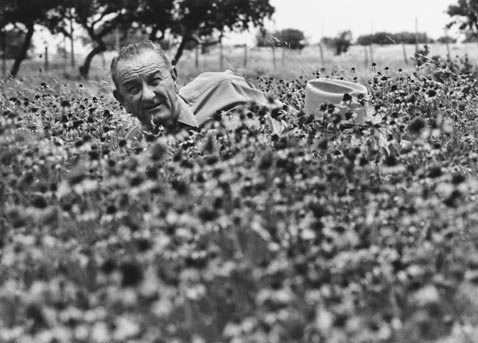
From the Annals of Texas Presidents –  In 1908, Lyndon Baines Johnson (LBJ) was born at his family’s home near Stonewall.   He was the first truly Texas son to become President.  Dwight Eisenhower was born in Denison but otherwise had little connection to the state.  LBJ rose to power representing Texas in the House of Representative and Senate.  But, he probably never would have become President but for the assassination of John F. Kennedy in Dallas in 1963.  LBJ’s legacy of tremendous accomplishment in civil rights and attempts to eliminate poverty were overwhelmed by the Vietnam War.

Today in Texas History – August 26

From the Annals of Police Thuggery –  In 1870, one of the more violent episodes in the infamous Sutton-Taylor Feud occurred.  The STF was one of the longest bloodiest feuds in early Texas.  The feud allegedly arose from disputes following the Civil War. Josiah Taylor was a Virginian who settled near Cuero in DeWitt County. His sons, Pitkin and Creed Taylor and their sons, nephews, in-laws, and friends were the mainstay of that faction. William E. Sutton was a native of Fayette County who had moved to DeWitt County.  Many of the Sutton group were associated with the State Police.  There appears to be no evidence to support the claim that the STF began in another state and was carried forward to Texas.  The tortured path of the STF is hard to follow, but it apparently began in  1866, when Buck Taylor shot a black sergeant who came to a dance at Taylor’s uncle’s home, and Hays Taylor killed a black soldier in an Indianola saloon.  The violent Taylor saga continued when  brothers Hays and Doby Taylor killed two Union soldiers at Mason in November 1867 and then escaped to Karnes County.  In March 1868, Deputy Sheriff William Sutton led a posse in pursuit of a gang of horse thieves. When the gang was caught in Bastrop, Charley Taylor was killed and James Sharp was taken prisoner and then shot while “trying to escape.”

The Taylors claim that the STF began with the killing of Buck Taylor and Dick Chisholm at Clinton on Christmas Eve in 1868.  Buck apparently claimed Sutton had been dishonest in some horse dealing and a gun fight erupted.  Ultimately, the STF devolved into a running battle between the Taylors and  party and  the State Police under Edmund J. Davis and orchestrated largely by Capt. Jack Helm.  The State Police were involved in the killing of several members of the Taylor clan.  One of the worst episodes was the assassination by the State Police of Henry and William Kelly, sons-in-law of Pitkin Taylor, on August 26, 1870. The Kellys were arrested on a trivial charge, taken a few miles from home and shot.  Helm was dismissed after the shooting, but continued to serve as sheriff of Karnes County.   Sutton then became the de facto leader of the group.  Helm had the distinction of later being killed by John Wesley Hardin in Wilson County.

Today in Texas History – August 25

From the Annals of the “Great” War –  In 1917, the 90th Division of the U.S. Army was activated at Camp Travis in San Antonio.  The division was initially formed from Texas and Oklahoma.   Known as the “Tough Ombres,” “Texas’ Own,” or the Alamo Division, it adopted the monogram insignia T-O in France during World War I. The division was posted in France in 1918 and saw action in Lorraine and in the St. Mihiel and Meuse-Argonne operations.  The 90th suffered 7549 casualties with a total of 1091 killed in action and 6458 wounded.  After the Armistice the Ninetieth did occupation duty in Germany and came home in 1919 for demobilization.   Red’s grandfather served as Lieutenant in the 90th in WWI.

Photo of 2nd Battalion, 358th Infantry, 90th Division.

Today in Texas History – August 24

From the Annals of Independence –  In 1821, the long Mexican fight for independence from Spain came to an end with the signing of the Treaty of Cordoba.   The treaty was signed by Juan O’Donoju, Captain General of New Spain and  met Agustín de Iturbide, General of the Mexican Army of the Three Guarantees.  The war had begun on September 16, 1810 when Father Miguel Hidalgo y Costilla issued the famous “El Grito” from the steps of his parish church in Dolores, a small town east of Guanajuato.  Spain’s attempt to control Mexico was doomed after former royalist Iturbide came to terms with independence leader Vicente Guerrero in 1820.   After 10 years of turmoil and incredible bloodshed from mostly local revolts and guerrilla actions, the unification of the factions effectively ended Spanish control.  At the time of the treaty, Spain only controlled Mexico City and Veracruz and the end of colonial rule was inevitable.

Today in Texas History – August 21

From the Annals of Heroism –  In 1968, Staff Sgt. Marvin Young was killed in action near Ben Cui, Vietnam.  Young was a native of Alpine who enlisted in the army in 1966. He was leading a patrol of Company C, Fifth Infantry, Twenty-fifth Infantry Division when they were attacked by a large force of North Vietnamese. When the squad leader was killed, Young assumed command and repeatedly exposed himself to enemy fire, while encouraging his men.  He ignored orders to pull back and remained behind to assist several of his men who were unable to withdraw.  Even after being wounded, he refused assistance and stayed to cover the withdrawal of other troops.  He was posthumously awarded the Congressional Medal of Honor.

Photo from http://www.vvmf.org