Tag Archives: Texas History

Today in Texas History – June 5

From the Annals of Banditry –  In 1880, the “Bandit Queen” married her second or possibly third husband.  The Queen was Myra Maybelle (Belle) Shirley Reed Starr and she marred outlaw Sam Starr in the Cherokee Nation.  Starr was from Missouri and her family had been involved with notorious Confederate irregulars including William Quantrill.  By the end of the Civil War, the family fled Missouri and moved to Scyene near Dallas. Their home became a hideout for bandits including the Younger and James brothers – veterans of Quantrill’s cutthroats.  Continuing a family legacy of criminal behavior, Belle’s first husband, Jim Reed rode with the Younger, James, and Starr gangs on their murderous rampage throughout Texas, Arkansas, and the Indian Territory. Reed was killed in Paris  by a deputy sheriff.  After that,  Belle may have married Bruce Younger.  In any event, she did later marry another outlaw in Sam Starr.   Belle and  were later convicted of horse theft and Belle received two six-month prison terms.   Unable to stay out of trouble, Sam Starr was later killed in a fight with an Indian policeman.  Belle Starr subsequently took several lovers, including Jim July (or Jim Starr), Blue Duck, Jack Spaniard, and Jim French.  In 1889, while Starr was living in the Choctaw Nation, Starr met her end when she was ambushed and killed.
 

Today in Texas History

Back after a considerable hiatus!

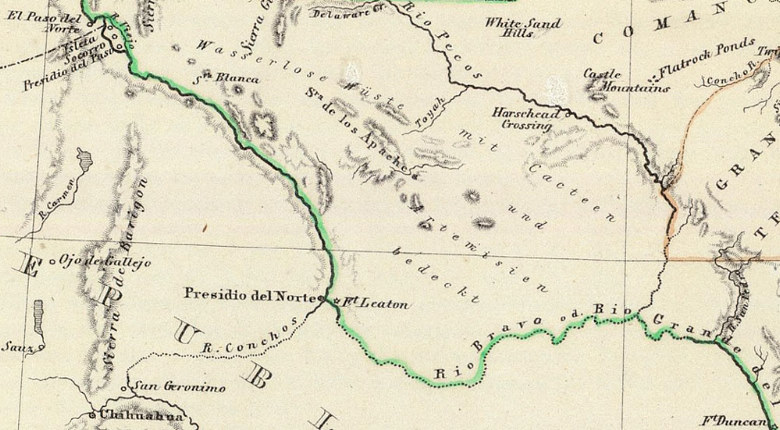
Image result for maps of route to el paso from 1800s

From the Annals of the Roads West – In 1849, Maj. Robert S. Neighbors returned to San Antonio after completing an expedition to survey a northern route to El Paso.   The expedition was aimed at creating a usable wagon road to west Texas.  The expedition left Torrey’s Trading Post near Waco on March 23, 1849, crossed the Colorado River on April 2, and crossed the Pecos at Horsehead Crossing on April 17.  The expedition reache El Paso on May 2 after determining that the last 100 miles of its trek was not practicable for wagon traffic.  On the return,  Neighbors took the northern route previously used by the Mexican army between El Paso and the Pecos River.  His report included that route.  If you are driving I-10 west to El Paso you are fairly much following the route that Neighbors surveyed.


Today in Texas History – April 3

From the Annals of Voting Rights  –  In 1944, the U.S. Supreme Court issued its opinion in Smith v. Allwright.   The Court held that the Democratic Party’s “white primary” system was unconstitutional.  The case started when African-American dentist Lonnie E. Smith attempted to vote in the Democratic primary in his Harris County precinct.   Under the “white primary” system, Smith was denied a ballot.   In the 1940’s, winning the Democratic primary was tantamount to election in all but rate cases.  If you could not vote in the primary, essentially you could not vote at all.   Smith fought back with the assistance of attorneys supplied by the National Association for the Advancement of Colored People (including future U.S. Supreme Court justice Thurgood Marshall).  Smith filed suit in the U.S.  District Court for the Southern District of Texas in 1942 arguing that he had been wrongfully denied his right to vote under the Fourteenth, Fifteenth, and Seventeenth amendments by the precinct election judge, S. E. Allwright.  He lost at the district court, but appealed all the way to the Supreme Court which in an 8-1 decision ruled in his favor.  Discrimination continued in the form of “poll taxes” and other tactics employed to suppress minority voting, but tThe Smith decision did end the white primary in Texas. The number of African Americans registered to vote in Texas increased from 30,000 in 1940 to 100,000 in 1947.

Today in Texas History – March 29

From the Annals of Spanish Texas – In 1813, the Battle of Rosillo Creek was fought near present day  San Antonio. The fight was between the Republican Army of the North led by José Bernardo Gutiérrez de Lara and Samuel Kemper and a Spanish royalist force under Texas governor Manuel María de Salcedo and Nuevo León governor Simón de Herrera.  The battle was for control of the far northern province and the Republicans were seeking a break from New Spain and an independent republic in Texas.   The battle involved remarkably large numbers as the Republican army was comprised of between 600 to 900 men and the Royalist forces may have numbered as much as 1500 men.  The Republicans were advancing along the road from La Bahía to San Antonio when they were engaged by the Royalists.   The Republicans inflicted heavy losses on the Royalists in the one-hour battle.   The Royalists lost somewhere between 100 and 300 men as wells most of their arms and ammunition, six cannons, and 1,500 horses and mules. The republicans lost only six men. The battle of Rosillo resulted in the capture of San Antonio and the establishment of a first “Republic of Texas.”  The Republic was short-lived as the Republican forces were soundly defeated five months later at the Battle of Medina.

Today in Texas History – March 24

From the Annals of Coahuila y Tejas – In 1825, the Mexican Congreso General  passed the State Colonization Law of March 24, 1825. The act was intended to foster migration (particularly from the United States) to the largely uninhabited  parts of the state of  Coahuila y Tejas.  The act had provisions that attracted land-hungry Anglo settlers.   They  could obtain a square league (approx. 4430 acres) of range land and a labor (177 acres) of farmland for a small price.  The act also provided tax relief for a period of time.  Immigrants had to swear allegiance to the federal and state constitutions, adopt the Catholic faith and display sound moral principles and good conduct.  Person who accepted the terms would be naturalized as Mexican citizens.  It was under this act that  Empresarios Stephen F. Austin, Green DeWitt and others began Anglo colonization of Texas.

Today in Texas History – March 10

From the Annals of Medicine  –  In 1890, the John Sealy Training School for Nurses opened with eighteen students.  The first formal training program for nurses was housed in Galveston’s brand new John Sealy Hospital. The school was initially independent of the hospital, but was incorporated into the University of Texas Medical Branch in 1896.

Today in Texas History – March 8

From the Annals of the War Slogans –  In 1836, Col. James W. Fannin raised a flag over the La Bahia mission at Goliad with the words “Liberty or Death”.   Fannin and his followers got death at the hands of Gen. Antonio Lopez de Santa Anna and against the express wishes of Gen. Jose de Urrea who pleaded for clemency and was outraged at the massacre.  Some Texans ultimately got Liberty.  Others remained slaves as one major focus of the Revolution was to protect the institution of slavery in Texas.

Today in Texas History – March 3

From the Annals of the Forgotten War – In 1899, the U.S. Congress authorized the formation of the Thirty-Third Infantry Regiment which came to be known as the “Texas Regiment.”  The 33rd was formed for combat to serve in the Philippine-American War (also known somewhat pejoratively as the “Philippine Insurrection”) – a conflict that is sometimes referred to as “America’s Forgotten War.” The PAW was a conflict between the First Philippine Republic and the U.S. that was essentially a continuation of the war for Philippine independence that had begun in 1896 against Spain.  The U.S. came into possession of the Philippines as a result of the Spanish-American War.  At the conclusion of the SAW, the nascent Philippine republic was dissatisfied with the terms of the Treaty of Paris which officially transferred possession to the U.S. and declared war on the U.S. on June 2, 1899.   The PAW was especially brutal and resulted in the deaths of between 200,000 and 250,000 civilians as well as the disestablishment of the Catholic Church as the state religion and the imposition of English as the official language of government, education and commerce.

The 33rd regiment was organized at Fort Sam Houston.  Approximately one-third of the officers and enlisted men were from Texas.  The 33rd served in the Philippines from October 27, 1899, until March 2, 1901 and was in action at the battles of Magnataram, Tirad Pass, Vigan, and Taguidin Pass.  Some of the soldiers chose to remain in the Philippines to serve with the Philippine Constabulary which continued to fight pockets of resistance until the final defeat at the Battle of Bud Bagsak in June of 1913.

Manila after U.S. shelling.

Today in Texas History – February 27


From the Annals of the Secessionists –  In 1850, Carlos Esparza and others first attempted to establish a territorial government and separate the Territory of the Rio Grande from the rest of Texas.  The secession movement was intended to protect the interests of Hispanics who were widely discriminated against despite their role in securing Texas independence.  The movement never went anywhere and was eventually dropped. Esparza was a Mexican-born follower of Juan Cortina and wealthy rancher.  He seemed an unlikely proponent of the Hispanic cause, but Esparza worked mostly behind the scenes in advance of Cortina’s goals.

During the Civil War he worked with both Union and Confederate forces  while promoting the Cortinista cause. In 1873 Esparza was appointed as an inspector of hides and animals for Cameron County and apparently used that position to aid Cortina in avoiding capture.  After Cortina was arrested in 1875, however, Esparza retreated to his ranch, avoided further political causes and was seldom seen thereafter.

Today in Texas History – February 23

From the Annals of Bad Decisions –  In 1861, Texas citizens (meaning white, property-owning men) voted on the Texas Ordinance of Secession. The vote was overwhelmingly for secession from the Union with 46,153 voting for secession and only 14,747 against. Of the 122 counties casting votes, only eighteen cast majorities against secession. Only eleven other counties had votes of as much as 40 percent against.  For those who claim the Civil War was not about slavery, please take a look at the vile racist screed that is the Texas Ordinance of Secession.