Category Archives: Today in Texas History

Today in Texas History – June 6

From the Annals of the Fair –  In 1936, the Central Centennial Exposition opened on the site of Fair Park east of downtown Dallas.  The remarkably quick project had started construction  in October 1935.  Architect George L. Dahl designed 50 buildings in an Art Deco style.  The CCE was the first world’s fair held in the Southwest.  The most popular attraction was the “Cavalcade of Texas,” a historical play depicting four centuries of Texas history.  Another feature, ” The Hall of Negro Life”,  was the first such exhibit (however racist) to feature black culture at a world’s fair.   The CCE ran through November 29 with official attendance of 6,345,385.  Many of the exposition buildings, including the Hall of State, were preserved and Fair Park touts itself as the only World’s Fair site predating 1950 that is still standing.   Fair Park is now the site of the annual State Fair of Texas.

Historical Footnote:  The CCE was used as the backdrop for The Big Show a modern-day western featuring Gene Autry.   Autry played movie star Tom Ford as well as his stunt double.  The movie also features sidekick Smiley Burnette and the Sons of the Pioneers (including future star and Red’s boyhood hero Roy Rogers).  Autry appears in the Cavalcade of Texas in one scene – singing to his horse Champion.  TBS is worth watching if only to see what the CCE actually looked like during its run.   The movie was filmed during the last two weeks of September in 1936.


Today in Texas History – June 5

From the Annals of Banditry –  In 1880, the “Bandit Queen” married her second or possibly third husband.  The Queen was Myra Maybelle (Belle) Shirley Reed Starr and she marred outlaw Sam Starr in the Cherokee Nation.  Starr was from Missouri and her family had been involved with notorious Confederate irregulars including William Quantrill.  By the end of the Civil War, the family fled Missouri and moved to Scyene near Dallas. Their home became a hideout for bandits including the Younger and James brothers – veterans of Quantrill’s cutthroats.  Continuing a family legacy of criminal behavior, Belle’s first husband, Jim Reed rode with the Younger, James, and Starr gangs on their murderous rampage throughout Texas, Arkansas, and the Indian Territory. Reed was killed in Paris  by a deputy sheriff.  After that,  Belle may have married Bruce Younger.  In any event, she did later marry another outlaw in Sam Starr.   Belle and  were later convicted of horse theft and Belle received two six-month prison terms.   Unable to stay out of trouble, Sam Starr was later killed in a fight with an Indian policeman.  Belle Starr subsequently took several lovers, including Jim July (or Jim Starr), Blue Duck, Jack Spaniard, and Jim French.  In 1889, while Starr was living in the Choctaw Nation, Starr met her end when she was ambushed and killed.


Today in Texas History

Back after a considerable hiatus!

Image result for maps of route to el paso from 1800s

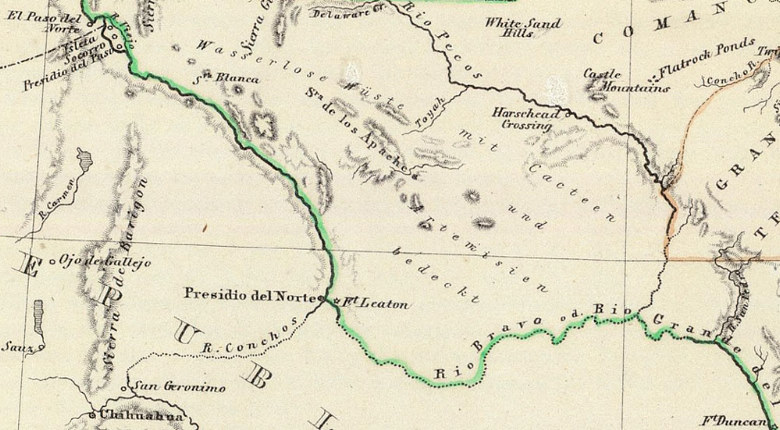
From the Annals of the Roads West – In 1849, Maj. Robert S. Neighbors returned to San Antonio after completing an expedition to survey a northern route to El Paso.   The expedition was aimed at creating a usable wagon road to west Texas.  The expedition left Torrey’s Trading Post near Waco on March 23, 1849, crossed the Colorado River on April 2, and crossed the Pecos at Horsehead Crossing on April 17.  The expedition reache El Paso on May 2 after determining that the last 100 miles of its trek was not practicable for wagon traffic.  On the return,  Neighbors took the northern route previously used by the Mexican army between El Paso and the Pecos River.  His report included that route.  If you are driving I-10 west to El Paso you are fairly much following the route that Neighbors surveyed.


Today in Texas History – May 4

From the Annals of Rome – In 1847, Pope Pius IX established the Catholic Diocese of Galveston.   Jean Marie Odin was called to be the new diocese’s first bishop. The Diocese  covered a huge area which included all of Texas and parts of Oklahoma, New Mexico, Kansas, Colorado, and Wyoming. Odin and twelve priests served the approximately  20,000 Catholics in the Diocese which included only ten established churches and a convent of Ursuline Sisters in San Antonio. The Diocese of Galveston underwent the first of many divisions in 1874, when the Diocese of San Antonio and the Vicariate Apostolic of Brownsville were established. The Diocese of Galveston is now known as the Diocese of Galveston-Houston.

Today in Texas History – April 19

From the Annals of the War Chiefs –  In 1875, Kiowa chief Tsen-tainte (“White Horse”) surrendered at Fort Sill. White Horse and his followers were notorious for their numerous raids across Texas, Oklahoma and New Mexico.  He was considered to be the fiercest of the Kiowa chiefs.  Along with Satank, Satanta, Zepko-ete, Mamanti and Big Tree participated in the Warren Wagon Train raid at Salt Creek Prairie in May 1871.  He also fought in the second battle of Adobe Walls in June 1874.  After that he fought with Quanah Parker and Guipago in the Red River War.  After the battle of Palo Duro Canyon in September 1874, he became convinced that further resistance was futile. When Gen. Philip Sheridan demanded that Chief Kicking Bird designate men for imprisonment in the east, White Horse was chosen.  Along with other he was imprisoned at St. Augustine, Florida. He became a practitioner of Ledger Art while in prison.  He was released in 1878 and returned to the reservation near Fort Sill.

Today in Texas History – April 7

From the Annals of the Halls of Congress –  In 1913, Sam Rayburn of Windom took the oath of office as a member of the United States House of Representatives.  Mr. Sam, as he was known, was to serve in Congress from the presidency of Woodrow Wilson until that of John F. Kennedy.  Rayburn  rose to majority leader in 1937 and was elected Speaker of the House in 1940.  He remained Speaker until his death in 1961.  Rayburn was a master politician who helped negotiate the Roosevelt-Garner ticket in 1932 backing his friend John Nance Garner for Vice-President.  He worked tirelessly to pass New Deal legislation and as chairman of the Interstate and Foreign Commerce Committee in the 1930s he oversaw legislation that established the Securities and Exchange Commission and the Federal Communications Commission.   He worked closely with Senate majority leader Lyndon B. Johnson in the 1950s and Texas benefitted greatly from have the two pillars of power working in D.C.  Rayburn was married only briefly and said that his greatest regret was not have a tow-haired son to take fishing.  The Sam Rayburn Reservoir and several schools in East Texas are name after Mr. Sam.  He was the longest serving Speaker in U.S. history.

Today in Texas History – April 6

From the Annals of the Artists –  In 1911,  friends of sculptor Elisabet Ney founded the Texas Fine Arts Association and the Elisabet Ney Museum to honor the late artist. Ney had immigrated to Texas in 1872 and was one of the first professional sculptors in the state. In 1892, Ney built her impressive house and studio, Formosa,  in the Hyde Park area of Austin.  Ney is famous for creating the sculptures of Stephen F. Austin and Sam Houston on display at the Capitol and the tomb of Confederate Gen. Albert Sydney Johnston at the Texas State Cemetery.  After her death in  1907, her friends Bride Neill Taylor, Julia Pease, Emma Cherry, and Emma Kyle Burleson decided to use Formosa as a the annual meeting place for the new association and as a gallery for its exhibitions.  In 1941 the city of Austin assumed ownership of the Elizabeth Ney Museum.  It remains a popular tourist destination to this day.

Today in Texas History – April 3

From the Annals of Voting Rights  –  In 1944, the U.S. Supreme Court issued its opinion in Smith v. Allwright.   The Court held that the Democratic Party’s “white primary” system was unconstitutional.  The case started when African-American dentist Lonnie E. Smith attempted to vote in the Democratic primary in his Harris County precinct.   Under the “white primary” system, Smith was denied a ballot.   In the 1940’s, winning the Democratic primary was tantamount to election in all but rate cases.  If you could not vote in the primary, essentially you could not vote at all.   Smith fought back with the assistance of attorneys supplied by the National Association for the Advancement of Colored People (including future U.S. Supreme Court justice Thurgood Marshall).  Smith filed suit in the U.S.  District Court for the Southern District of Texas in 1942 arguing that he had been wrongfully denied his right to vote under the Fourteenth, Fifteenth, and Seventeenth amendments by the precinct election judge, S. E. Allwright.  He lost at the district court, but appealed all the way to the Supreme Court which in an 8-1 decision ruled in his favor.  Discrimination continued in the form of “poll taxes” and other tactics employed to suppress minority voting, but tThe Smith decision did end the white primary in Texas. The number of African Americans registered to vote in Texas increased from 30,000 in 1940 to 100,000 in 1947.

Today in Texas History – March 29

From the Annals of Spanish Texas – In 1813, the Battle of Rosillo Creek was fought near present day  San Antonio. The fight was between the Republican Army of the North led by José Bernardo Gutiérrez de Lara and Samuel Kemper and a Spanish royalist force under Texas governor Manuel María de Salcedo and Nuevo León governor Simón de Herrera.  The battle was for control of the far northern province and the Republicans were seeking a break from New Spain and an independent republic in Texas.   The battle involved remarkably large numbers as the Republican army was comprised of between 600 to 900 men and the Royalist forces may have numbered as much as 1500 men.  The Republicans were advancing along the road from La Bahía to San Antonio when they were engaged by the Royalists.   The Republicans inflicted heavy losses on the Royalists in the one-hour battle.   The Royalists lost somewhere between 100 and 300 men as wells most of their arms and ammunition, six cannons, and 1,500 horses and mules. The republicans lost only six men. The battle of Rosillo resulted in the capture of San Antonio and the establishment of a first “Republic of Texas.”  The Republic was short-lived as the Republican forces were soundly defeated five months later at the Battle of Medina.

Today in Texas History – March 28

From the Annals of the Army (sort of) –  In 1958, recently drafted rock and roll star Elvis Presley arrived at Fort Hood for basic training.  He remained stationed at Fort Hood for six months.   Presley, along with his manager and illegal alien Col. Tom Parker, made the decision that Elvis would serve as a regular soldier and not as an entertainer in Special Services.  Parker did not want Presley performing for free and both decided it would be good for image to not receive special treatment.   At Fort Hood, Presley was assigned to Company A of the Third Armored Division’s 1st Medium Tank Battalion and completed basic training by June. He was a pistol sharpshooter, and apparently liked the  “rough and tumble” of the tanks obstacle course.  He was homesick and did not like the training and was constantly worried about his career.

After a short break to record new material in June, Presley returned to Fort Hood to finish his tank training.  Soldiers were allowed to live off-post with family, so Elvis rented a house where he lived with his mother, father, grandmother, and friend Lamar Fike.   This cheered up the star, but in early August, his mother Gladys began to succumb to her alcoholism and use of diet pills. One afternoon, after a heated argument with her husband Vernon, Gladys collapsed from exhaustion. Presley arranged for her and Vernon to return to Memphis by train on August 8. She died in Memphis on August 14.  Elvis was granted emergency leave and was in Memphis when she passed.  He returned to Fort Hood about a week later and shipped out for duty in Germany in mid-September.