Tag Archives: Texas History

Today in Texas History – May 6

From the Annals of Hamburgers –   In 1999, Whataburger opened “Whataburger by the Bay” in Corpus Christi.  The restaurant is a tribute to founder Harmon Dobson featuring  – not surprisingly – views of Corpus Christi Bay and and a life-size bronze statue of Dobson by the entrance.  Dobson began in 1950 with a humble stand located on Ayers Street in Corpus Christi.  Dobson was killed in a plane crash in 1967 but his family continued the business.  Whataburger now has more than 700 locations from Arizona to Florida.  Red still remembers the first time his Dad took him to a Whataburger in Victoria. Dad had long talked about what a great hamburger they served and Red was pleased to confirm those reports for himself.

Today in Texas History – May 5

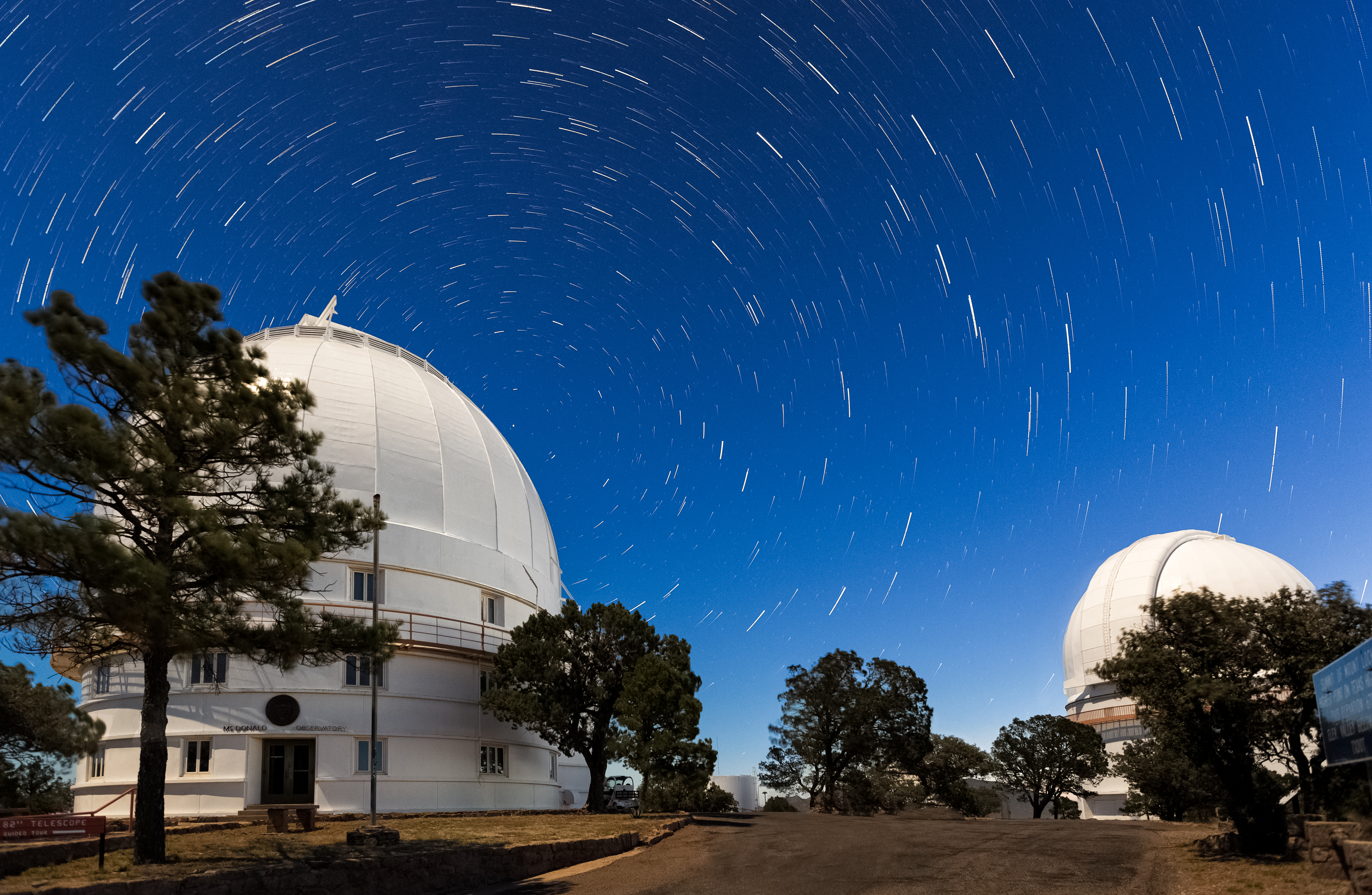
domes with star trails

From the Annals of the Skywatchers – In 1939, the Otto Struve telescope at the  McDonald Observatory was dedicated.  The Struve Telescope was the first major telescope to be built at McDonald Observatory. Its 2.1-meter (82-inch) mirror was the second largest in the world at the time. The telescope is still in use today. The popular observatory is located on Mount Locke  and Mount Fowlkes in the Davis Mountains and is a unit of The University of Texas at Austin featuring astronomical research, teaching, and public education and outreach.   The Davis Mountains offer some of the darkest night skies in the continental United States.

The Texas Flag Pledge

Don Munsch of the Killeen Daily Herald wonders about the increasing use of the Pledge to the Texas Flag at official meetings and in courtrooms across the State.  The pledge itself reads:

Honor the Texas flag; I pledge allegiance to thee, Texas, one state under God, one and indivisible.

Putting aside the somewhat redundant nature of the language (Texas being one state and also one and indivisible), and the possible First Amendment violation involved in requiring anyone to pledge that Texas is a state under God, the once obscure pledge is now in common use by certain governmental bodies in addition to the Pledge of Allegiance – which Munsch points out necessarily includes Texas by reference to the fifty-starred flag.

The Herald asked city and school officials about the practice.

“The best answer we can offer as to why we do it is that it is simply a show of respect to our state’s flag,” said Kevin Keller, public information officer for the city of Copperas Cove.

In a statement from the Killeen Independent School District, district spokesman Shannon Rideout said the KISD school board follows the policies written in the Texas Education Code, which states that school boards of each district should require students to recite pledges to both flags — American and Texas — in accordance with applicable government code.

The board just abides by the standards set in the code, by which students are held to, as well.

“I moved from Georgia to Harker Heights in January of 2004 and the pledge to the Texas flag was something being done at that time,” said Harker Heights City Manager David Mitchell. “As far as when that started, I could not tell you. I asked around the office and no one can remember when the city began to include the pledge to the Texas flag.”

Today in Texas History – April 27

From the Annals of Heat –  In 1983, Nolan Ryan playing for the Houston Astros set a new major league record with after recording strike-out number 3509 against Brad Mills of the Montreal Expos.  Ryan broke a 55-year-old major league baseball record with the K.  Ryan would go on to strike out a total of 5714 batters in his remarkable career and record a MLB record seven no-hitters.   Less noted is the fact that he also is the all-time leader in bases on balls – but that is the price of longevity.  Ryan is the only player to have his number retired by three different ball clubs – the Angels, Astros and Rangers.  Among the stranger records he holds is his claim to have been the only pitcher in MLB history to have struck out seven pairs of fathers and sons.   He was inducted into the Baseball Hall of Fame in Cooperstown in 1999.  Sadly, he is depicted wearing a Texas Rangers cap on his hall of fame plaque.

Today in Texas History – April 26

From the Annals of the Early “Bloggers” –  In 1874, the first of a series of twenty-three letters and poems authored by “Pidge” was published in the Austin Statesman.  The actual author was Thomas C. Robinson. Robinson had come to Austin in 1874 following a feud with a neighbor in his native Virginia.  He enlisted in the Texas Rangers and served under Leander H. McNelly during the Sutton-Taylor feud.  He was also involved the continuing conflicts with Juan N. Cortina’s raiders.  Robinson’s works describe Austin in the 1870s, but more importantly provide one of the few insights into what service was like in the Texas Rangers from observations in the field.  Unfortunately, Robinson returned to Virginia on leave to settle the feud with his former neighbor and was killed in a gunfight on April 4, 1876, shortly after the last “Pidge” letter was published.

Fire Guts Cleburne Cafeteria

The greatest cafeteria in Texas was destroyed Monday night when a blaze consumed the Cleburne Cafeteria on Bissonnet Street.  The Houston landmark was almost entirely gutted by the blaze.  The CC was celebrating its 75th anniversary this year.  The CC had been rebuilt after a fire destroyed the previous structure in 1990.  The CC – notorious for accepting only cash and checks – has been run by the Mickelis family since its inception and the walls were decorated with the art work of founder Nick Mickelis.  George Mickelis, son of the founder, was distraught over the loss of his father’s artwork – much more than the loss of the cafeteria itself.  But it appears that a few of the paintings may have survived the blaze.  The loss will be felt throughout the community and especially among its loyal patrons who packed the restaurant at lunch and on Sunday afternoons.  Mickelis vows to rebuild again.  Red will be back for the grand re-opening.

Photo from KPRC. 

Today in Texas History – April 21


From the Annals of the Revolution  – In 1836, Texian forces under the command of Gen. Sam Houston defeated part of the Mexican Army encamped at San Jacinto under the command of Gen. Antonio Lopez de Santa Anna.  Santa Anna overextended his troops by crossing the San Jacinto River without his full field artillery and isolating his unit from the larger commands of General Filosola and Urea.  Houston would likely not have attacked but for learning that Santa Anna had divided his army and only had about 1200 troops at San Jacinto.  It was as close to a chance at an even fight as Houston would ever have.  Convinced that the Texians would not attack even though they were less than a mile away, Santa Anna incredibly failed to take necessary precautions and the Mexicans were routed in a surprise attack that lasted only about 18 minutes.  Had Santa Anna attacked the Texians in battle formation, they likely would have been routed and the idea of an independent Texas would have been dead for years to come.  Santa Anna was captured after the battle.  Houston realized that his chances of defeating the rest of the Mexican Army were not good and that Santa Anna was his best bargaining chip.  He resisted calls to execute “El Presidente” and to save his life, Santa Anna ordered the remainder of the still overwhelming Mexican forces in Texas to return to Mexico.  If Urea and Filosola had refused to obey the order they likely would have been Mexican heroes for generations and Texas independence would have been problematic at best.  But the generals grudgingly complied and withdrew.

Today in Texas History – April 19

From the Annals of the Traveling Capital –  In 1837, Houston became the capital of Texas  two months before the community was actually incorporated as a city. The former Harrisburg had been founded by the Allen brothers only a year before and named after Gen. Sam Houston -hero of the Battle of San Jacinto. The capital remained on Buffalo Bayou until January of 1839 when Austin was approved as the new capital.

Photo of the building that served as the Capitol from mysanantonio.com.

Today in Texas History – April 18

From the Annals of the Tejanos – In 1842, Juan Seguín resigned as Mayor of San Antonio due to threats on his life.   He was falsely accused of aiding the Mexican army and discrimination against Texans of Mexican origin – even those who served in the revolution –  became too oppressive.  He fled to Mexico to “seek refuge amongst my enemies,” where he was captured, arrested and coerced to enlist in the Mexican army as a staff officer. He returned to San Antonio with the opposition army of Adrian Woll  in September 1842 and in a cruel twist of fate later served under Santa Anna in the Mexican-American War of 1846–1848.

In February 1848, Seguín requested permission to return to Texas and eventually  established a home adjacent to his father’s house and began ranching in Floresville.  He also returned to political life and was elected to two terms as Justice of the Peace of Bexar County and later County Judge of Wilson County. In 1883 he settled in Nuevo Laredo, Tamaulipas to be near his son Santiago, who was mayor. He died there on August 27, 1890. His remains were returned to Texas in 1974 and as part of the nation’s Bicentennial celebration were reinterred in Seguin during ceremonies on July 4, 1976.

New York Has Cruz Problem Figured Out – Just Ignore Him

The all-consuming ego of Sen. Ted Cruz (TP-Texas) took a hit last night when his speech was almost completely ignored by the crowd at a gala event at the Grand Hyatt in Midtown Manhattan.  After Donald Trump and even John Kasich got welcome receptions, the audience snubbed the brash Texan.  Cruz, trying to look gallant in a tuxedo (unsure if it was combined with cowboy boots), began with a joke in reference to Trump’s speech, which was mostly a detailed list of his various real estate and construction ventures. “I will admit to you, I haven’t built any buildings in New York City,” Cruz said.  As the say at the bullfights – Silencio.

Cruz did not fare any better with his standard stump speech – a diatribe that anyone paying attention to the GOP race has already heard multiple times.  But his scripted applause lines fell flat as most of the audience quickly stopped paying attention.  As Cruz droned on, the crowd grew increasingly loud and less interested in Cruz with many people talking amongst themselves, milling about, and eating and drinking.   It’s hard to say the crowd was anything other than rude to our Junior Senator, but then again, one might think that Ted must be used to people hating him by now.  However, for a complete narcissist like Cruz the worst possible thing is to be ignored.  He can only hope that the nation ignores his likely third place finish in New York.