Tag Archives: Texas History

Today in Texas History – October 16

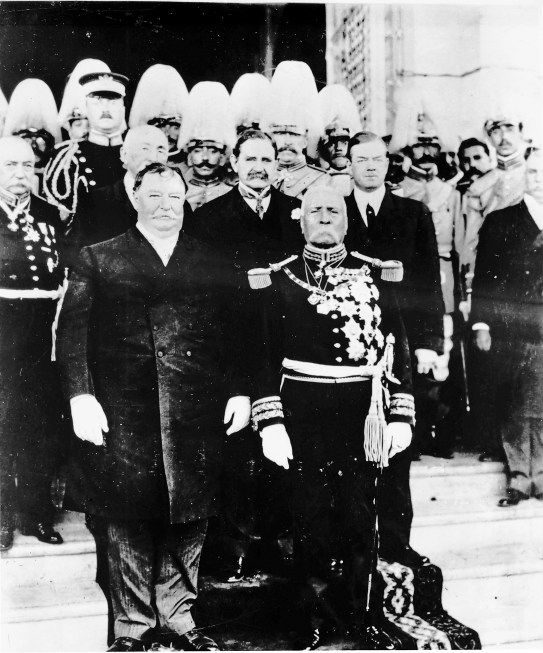
From the Annals of the Fat Presidents –  In 1909, Pres. William Howard Taft met with Mexican Pres. Porfirio Diazo.  This first ever meeting between U.S. and Mexican presidents was part of a planned summit that took place in  both El Paso and Ciudad Juarez.  The initial meeting was at the Chamber of Commerce building in El Paso, but continued later at the Custom House in Juarez. When Taft crossed the Rio Grande, it was the first time an American president entered Mexico, and only the second international trip by a sitting president.  Diaz requested the meeting as a build up to his eighth campaign for president, and Taft agreed to support Diaz to protect American business interests that had invested heavily in Mexico.  The meeting has been described as a “veritable pageant of military splendor, social brilliance, courtly formality, official protocol, and patriotic fervor.”

Today in Texas History – October 15

Davy Crockett portal sign.

From the Annals of the Piney Woods – In 1936, President Franklin D. Roosevelt proclaimed the establishment of the Davy Crockett National Forest.    The national forests in Texas were initiated by an act of the Texas legislature in 1933 authorizing the purchase of lands for the national forest system.  The DCNF is administered by the United States Department of Agriculture Forest Service local headquarters in Lufkin.  It contains a total of 161,842 acres, with 94,481 acres in Houston County and 67,361 acres in Trinity County. The national forests are managed on a multiple-use philosophy and are used for lumbering, grazing, oil production, hunting, and recreation. DCNF which is bordered on the northeast by the Neches River, includes the 45-acre Ratliff Lake. The area is pine-hardwood woodlands with flat to gently rolling terrain. Recreational facilities at this national forest include a bathhouse, camping and picnicking areas, boat ramps, and hiking trails.

Today in Texas History – October 14

From the Annals of  Gun Safety (or Lack Thereof) – In 1867,  Lt. James Pike died during an Indian attack on his unit.  When Indians attacked Pike’s unit at dinner, the lieutenant seized his rifle and rushed to the defense. The rifle jammed, however, and in his frustration he smashed the barrel on a nearby rock, whereupon the gun discharged and killed him bringing an ignominious end to his rather distinguished career.  Pike was the son of an outspoken newspaper editor.  He arrived in Austin in 1859 and attempted to get a job as a printer.  When that failed, he joined John Henry Brown’s company of Texas Rangers at Belton. For the next two years he took part in a series of campaigns against the Comanches. When Texas seceded from the Union,  Pike left the Rangers and went north, where joined the Fourth Ohio Cavalry. Pike saw considerable action as a scout, spy, and courier in Gen. William T. Sherman’s army.  Pike was captured in 1864 and imprisoned in Charleston, South Carolina, then escaped and returned to Hillsboro, Ohio, where he wrote his memoirs of ranger and army service.  After the war, Pike obtained a commission as a second lieutenant in the First United States Cavalry and was later promoted to first lieutenant.

Pike’s memoirs were published in 1865 as The Scout and Ranger: Being the Personal Adventures of Corporal Pike, of the Fourth Ohio Cavalry.

Today in Texas History

From the Annals of Flight – In 2014, the Wright Amendment expired.  The amendment was passed in 1979 and named after former House Speaker Jim Wright.  It was intended to protect the newly opened DFW International Airport from competition fueled by flights from upstart Southwest Airlines at Dallas Love Field.  The Wright Amendment restricted flights from Love Field to neighboring states.  Southwest and other airlines were prohibited from flying out of Love Field to anywhere other than New Mexico, Oklahoma, Arkansas and Louisiana.  The restriction prevented any substantial investment in the facilities at Love Field and while convenient the airport remained mired in the 1960’s.  That will soon change with the Love Field Modernization Project.

Today in Texas History – October 9

From the Annals of Reconstruction –  In 1871, Governor Edmund J. Davis declared martial law in Freestone County.  There had been extensive reports of coercion and fraudulent voting in Fairfield, the county seat during the election of October 3-6.  Freestone County had been a hotbed of slave ownership and a strong supporter of secession having voted 585 to 3 in favor of secession at a county convention.  Racial troubles continued after the war and well into the 20th Century with Klan activity and violence against Blacks.  Martial law was lifted a month later, on November 10. Freestone County was one of four Texas counties in which martial law was declared during Reconstruction.

Today in Texas History – October 8

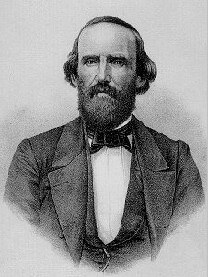
From the Annals of the Filibusters –  In 1821, James Long and his filibuster forces to Mexican Army troops commanded by Colonel Juan Ignacio Pérez at La Bahia. Long was a former U.S. Army surgeon with dreams of conquest. The Long expedition was one of the first Anglo-Americans attempts to seize control of Texas from Spain. The expedition was formed in the Natchez, Mississippi area by elements who were opposed to the boundary of the Louisiana Purchase as set up in the Adams-Onís Treaty.  In 1819, Long had some initial success in taking Nacogdoches and declaring a new Republic of Texas with Long as President.  But the filibusters were quickly driven out by Pérez and the nascent Republic lasted less than a month.  Undeterred, Long regrouped and joined forces with José Félix Trespalacios, who was organizing an expedition in New Orleans to support the Mexican liberals. Long established his headquarters at Fort Las Casas near Point Bolivar.  There he was joined by his wife, Jane Long, the “Mother of Texas.” He later broke with Trespalacios, and sailed with his wife and an uncertain number of men to the coast south of La Bahia.  The group easily took the presidio but was just as easily routed again by Perez days later.  Long’s filibustering career was over.  He was captured taken to Mexico where he died in prison six months later after being shot by a guard.

Photo of La Bahia from Texas Parks & Wildlife

Today in Texas History – October 7

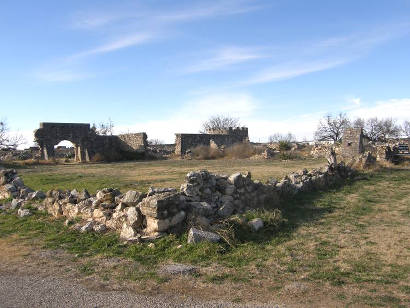
From the Annals of the Red River – in 1759, a Spanish troop led by Diego Ortiz Parrilla was defeated by a group of Native Americans at a fortified Taovaya (Wichita) village near Spanish Fort. Parrilla’s expedition was intended to punish the Norteños (in this case the Tawakonis, Tonkawas, and Wichitas) for their destruction of Santa Cruz de San Sabá Mission in1758. Parrilla’s force consisted of 400 troops from the provinces of northeastern Mexico and the Texas presidios and 176 mission Indians and Apaches.   The need for retribution was reinforced by continuing attacks.  In December 1758, a Comanche band accompanied by members of eleven other groups surprised a group of Apaches near the presidio and killed twenty-one. In March a native force reportedly made up of the same tribes responsible for the mission attack massacred nineteen men guarding the presidio’s horse herd, leaving only one survivor.

On October 7, the troop was attacked by sixty or seventy warriors who led the Spaniards into a well-laid trap.  In pursuit, the troop was led to a sandbank at the edge of the Red River, before the fortified Taovaya village.  The Spaniards attempted to withdraw to regroup but found the road cut off by mounted Indians firing muskets. The Spaniards were trapped in the sand with horses sinking up to their knees.  The resulting 4 hour battle went badly for the force.  Facing a superior force of Comanches, Yaceales, and Tawakonis, and Taovayas, the Spaniards were attacked from the fort and the field.   The troop eventually unlimbered two cannons but they did not affect the course of the engagement. The Apaches, Mission Indians and a number of Spaniards deserted. As darkness fell, Ortiz Parrilla managed an orderly withdrawal, leaving the cannons on the field but with losses of nineteen men killed, fourteen wounded, and nineteen by desertion.

Ruins of San Saba Mission from Texas Escapes.

Today in Texas History – October 6

From the Annals of the Code Duello –  In 1839, Reuben Ross and Ben McColluch fought a duel in a field north of Gonzales.  The dispute was actually between McColluch and Alonzo B. Sweitzer and arose during their 1839 race for a seat in the Texas House of Representatives and came to a head during their subsequent involvement in the pursuit of Indians who had raided Gonzales County.  Following a lengthy exchange of insults, Sweitzer’s friend Ross delivered a formal challenge to McCulloch, who refused to accept on the grounds that Sweitzer was not a gentleman. Ross, however, was an acceptable substitute.  Ross, an trained and  experienced duelist, seriously wounded Ben McCulloch in the rifle duel. A shot to his right arm left McCulloch permanently crippled.  Ross sent his personal surgeon to attend to McCulloch and expressed regret at having to have engaged “so brave a man in a private encounter.”  McCulloch was indicted for accepting the challenge but was not prosecuted.  Ross himself was later killed by McCulloch’s brother Henry in an alcohol fueled confrontation.  And Sweitzer died in a duel in 1841.  The encounter was one of many foolish examples of code duello tradition that persisted in Texas despite the antidueling law passed by the Congress of the republic in 1836.

The Slaves Were Just Workers Without Choice of Employer, Salary or Freedom

Think Progress reports on the utter stupidity that has come from Texas’ control on textbook content.  Textbook publishers must kowtow to the ultra-right Texas Board of Education in crafting textbooks because Texas is a huge market.

A Texas mother spoke out against part of McGraw-Hill’s textbook, “World Geography,” when she noticed that the language erased slavery by calling slaves “workers” and including them in the section “Patterns of Immigration.” One example of the text:

The Atlantic Slave Trade between the 1500s and 1800s brought millions of workers from Africa to the southern United States to work on agricultural plantations.

Roni Dean-Burren, who taught English for more than a decade and is now a doctoral candidate at the University of Houston, pointed out that the language of “worker” suggests compensation and “immigration” suggests that people weren’t kidnapped and brought to North America against their will. She first learned about the textbook section when her son sent her a photo of the text.

The real political correctness is now coming from the right-wing.  We can’t really mention the inconvenient fact that much of the early U.S. economy was built on slave labor.

Today in Texas History – October 5

From the Annals of the Governors – In 1907, Allan Shivers was born in Lufkin.   Shivers was the youngest Senator in Texas history when he was elected to the state senate in 1937.  He had been a force in the Texas Senate.  After serving in Europe in World War II, he sought the position of Lt. Governor in 1946.   He became Governor upon the death of Gov. Beauford Jester.  He served as Governor for 7.5 years.  Shivers was initially very popular, but his sway on the public and influence in the Democratic Party declined when he supported Dwight Eisenhower for President.  Texas supporters of Eisenhower were known as Shivercrats.  Shivers did accomplish much in politics including establishing Texas Southern University, putting women on juries for the first time, and creating the Legislative Budget Board.