Category Archives: Today in Texas History

Today in Texas History – January 7

Vintage Postcard, Waco Suspension Bridge, Waco, Texas ...

From the Annals of Engineering – In 1870, the Waco Suspension Bridge opened to traffic.  The WSB is a 475 foot long single-span suspension bridge over the Brazos River that looks like a smaller version of the Brooklyn Bridge.  The twin double-towers on each side of the Brazos were considered engineering marvels of the day and contain more than 3 million bricks made onsite.  At the time of construction, Waco lacked the ability to manufacture much of the material needed.  The suspension cables were made by the Roebling Company of Trenton, NJ and other materials were made in or imported via Galveston and then shipped up the Brazos to Bryan and then by oxcart to Waco.

The WSB could accommodate two stagecoaches passing each other.  But the main initial use was for cattle crossing and pedestrian traffic.  For years it was the only bridge crossing the Brazos.  As a result, the $141,000 cost to build the bridge was quickly paid back by tolls.

The WSB It was closed to vehicle traffic in 1971 and is now open only to pedestrians and bicycles. The bridge is in the National Register of Historic Places and received a state historic marker in 1976.
Today in Texas History – January 4

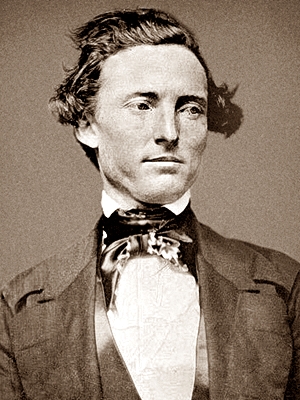
The Texas Underground: Samuel Hamilton Walker

From the Annals of Weaponry –  In 1846, Captain Samuel Walker of the Texas Rangers procured an order of 1,000 revolvers for gunmaker Samuel Colt.  Colt had previously produced the Paterson Revolver which proved to be useful but too fragile for rough conditions and ready use.  As a result, Colt’s business had gone bankrupt.  His friend, Walker, pointed out the problems with the Paterson and suggested improvements to the trigger and the need for a pistol that did not require removal of the barrel for reloading. Colt was eager to restart his business and agreed with Walker’s suggestions and made some additional improvements on his own.

The result was the most powerful handgun yet made.  The six-shot “Walker” Colt had a 9 inch barrel, a longer cylinder than the five-shot Paterson and was manufactured in .44 caliber rather than .36, and was easily reloaded.  The big gun weighed a hefty 5 pounds, but the longer barrel and weight improved its accuracy.

Colt needed a buyer and Walker went to straight to President Polk to whom he was known from his army and Texas Ranger exploits.   The celebrated Texas Ranger explained the benefits and need for Colt’s new revolver.  Polk immediately ordered his Secretary of War to purchase 1,000 of the revolvers for twenty-five dollars each.  Colt contracted with Eli Whitney to manufacture the weapons.  The power and accuracy of the new weapon completely changed the ability of mounted fighters to conduct operations from the saddle.

Today in Texas History – January 3

Image result for groundbreaking ceremony astrodome

From the Annals of the Taxpayer Funded Stadiums –  In 1962, the ceremonial groundbreaking ceremony was held for the Harris County Domed Stadium (later dubbed the Astrodome) in Houston. It was designed to be the first fully air-conditioned and completely enclosed sports stadium in the world.  The Houston team at the time was named the Colt 45’s so the ceremony was not held with the standard gold-plated shovels.   Harris County Judge Roy Hofheinz and other local dignitaries shot Colt .45 pistols into the dirt.  Red is disappointed to learn they shot blanks and that the pistols have been lost to history; but it was a foreboding sign for a team that would take 55 seasons to finally win the World Series.  The Astrodome itself is rusting hulk that has now sat empty for more than 15 years.

Today in Texas History – January 2

New Orleans Saints: Sean Payton Wants Bill Parcells To ...

From the Annals of Football –  In 2003, the Dallas (Arlington) Cowboys announced that Bill “Big Tuna” Parcels would be their new head coach.  The two time NFL Championship head coach would post a decidedly mediocre 34-30 record as the Cowboys’ coach – making the playoffs in 2003 and 2006 but never winning a playoff game.  Since retiring (or being fired) after the 2006 season, Parcels has never coached again.

Today in Texas History – December 27

From the Annals of the Capital City –  In 1839, the City of Austin was incorporated.  At the time the city had 856 citizens.   The site of Waterloo had been previously chosen for the Capital of the Republic of Texas moving from Houston to a more central but dangerous location.  The Texas Congress designated the name of the new Capital as Austin after Stephen F. Austin who was already revered as the father of Texas.  President Mirabeau B. Lamar assigned Judge Edwin Waller to lay out the plan for a capital city. Waller chose a 640-acre site on a bluff above the Colorado River, bordered by Shoal Creek and Waller Creek on the west and east respectively. Waller surveyed a square-mile plot with 14 blocks running in both directions.  The main throughway was designated as Congress Avenue by Lamar and ran from Capitol Square to the Colorado River. The streets running north-south were named for Texas rivers in geographical order. The east-west streets were named after native trees.  Downtown Austin retains much of this original design today.

Today in Texas History – December 17

From the Annals of PTSD –  In 1883, Col. Ranald Slidell Mackenzie, a veteran U.S. Army Cavalry officer, was diagnosed as suffering from “paralysis of the insane.”  Mackenzie was from New York and graduated first in his class from West Point in 1862.  He served with great distinction in the Union cavalry during the Civil War, ending the conflict as a brevet major general.  After the war he was stationed in Texas at various times in command of the Fourth United States Cavalry.  He was largely forgotten to history until publication of Empire of the Summer Moon: Quanah Parker and the Rise and Fall of the Comanches, the Most Powerful Indian Tribe in American History by S. C. Gwynne.   Gwynne’s book focused on the Comanches but also told the story of Mackenzie who was almost single-handedly responsible for bringing an end to the Comanches reign of terror over the vast expanse of territory in which their warriors operated.  Mackenzie is best known for his victory against the Comanches at Palo Duro Canyon and for the extralegal Remolino raid into Mexico in pursuit of Kickapoo raiders.  But is was his incredible determination that finally put an end to the Comanches’ raids. Mackenzie had planned to marry and to retire near Boerne, Texas.  However, it seems likely that he suffered from severe undiagnosed PTSD and he was committed to a New York asylum in 1884.  He died on Staten Island in 1889.

Today in Texas History – December 14

From the Annals of Medicine – In 1837, the Congress of the Republic of Texas established the Board of Medical Censors and authorized it to grant licenses to practice medicine and surgery in the republic.  The BMC was composed of one physician from each senatorial district who were graduates of medicine and surgery from accredited colleges and universities.  Prospective physicians had to pass a test and pay a $20 license fee.  Unlicensed physicians were prohibited from collected unpaid fees in Texas courts. The board was to meet once each year but that proved difficult in frontier Texas.  The BMC was disbanded upon statehood and the function is now performed by the Board of Medical Examiners.

Today in Texas History – December 13

72466: Cabinet Card of Commodore Edwin Ward Moore : Lot 72466

From the Annals of “Gunboat” Diplomacy –   In 1841, a flotilla of three ships from the Navy of the Republic of Texas left Galveston  to provide support for the province of Yucatán in its rebellion against Mexico. Edwin Ward Moore was the commander-in-chief of the Texas Navy.  Moore had earlier sailed along the Mexican coast in a failed attempt to speed up peace negotiations between the Republic of Texas and  Mexico.  Moore returned to Texas and President Mirabeau B. Lamar signed a treaty with the Mexican state of  Yucatan to lease of the Texas navy for $8,000 per month and to protect their ports from being a Mexican Navy blockade.  Moore’s ships joined the small fleet of the State of Yucatan under the command of former Texas Navy officer Captain James D. Boylan.

The Yucatan rebellion (also known as the Caste War of Yucatan) itself is an interesting and rarely mentioned part of Mexican history.  The indigenous Mayans more or less held control of large parts of the Yucatan peninsula for more than 50 years despite numerous efforts by Mexico to assert control.  

Today in Texas History – December 12

From the Annals of the Supreme Court –   In 2000, the United States Supreme Court issued its opinion in Bush v. Gore, holding that the use of different standards of counting in different counties violated the Equal Protection Clause of the U.S. Constitution and that no alternative method could be established within the time limit under federal law to determine controversies as to appointment of electors – which was the same day. The Court voted 7-2 on the violation of the Equal Protection Clause with a proviso that it was more or less a one-time only decision.  However, the Court was split 5–4 as to whether an alternate recount method was feasible. The widely-criticized decision had the effect of awarding all of Florida’s electoral college votes to Texas Gov. George W. Bush which gave him a total of 271 or one more than needed.  U.S. Vice President Al Gore conceded the election the next day.

Bush’s presidency proved disastrous on several counts with Bush leading the U.S. into the war in Iraq on spurious grounds, the inability to conclude the war in Afghanistan, and the near complete financial collapse of 2008.

Today in Texas History – December 11

From the Annals of the Warrior Chiefs – In 1737,  Spanish military forces captured Cabellos Colorados (Red Hair).   CC was a Lipan Apache chief who had staged repeated raids on the Spanish outpost at San Antonio de Bexar.  The historical record on Cabellos Colorados is scant but his name appears in Spanish colonial records as figuring prominently in a number of raids.  There was a raid in 1731 and again in 1734 when his band seized two Spaniards. He was also reported as having stolen horses from San Francisco de la Espada Mission and killed Indians from the missions of San Juan Capistrano and Nuestra Señora de la Purísima Concepción de Acuña. After more raids in 1736 and 1737, he was captured and imprisoned at Bexar until October 1738, when he was sent as a prisoner to Mexico City.