From the Annals of the 6-10 Split – in 2010, the International Bowling Museum and Hall of Fame had its grand opening. Located in Arlington, the IBMHOF provides a “journey back to where bowling began.” It is described as an “interactive museum brimming with one-of-a-kind bowling artifacts, a unique bowling experience and a cutting-edge glimpse at the far-flung future of this global pastime.” Red thinks this is a must see for his next trip to Arlington.
Category Archives: Today in Texas History
Today in Texas History – January 23
From the Annals of Spanish Texas – In 1691, the Domingo Terán de los Ríos was appointed as the first governor of the Spanish province of Coahuila y Tejas. This is considered to be the beginning of Texas as a distinct political entity. Terán was charged with establishing seven missions among the Native Americans of Texas; to investigate troublesome rumors of French settlement on the Texas coast; and to keep records of geography, natives, and products. Teran was experienced in governing the far flung provinces of the Spanish Empire as he had served as Governor of Sonora y Sinaloa in New Spain and had spent many years in Peru. Terán crossed the Rio Grande in May of 1691 and travelled across the state to the Caddo settlements on the Red River. By March 1692 Terán was encamped on Matagorda Bay, where he received instructions from the Viceroy of New Spain to explore the lower Mississippi River. Terán never undertook that project and returned to Veracruz in April. Terán failed to complete any of his intended mission beyond basic exploration. He did not establish any missions and provided very little new information about the region. Terán did write a lengthy report, defending his actions and detailing the dismal situation in East Texas. The primary lasting impact of Teran’s exploration was to name the Texas rivers which continue to bear the names given by members of his expedition. Which is a fitting tribute to a man named de los Rios.
Today in Texas History – January 17
From the Annals of the Governors – In 1874, Richard Coke was inaugurated as the 15th Governor of Texas. Coke was a Democrat and his election as Governor is considered to be the end of Reconstruction in Texas. Coke’s election was the subject of legal controversy. The Texas Supreme Court invalidated the election, but Coke ignored the ordered and with supporters and militia seized control of the physical Governor’s office at the State Capitol. The incumbent governor requested that President Grant send in federal troops, but Grant declined to intervene and Coke took office.
Coke was a veteran of the Southern Rebellion. After the war he was appointed a Texas District Court judge, and in 1866 he was elected as an associate justice to the Texas Supreme Court. His political career took off when the military governor General Philip Sheridan removed Coke and four other judges as ‘an impediment to reconstruction.’ The removal made Coke famous and he took advantage of his new found celebrity to run for Governor in 1873. Resentment to Union occupation insured his victory and reestablished the Democratic Party as the power base in Texas for the next 100 years. Unfortunately, the Democrats power was based on disenfranchisement of Blacks, Mexican-Americans and poor whites through the use of poll taxes, overt discrimination and “White Primaries” in which only white property owners could vote. Winning the Democratic Primary was tantamount to victory. Coke’s legacy as Governor is largely one of discrimination and abuse of power. However, he did usher in the Constitution of 1876 which remains the basis for Texas government today – however heavily amended. Coke resigned as Governor after being elected to the U.S. Senate where he served from 1876 to 1895.
Today in Texas History – January 16
From the Annals of the Senate – In 1850, five years after Texas was admitted to statehood, Senator Thomas Hart Benton of Missouri introduced a bill that would have divided Texas into two states and ceded additional land to the U.S. for $15 million. The measure failed to gain any traction. This was but one of several efforts to divide Texas into multiple states. Later proposals included dividing the state into East and West Texas along either the Brazos or the Colorado, or selling off the land west of the Pecos to the federal government. Various proposals to divvy up the state have continued to erupt. The latest came in 1991, when Rep. David Swinford submitted a House bill to make the Panhandle into the state of “Old Texas.” The bill was not considered. Texas remains intact today.
Today in Texas History – January 12
From the Annals of the Vigilantes – In 1874, a vigilante gang hanged a suspected horse thief in Denton. After the Missouri-Kansas-Texas Railroad reached the Red River, there was an increase in crime and general lawlessness with the introduction of outsiders. Such actions were not uncommon in post-war Texas, especially where local courts and law enforcement were either in the formative stages, undependable or non-existent. So-called “vigilance committees” formed to mete out their own form of justice in an effort to deter crime and punish desperadoes. It was rough justice at best and sometimes degenerated into mob rule or the instrument for settling personal vendettas. The historical record of their activities is typically limited to newspaper accounts which may be of dubious accuracy.
Today in Texas History – January 10
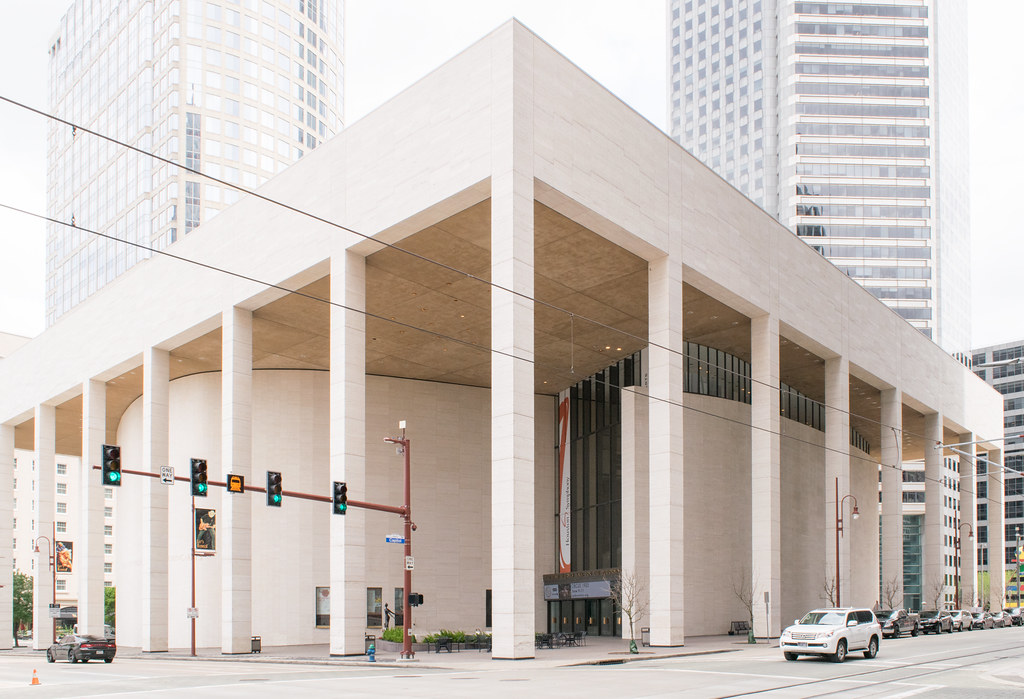
From the Annals of the Performing Arts – In 1964, the groundbreaking ceremony for the Jesse H. Jones Hall for the Performing Arts took place in Houston. The massive concert hall was underwritten by the Houston Endowment, a charitable foundation endowed by Jesse H. Jones and his wife, Mary Gibbs Jones. The venue was notable for its modernistic style and it received the American Institute of Architects’ Honor Award in 1967. Critics of the building claim that its acoustics are subpar, its access is confusing, restrooms are inadequate and that it has outlived its usefulness. Plans for renovation are underway. But the JHPA is still in use today and is the home for the Houston Symphony Orchestra and the Society for the Performing Arts.
Today in Texas History – December 19

From the Annals of the Museums – In 1980, The Old Jail Art Center opened to the public in Albany. The OJAC was originally located in Shackelford County’s former jail house. Additional buildings have been added for more exhibition and operation space as well as an education wing. The museum is home to an impressive collection of more than 2000 works and features important traveling exhibits. The original jail building is an outstanding example of 19th Century Classic Architecture and is on the National Register of Historic Places. This is a must see if you are travelling through the area.
Today in Texas History – December 15

From the Annals of the Iron Horse – In 1887, the Fort Worth and Denver City Railway became the first rail line to enter northwest Texas. The train was run into the new community of Cheyenne in Oldham County. The line was nicknamed “the Denver Road” and operated in the Texas from 1881 to 1982. The FWDC was chartered by the Texas legislature on May 26, 1873. The company would later change its name to the Fort Worth and Denver Railways Co. in 1951. The main line ran from Fort Worth through Wichita Falls, Childress, Amarillo and Dalhart to Texline where it connected with the Colorado and Southern line.
Today in Texas History – December 12

From the Annals of the Streetcars – In 1910, the “Toonerville Trolley” streetcar line began operating between Houston and the suburban community of Bellaire .In 1909 the Westmoreland Railroad Company, directed by Bellaire developer William Wright Baldwin, began construction of a streetcar line between the intersection of Bellaire Blvd and South Rice Ave and Houston’s Main Street 4 miles to the east to improve transportation between Bellaire and Houston. The line ran on the esplanade of Bellaire Boulevard. At the same time, the Houston Electric Company extended its south end line from Eagle Avenue down present Fannin Street to connect with the Bellaire line. The trip between Bellaire and downtown Houston required one transfer at Eagle Avenue. Sadly, the line was abandoned on September 26, 1927.
Today in Texas History – December 11
From the Annals of the Chiefs – In 1737, Spanish military forces captured Cabellos Colorados. CC was a Lipan Apache chief who had staged repeated raids on the Spanish outpost at San Antonio de Bexar. The historical record on Cabellos Colorados is scant but his name appears in Spanish colonial records as figuring prominently in a number of raids. There was a raid in 1731 and again in 1734 when his band seized two Spaniards. He was also reported as haven stolen horses from San Francisco de la Espada Mission and killed Indians from the missions of San Juan Capistrano and Nuestra Señora de la Purísima Concepción de Acuña. After more raids in 1736 and 1737, he was captured and imprisoned at Bexar until October 1738, when he was sent as a prisoner to Mexico City.