Category Archives: Today in Texas History

Today in Texas History – March 27

From the Annals of the Revolution –   In 1836, about 340 Texians under the command of Col. James Fannin  were executed by firing squad at La Bahia in  Goliad.  As rebels and “perfidious foreigners” according to Gen. Antonio Lopez de Santa Anna, the Mexican dictator had decreed that all those in arms against the Mexican government were to be treated as traitors.  Most of those executed  had been trying to escape the onslaught of Mexican forces under Gen. Jose de Urrea but had been surrounded on open ground without adequate supplies largely because of Fannin’s incompetence as a military leader.  After the two-day Battle of Coleto, the men voted  to surrender thinking they would be exiled to the U.S.  Other prisoners had been captured in minor skirmishes with Urrea’s forces.   After capture, Urrea, who had previously executed other prisoners he considered to be mercenaries, pleaded for clemency – but Santa Anna ordered the mass execution when Urrea was away from Goliad.  The “Goliad Massacre” was carried out by Lt. Colonel José Nicolás de la Portilla – whose enthusiasm for the deadly work has been debated by historians.  On Palm Sunday, Portilla had between 425 and 445 Texians marched out of the Mission  in three columns on the Bexar Road, San Patricio Road, and the Victoria Road, between two rows of Mexican soldiers.  The Texians  were shot point blank, survivors were were hunted down and killed by gunfire, bayonet, or lance.  About 30 men escaped by feigning death and another 20 or so were granted clemency to act as doctors, workers and interpreters.  Another 75 men were marched to Matamoros for imprisonment.  Remember Goliad – along with Remember the Alamo – became the rallying cry for the remaining Texian Army.

March to the Massacre from the Texas State Historical Association.
Today in Texas History – March 24

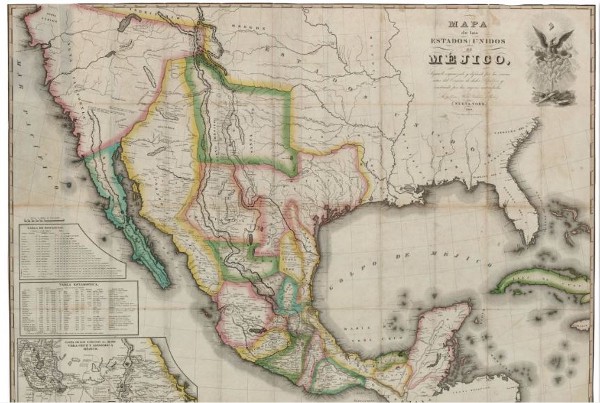
From the Annals of Coahuila y Tejas – In 1825, the Mexican Congreso General  passed the State Colonization Law of March 24, 1825. The act was intended to foster migration (particularly from the United States) to the largely uninhabited  parts of the state of  Coahuila y Tejas.  The act had provisions that attracted land-hungry Anglo settlers.   They  could obtain a square league (approx. 4430 acres) of range land and a labor (177 acres) of farmland for a small price.  The act also provided tax relief for a period of time.  Immigrants had to swear allegiance to the federal and state constitutions, adopt the Catholic faith and display sound moral principles and good conduct.  Person who accepted the terms would be naturalized as Mexican citizens.  It was under this act that  Empresarios Stephen F. Austin, Green DeWitt and others began Anglo colonization of Texas.

Today in Texas History – March 23

From the Annals of Lying Ted – In 2015, Sen. Ted Cruz (TP-Texas) announced that he would seek the GOP nomination for President.  Cruz who had held elective office for less than 2 years and was widely reported to be the most hated man in the U.S. Senate seemed a long shot at the time but stunned observers by winning the Iowa Caucuses.  That win kept him in the race for the long haul.  Cruz racked up several more primary and caucus wins including Texas.  Cruz’s campaign, however, was dogged by accusations and proof of various “dirty tricks” including a misinformation campaign about Ben Carson before the Iowa Caucus and a smear campaign against Marco Rubio.  These problems resulted in Donald Trump (amazingly now it seems) tagging his as “Lying Ted.”  In the end, Cruz was unable to match the bombastic firepower of Donald Trump and was forced to suspend his campaign after losing in Indiana.  There was talk of Cruz attempting to engineer a brokered convention but that fell apart with Trump’s closing rush.  It is hard to say how the losing run will affect Cruz’s political future.  He seems certain to draw an opponent in the Republican primary in 2018.

On a personal note, Red can state that within in 10 minutes of meeting Ted Cruz (well before he became a major public figure), he was convinced that he was about the most obnoxious person he had ever met.

Today in Texas History – March 22

From the Annals of Reconstruction – In 1866, the Texas State Central Committee of Colored Men met for the first time in Austin.  The group was founded to address the concerns  of African Americans arising after the conclusion of the Civil War.  The group was one of the first to focus on the social, economic and political problems facing freed former slaves and free blacks.  Jacob Fontaine, a Baptist minister, presided over the convention. Fontaine was also the publisher of The Gold Dollar, said to be the first black newspaper published in Austin and the greater Travis County area. The promise of real freedom was short-lived in Texas as successive Republican administrations abandoned efforts to fully integrate African Americans into American social and political institutions.  It would be another hundred years before minorities in Texas would obtain full federal protection for their rights.  Ironically, it would be a president from Texas who shepherd through the required legislation.

Today in Texas History – March 21

From the Annals of the Losing Litigators –  In 2010, then Texas Attorney General (and now Poor Idiot Governor) Greg Abbott made the following statement regarding the passage of the Affordable Care Act: “The federal health care legislation passed tonight violates the United States Constitution and unconstitutionally infringes upon Texans’ individual liberties. To protect all Texans’ constitutional rights, preserve the constitutional framework intended by our nation’s founders, and defend our state from further infringement by the federal government, the State of Texas and other states will legally challenge the federal health care legislation.”

Abbott  completely failed in his attempt (and wasted a bunch of Texas tax dollars) to have the ACA overturned in federal court.   In National Federation of Independent Business v. Sebelius, the Unitied States Supreme Court upheld Congress’ power to enact most provisions of the ACA and Health Care and Education Reconciliation Act including the individual mandate requiring most Americans to have health insurance or pay a penalty.  The Court upheld the mandate as a constitutional exercise of Congress’s taxing power.

Kenneth Threadgill and Janice Joplin

From the Annals of the Troubadours – In 1987, legendary Austin country singer and tavern owner Kenneth Threadgill passed away.  Threadgill was instrumental in creating the Austin music scene.  Born in Peniel, he moved to Austin in 1933 and began working at an old service station on North Lamar across from the DPS Headquarters. Threadgill had been performing on and off for years and was legendary for his yodeling prowess which he learned from imitating Jimmie Rodgers.   He soon bought the service station and renamed it Threadgill’s Tavern.  He still sold gas and food but cleverly obtained the first beer license in Austin after the repeal of Prohibition. Threadgill’s became known for its Wednesday night hootenannies, at which university students and local residents congregated for beer, country music, yodeling, and the “Alabama Jubilee,” the song that would usually get Kenneth to dance his patented shuffle. Bill Neely and Janis Joplin were among the many performers who began their careers performing at Threadgill’s.  Threadgill gained some measure of national celebrity himself when he acted and sang in the Willie Nelson movie Honeysuckle Rose (1980). He sold the tavern in the early eighties and it was taken over by Eddie Wilson.  After being closed for quite some time, the original Threadgill’s Old No. 1 on North Lamar is back and Threadgill’s World  HQ on Barton Springs remains an Austin institution – complete with live music.

Photo of Threadgill and Janis Joplin from http://austinot.com/threadgills-Austin 

Today in Texas History – March 10

From the Annals of Medicine  –  In 1890, the John Sealy Training School for Nurses opened with eighteen students.  The first formal training program for nurses was housed in Galveston’s brand new John Sealy Hospital. The school was initially independent of the hospital, but was incorporated into the University of Texas Medical Branch in 1896.

Today in Texas History – March 8

From the Annals of the War Slogans –  In 1836, Col. James W. Fannin raised a flag over the La Bahia mission at Goliad with the words “Liberty or Death”.   Fannin and his followers got death at the hands of Gen. Antonio Lopez de Santa Anna and against the express wishes of Gen. Jose de Urrea who pleaded for clemency and was outraged at the massacre.  Some Texans ultimately got Liberty.  Others remained slaves as one major focus of the Revolution was to protect the institution of slavery in Texas.

Today in Texas History – March 7

From the Annals of the Wildflowers –  In 1901,  Texas legislature proclaimed the “bluebonnet” as the state flower.  Although consideration was given to the cotton boll and varieties of cactus flower, the choice of the National Society of Colonial Dames of America in Texas prevailed.  That was the Lupinus subcarnosus (“also known as buffalo clover or bluebonnet” as stated in the resolution) and the bluebonnet became the state flower without any recorded opposition.

But that is not the end of the story.  Lupinus subcarnosus is a small variety of the Lupine family which largely inhabits areas of coastal and south Texas.   Some wildflower enthusiasts believed that the LS was the least attractive of the Texas bluebonnets. Thus, began a push for Lupinus texensis, a hardier and showier blue beauty which covers most of Texas to take up the mantle as the official state flower.

For 70 years, the Legislature was encouraged to correct its oversight.  In order to avoid any wildflower controversy or offend patrons of the Lupinus subcarnosus,  the wise representatives of the people declared that both LS and LT as well as “any other variety of bluebonnet not heretofore recorded”, would now be the one and true state flower.

Well surprise, there are at least three other species of Lupines and the Legislature made all of them the state flower as well.  If new species are discovered, they also will automatically be the Texas State Flower.

As it stands now, the five state flowers of Texas are:

  1. Lupinus subcarnosus, the original which grows naturally in deep sandy loams from Leon County southwest to LaSalle County and down to the northern part of Hidalgo County in the Valley.
  2. Lupinus texensis, the most widely known and easiest of all the species to grow.
  3. Lupinus Havardii, also known as the Big Bend or Chisos Bluebonnet, is the most majestic of the Texas bluebonnet tribe with flowering spikes up to three feet.
  4. Lupinus concinnus,  a small Lupine known as  the Annual Bluebonnet grows from 2 to 7 inches tall and has flowers which combine elements of white, rosy purple and lavender.  It is uncommon in the Trans-Pecos region.
  5. Lupinus plattensis,  also known as the Dune Bluebonnet, the Plains Bluebonnet and heretically the Nebraska Lupine, grows to about 2 feet tall and is the only perennial species in the state, It is found mostly on sand hills in the Panhandle.

Photo of Lupinus Havardii from texasflashdude

Today in Texas History – March 6

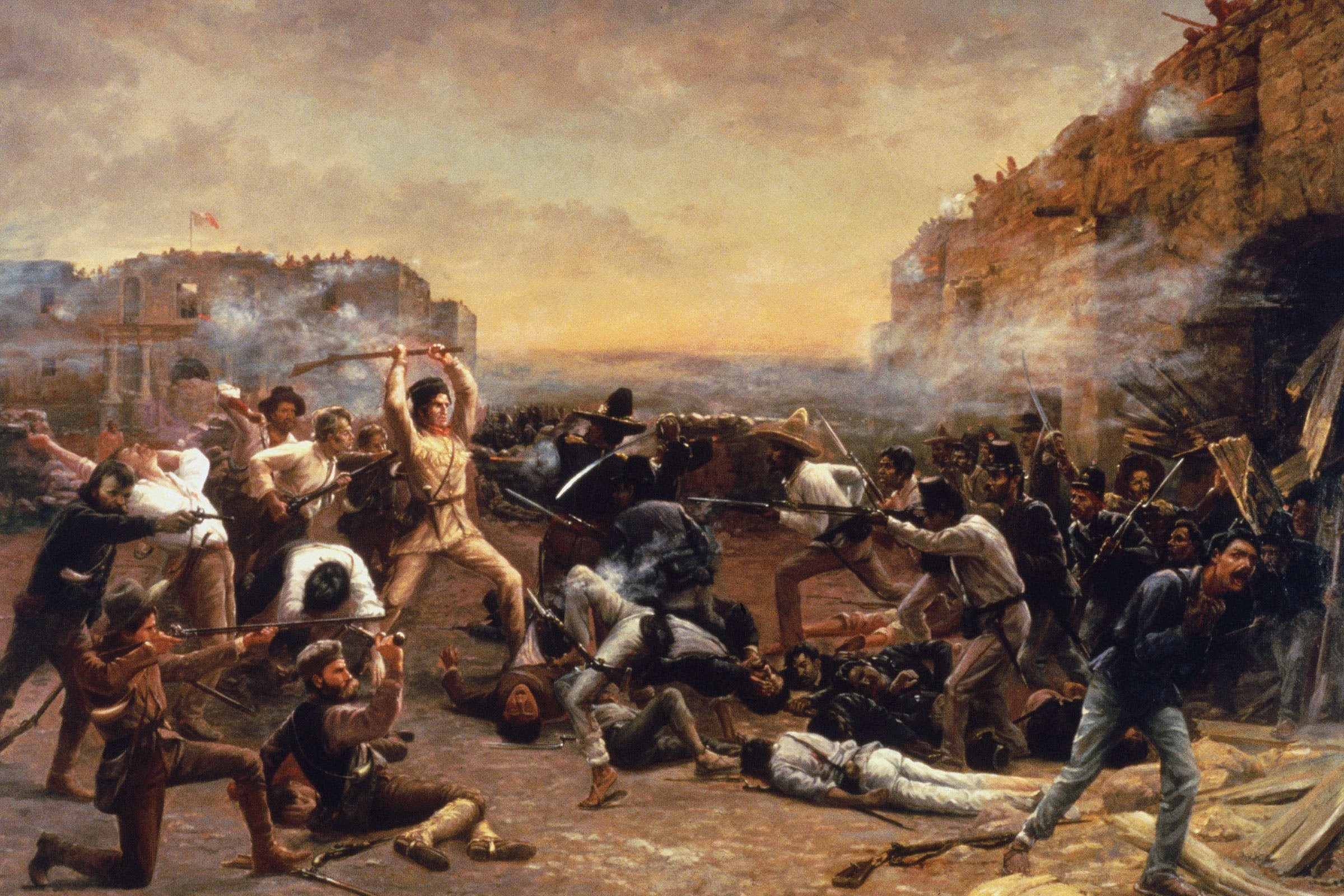
From the Annals of the Revolution –  In 1836, the San Antonio de Valero Mission better known as the Alamo, was stormed after a 13 day siege by the Mexican army.  The Mexican troops were under command of General Antonio Lòpez de Santa Anna who had pledged no quarter to the rebels.  The early morning assault caught the defenders of the makeshift fortress relatively unaware.  The battle lasted only 90 minutes during which time the Alamo was taken and all the Texian forces were killed. The crumbling chapel – which is the  iconic symbol of Texas Independence – fell last.   The historians debate whether the most famous Alamo defender David Crockett – who had arrived in San Antonio days before the siege – was killed or captured along with a handful of survivors.  Crockett did not fancy himself a military figure and was likely surprised to be among the fighters in a hopeless situation.   Santa Anna might have been anxious to take a valued captive.  Regardless of whether Crocket was killed or executed after the battle, his sacrifice and the sacrifice of the other 185 defenders inspired the continued fight for independence from Mexico.

A romanticized version of Crockett’s death from Robert Onderdonk’s  The Fall of the Alamo – at the Texas State Archives.