From the Annals of the Vigilantes – In 1874, a vigilante gang hanged a suspected horse thief in Denton. After the Missouri-Kansas-Texas Railroad reached the Red River, there was an increase in crime and general lawlessness with the introduction of outsiders. Such actions were not uncommon in post-war Texas, especially where local courts and law enforcement were either in the formative stages, undependable or non-existent. So-called “vigilance committees” formed to mete out their own form of justice in an effort to deter crime and punish desperadoes. It was rough justice at best and sometimes degenerated into mob rule or the instrument for settling personal vendettas. The historical record of their activities is typically limited to newspaper accounts which may be of dubious accuracy.
Tag Archives: Texas History
Today in Texas History – January 10
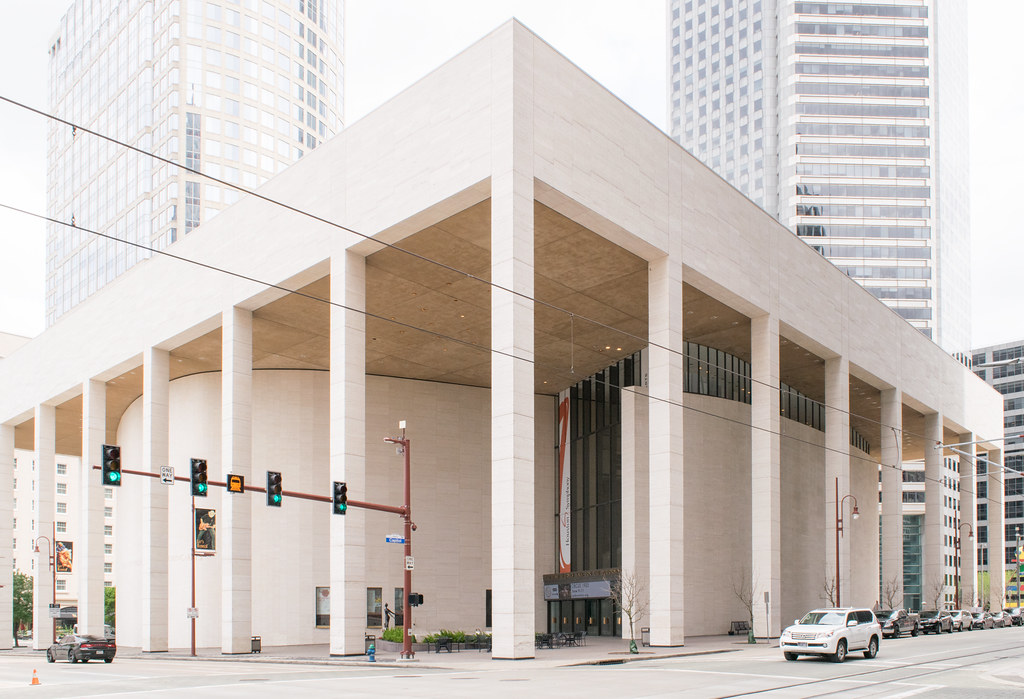
From the Annals of the Performing Arts – In 1964, the groundbreaking ceremony for the Jesse H. Jones Hall for the Performing Arts took place in Houston. The massive concert hall was underwritten by the Houston Endowment, a charitable foundation endowed by Jesse H. Jones and his wife, Mary Gibbs Jones. The venue was notable for its modernistic style and it received the American Institute of Architects’ Honor Award in 1967. Critics of the building claim that its acoustics are subpar, its access is confusing, restrooms are inadequate and that it has outlived its usefulness. Plans for renovation are underway. But the JHPA is still in use today and is the home for the Houston Symphony Orchestra and the Society for the Performing Arts.
Today in Texas History – December 15

From the Annals of the Iron Horse – In 1887, the Fort Worth and Denver City Railway became the first rail line to enter northwest Texas. The train was run into the new community of Cheyenne in Oldham County. The line was nicknamed “the Denver Road” and operated in the Texas from 1881 to 1982. The FWDC was chartered by the Texas legislature on May 26, 1873. The company would later change its name to the Fort Worth and Denver Railways Co. in 1951. The main line ran from Fort Worth through Wichita Falls, Childress, Amarillo and Dalhart to Texline where it connected with the Colorado and Southern line.
Today in Texas History – December 12

From the Annals of the Streetcars – In 1910, the “Toonerville Trolley” streetcar line began operating between Houston and the suburban community of Bellaire .In 1909 the Westmoreland Railroad Company, directed by Bellaire developer William Wright Baldwin, began construction of a streetcar line between the intersection of Bellaire Blvd and South Rice Ave and Houston’s Main Street 4 miles to the east to improve transportation between Bellaire and Houston. The line ran on the esplanade of Bellaire Boulevard. At the same time, the Houston Electric Company extended its south end line from Eagle Avenue down present Fannin Street to connect with the Bellaire line. The trip between Bellaire and downtown Houston required one transfer at Eagle Avenue. Sadly, the line was abandoned on September 26, 1927.
Today in Texas History – December 11
From the Annals of the Chiefs – In 1737, Spanish military forces captured Cabellos Colorados. CC was a Lipan Apache chief who had staged repeated raids on the Spanish outpost at San Antonio de Bexar. The historical record on Cabellos Colorados is scant but his name appears in Spanish colonial records as figuring prominently in a number of raids. There was a raid in 1731 and again in 1734 when his band seized two Spaniards. He was also reported as haven stolen horses from San Francisco de la Espada Mission and killed Indians from the missions of San Juan Capistrano and Nuestra Señora de la Purísima Concepción de Acuña. After more raids in 1736 and 1737, he was captured and imprisoned at Bexar until October 1738, when he was sent as a prisoner to Mexico City.
Today in Texas History – December 6
From the Annals of the Gridiron – In 1896, Texas Christian University played its first football game. It was an 8-6 victory over Toby’s Business College of Waco. At the time, the school was called the AddRan Male & Female College and was located near Waco. The school changed its name to TCU in 1902 and relocated to Waco in 1910. The storied program has had its ups and downs, but the Horned Frogs are ranked as the 5th best private college football program of all-time behind such notables as Notre Dame, USC and Miami. TCU has won two National Championships (both in the 1930s), numerous conference championships and has played in all of the major bowl games.
Today in Texas History – December 4
From the Annals of the Wildcatters – In 1928, Carl G. (the Big Swede) Cromwell drilled the world’s deepest oil well. Cromwell was the drilling superintendent of the Texon Company. Texon was working the rapidly expanding field on University of Texas land in Reagan County. He also acquired his own leases and became known as an honest, generous, free-spirited wildcatter. In association with company engineer Clayton W. Williams, Cromwell experimented in drilling deeper than the average 3,000 feet. In 1926 Williams located a site and Cromwell’s crews began work. In late November 1928, because of mounting expenses and problems, Cromwell was directed to shut down. Instead, he disregarded orders, went into hiding, and kept drilling. On December 4, the well came in at 8,525 feet. It was the deepest oil well in the world for another three years.
Today in Texas History – November 30

From the Annals of the Southern Rebellion – In 1864, Rebel commander Hiram B. Granbury was killed at the Battle of Franklin, Tennessee. The battle was a near-complete disaster for the Rebel forces under the command of John Bell Hood and they lost more soldiers in that battle than in any other one-day battle of the entire war. The loss was not quite the end for Rebel forces in Tennessee as that came shortly afterwards at Nashville.
Granbury was born in Mississippi and graduated from Oakland College. In the 1850’s Granbury moved to Waco where he was admitted to the Texas State Bar and served as chief justice of McLennan County. After secession, Granbury recruited the Waco Guards and was elected by the troops as Major.
On February 15, 1862, he was captured with his command at the Battle of Fort Donelson – one of U.S. Grant’s first brilliant victories. He surrendered and was taken as a POW. Later that year, the Rebel officers were paroled as part of an officers exchange from prison. Granbury was given an early parole to take care of his terminally-ill wife Fannie. Granbury returned to service after his parole and was ultimately commissioned brigadier general.
The city of Granbury in Hood County is named for him and a statute of the Rebel leader sits on the Courthouse square.
So is Red honoring Granbury by relating this history? No, he is stating the known facts. Are Hood County and the State of Texas honoring Granbury by continuing to have a city named after him and a statute on the Courthouse lawn? Yes, and Red fully supports taking down such monuments to traitors. Renaming entire cities is a more difficult proposition that will take some time to deal with.
Today in Texas History – November 29
From the Annals of the Methodists – In 1838, Rev. Jesse Hord entered Texas at Gaines Ferry on the Sabine River. Hord had volunteered for service in Texas and was assigned to the Texas Mission District by the Methodist Church in October of 1838. In October he traveled by horseback with his fellow missionary Isaac Strickland to Texas. The day after entering Texas he preached his first sermon at San Augustine. Hord had converted to Methodism at age 17. Four years later he was admitted on trial into the Tennessee Conference where he was ordained him a deacon in 1836 and an elder in 1837. He was charged with forming a circuit in the Houston area and he established the first Methodist congregations at Richmond, Matagorda, Brazoria, Bay Prairie, DeMoss, Texana, Velasco, East Columbia, and Houston. His 500-mile circuit included twenty congregations. He is considered the founder of Methodism in Texas.
Today in Texas History – November 27

From the Annals of the Borders – In 1941, the State of Louisiana lost its legal challenge to the eastern border of Texas. Louisiana claimed that its western boundary extended not to the middle of the Sabine River but to the western bank. The exact boundary has been the subject of much legal wrangling.
Price Daniel Sr. wrote an informative if somewhat dull history of the boundary dispute for the Southwestern Law Journal.