Tag Archives: Texas History

Today in Texas History – March 4

From the Annals of the Trail Drivers –  In 1868, Jesse Chisholm died from food poisoning in Oklahoma.   Chisholm was not a cattleman.  He was a frontier trader.  But he did blaze the famous trail that bears his name.  He was born in Tennessee to a Anglo father and Cherokee mother.  He was an early pioneers into the Arkansas Territory. In his 20s, he joined a community of Cherokee Indians in northwestern Arkansas and took up trading.   trader. His familiarity with both Anglo and Native American culture and language (he could reportedly speak 14 different Indian dialects) helped him build a thriving trade with the Osage, Wichita, Kiowa, and Commanche.

Chisholm’s trading expeditions gave him a superior knowledge of southwestern geography. He led several important expeditions into the Southwest during the 1830s and 1840s, and during the Civil War opened a trading post near Wichita, Kansas.  After the war, he blazed a first trading routefrom Wichita to the Red River in North Texas and then extended the route to the Gulf of Mexico.  The route became known as the Chisholm Trail.

The trail was a straight wagon road with easy river crossings and relatively easy grades.   The trail was designed for the lumbering heavy freight wagons used for commerce.  By 1867, the first cattle drivers began using the trail to move beef on the hoof to the railroads in Kansas. During the next five years, millions of cattle trampled down the trail.  The large numbers of cattle cut a swath 200 to 400 yards wide.  The heavy use and erosion cut the trail down below the level of the plains it crossed. Traces of the trail may still be seen to this day.

Today in Texas History – March 3

From the Annals of Diplomacy – In 1837, U.S. President Andrew Jackson appointed Alcée La Branche as the American chargé d’affaires to the Republic of Texas. The act officially recognized Texas as an independent republic.  La Branche was born on his father’s plantation on the Mississippi River near New Orleans in 1806. The family, earlier named Zweig (the German equivalent of French branche) had emigrated from Bamberg, Bavaria to Louisiana in 1721. Alcée  attended the University of Sorreze in France. and after returning home he was elected to the  Louisiana House of Representatives in 1831 and was elected as speaker of the House in 1833.

Texas received him enthusiastically viewing him as friend of annexation.  La Branche, however, was loyal to his country and aggressively defended the United States claim to disputed territory in Red River County (now Bowie, Red River, Franklin, Titus, Morris, and Cass counties). The two countries signed the Convention of Limits, which recognized Texas claims to the contested county and the Sabine River as the eastern boundary of Texas. La Branche also sought to reduce tensions concerning cross-border raids in pursuit of Native Americans.  He believed that the majority of Indian attacks were caused by Texans’ trespassing and surveying Indian lands.

La Branche Street in Houston is named in his honor.

Today in Texas History – March 2

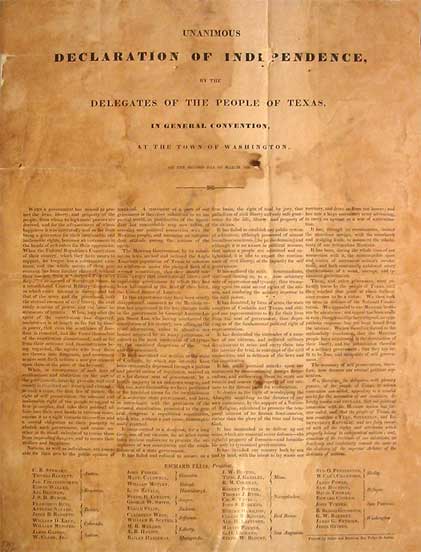
From the Annals of the Revolution – In 1836, Texas declared its independence from Mexico.  The previous day, delegates from the seventeen Mexican municipalities of Texas and the settlement of Pecan Point met at Washington-on-the-Brazos to consider independence from Mexico. George C. Childress presented a resolution calling for independence.  Richard Ellis, the president of the convention appointed Childress to head a committee of five  Edward Conrad, James Gaines, Bailey Hardeman, and Collin McKinney to draft a Declaration of Independence from Mexico.  Childress probably already had a draft version of the document with him when he arrived. As the delegates worked, they received regular reports on the ongoing siege on the Alamo by the forces of Santa Anna’s troops.  Childress and the committee drew heavily on the United States Declaration of Independence.   In the early morning hours of March 2, the convention voted unanimously to accept the resolution.

Red’s favorite passage:  “It has, through its emissaries, incited the merciless savage, with the tomahawk and scalping knife, to massacre the inhabitants of our defenseless frontiers.”

Today in Texas History – March 1

From the Annals of Geologic Formations –  In 1978, The Nature Conservancy bought Enchanted Rock from the Moss family for $1.3 million.   The purchase kept the property preserved for posterity.  Various plans had been floated for the site including turning it into a real estate development or quarry.  The Moss family wanted the site preserved but the state of Texas lacked the funds or the willpower to purchase the Rock. TNC deeded the property to the State six days after the purchase.  The site was closed to the public for several years and reopened as the Enchanted Rock State Natural Area in March of 1984.

The granite pluton batholith near Fredericksburg rises to an elevation of 1825 feet and is formed from some of the oldest rock on the planet.  The Rock has long been a popular spot for hiking, rock climbing and camping.   The weathered dome, standing above the surrounding plain is known to geologists as a monadnock.  Archaeological evidence indicates human visitation at the rock going back at least 11,000 years. The  name “Enchanted Rock” is derived from Native American legend which attributed magical and spiritual powers to the high ground.

Red first visited the then private park in 1967 and has been back dozens of times since then.  It is a must see for all Texans.

Today in Texas History – February 26

In 1871, Clint and Jeff Smith were abducted as young boys from their home on Cibolo Creek, and lived as  Indian warriors for years. They returned to white society, married and had children, but always held on to some part of that life. Their story, “The Boy Captives,” first published in 1927, continues to be available. It is a first-hand account of their incredible, and sometimes horrifying, experiences.

From the Annals of the Captives – In 1871, Clinton and Jefferson Smith were captured by Lipan and Comanche raiders.  The brother, eight and ten at the time, were taken while herding sheep on Cibolo Creek near Boerne.  Initial efforts to find the boys failed.  Their father, Capt. Henry Smith, and his cousin Capt. John W. Sansom, of the Texas Rangers and numerous other Rangers combined with a volunteer posse led by Capt. Charles Schreiner, in an effort to rescue the boys.  The large group pursued the Indians from near Kendalia to Fort Concho in West Texas but never recaptured the boys.  Clint and Jeff were not returned to their family for several more years.

In his 1927 book, “The Boy Captives,” Clinton gave a first hand account of his and his younger brother Jeff’s time with the Comanche.   Clint’s roamings with the Comanches took him  into Utah, over the Rocky Mountains,as far west as the Pacific coast. After a period of adjustment, Clint said he became nearly indistinguishable from any other young warrior, as he chased Rangers and soldiers with his adopted family.  He remained in captivity for five years.  Jeff was sold to Geronimo who branded him for identification. time. Clint begged his Indian father, Tasocowadi, to bring Jeff back, even offering to trade all his belongings.  Geronimo, however, would not agree to the deal.

The Indians gave their captives native names. Clint became “Backecacho” (End of Rope), while Jeff was called “Catchowitch” (Horse Tail), and also “Na-i-Flink.” They were often used as bait on bear hunts, and mocked as they were made to exhibit feats of prowess such as fighting other Indian children or, as Jeff once described, being tied to a wild buffalo and made to ride it.

After being ransomed back and returning to Anglo culture, the brothers somehow successfully re-integrated.  They both married, raised children and took up ranching. As with many other returned captives, their experiences with the Indians never left them completely.  Clint and Jeff both expressed that they felt bound to their native brothers and each other in ways only they understood.

Today in Texas History – February 25

From the Annals of the Cowboys – In 1989, Jerry Jones, the new owner of the Dallas Cowboys, fired head coach Tom Landry after a 29-year career.   Jones made Cowboys General Manager Tex Schramm accompany him to Landry’s vacation home in Lakeway.  Schramm characterized it as, “a very difficult meeting.  It’s very, very sad.  It’s tough when you break a relationship you’ve had for 29 years.”  Schramm stood solemnly and red-eyed at a news conference where JJ announced the firing of Landry later that evening at the team’s Valley Ranch headquarters. Landry’s recent results had been well below his standards with the Cowboys failing to make the playoffs in 4 of his last 5 seasons.  Landry had indicated that he wanted to coach into the 90’s if he wasn’t fired. Jones for his part wasted no time in kicking Landry to the curb having only finalized his purchase of the iconic franchise two days before firing Landry.  Jones was adamant that he would not have bought the team unless he could bring his long-time friend and former University of Miami coach Jimmy Johnson on to lead the Cowboys.  Landry ended his coaching  career as the third-winningest coach in NFL history behind only George Halas and Don Shula, with a record of 270-178-6.  He ranks only behind Bill Bellicheat with 5 trips to the SuperBowl as a head coach.

For his part, Red had already given up his 27 year fanship of the Cowboys during the strike year of 1987 when Cowboys quarterback Danny White led the movement to break the players union and Dallas fans thumbed their noses at the players they formerly idolized.

Today in Texas History – February 24

From the Annals of the Police State – In 1969, approximately 100 Texas Rangers, local lawmen, and state police descended on Wiley College in a wild overreaction to a series of nonviolent student demonstrations on the campus.  Wiley, in Marshall, is the oldest black college west of the Mississippi River.  The students were demonstrating over faculty hiring practices, primitive dormitory facilities, and cutbacks in the intercollegiate athletic program. The police undertook a massive search for concealed weapons in the dorms – something the right-wing would now have to condemn but undoubtedly condoned because black students were the ones targeted.  The search turned up nothing and only resulted in the campus being closed for several weeks.  The demonstrations continued after the police raid and ultimately resulted in the school administration’s decision to improve living conditions on campus.

Today in Texas History – February 23

From the Annals of the Revolution –  In 1836, the siege of the Alamo began when Mexican troops under the command of Gen. Antonio Lopez de Santa Anna entered San Antonio de Bexar and began to encircle the crumbling mission.   Despite knowledge that the Mexican Army was on the move, the Texian troops at the Alamo commanded by the inexperienced Col. William B. Travis were almost completely surprised by their arrival.  Historians have speculated that the Texians were still recovering from an all night party celebrating George Washington’s birthday.  The Mexican troops were no more than 1.5 miles from Bexar when they were finally spotted by a sentry in the San Fernando Church bell tower. Advance Mexican cavalry under the command of Gen. Joaquin Ramirez y Sesma would likely have taken the mission in a surprise attack but were delayed by rains which flooded the Medina River.  At the time, the Texians had only 156 able-bodied troops in the Alamo and almost no provisions.  They were able to herd a few cattle into the compound and scrounged enough corn from local houses to last for maybe a month.  By late afternoon, Béxar was occupied by about 1500 Mexican troops, who quickly raised a blood-red flag signifying “No Quarter.”  Travis answered Santa Anna’s request for a parlay with a cannon shot.  Believing that Travis had acted foolishly, James Bowie who was in command of the volunteers at the Alamo, sent Green B. Jameson to meet with Santa Anna.  The General refused but did allow Jameson to meet with some of his officers.  The Mexican officers conveyed the following message:  “I reply to you, according to the order of His Excellency, that the Mexican army cannot come to terms under any conditions with rebellious foreigners to whom there is no recourse left, if they wish to save their lives, than to place themselves immediately at the disposal of the Supreme Government from whom alone they may expect clemency after some considerations.”

Today in Texas History – February 22

From the Annals of Broken Promises –  In 1819 the Adams-Onís Treaty was signed by Secretary of State John Quincy Adams for the United States and Luís de Onís for Spain.  The treaty fixed the western boundary of the Louisiana Purchase and had the effect of renouncing U.S. claims to Texas.  The newly fixed boundary began at the mouth of the Sabine River and ran along its south and west bank to the thirty-second parallel and thence directly north to the Río Roxo (Red River).  The boundary then followed the course of the Río Roxo westward to the 100th meridian and then due north to the Arkansas River.  From there the boundary followed the southern bank of the Arkansas to its source near the 42nd parallel and then following the 42nd to the “South Sea” (Pacific Ocean).  Spain delayed ratification of the treaty and in the interval Mexico declared its independence.  The newly formed country refused to accede to the terms of the treaty and never recognized the negotiated boundary.

Today in Texas History – February 18

From the Annals of Heroism –  In 1943, First Lieutenant Wilma Vinsant “Dolly” Shea of San Benito graduated with the first flight-nurse class of the U.S. Army Air Corps at Bowman Field, Kentucky.  Shea had received her nurse training at John Sealy Hospital in Galveston, and had worked as an air nurse for Braniff Airlines before she enlisted in 1942. Shea completed rigorous training for flight nurses which included jumping, with heavy pack and fully clothed, into water twenty feet deep and gaining shore unaided.   Shea was posted to the European Theater during World War II.  On January 15, 1945, Dolly Vinsant married Maj. Walter L. Shea, an air force navigator from the Bronx, New York.  Shortly thereafter she was promoted to first lieutenant.  Shea had completed her hazardous-flight quota, the maximum number allowed under United States Military regulations.  However, her commander reluctantly granted her request “to make one more trip.” She was killed in action on April 14, 1945 when her evacuation plane which was carrying wounded GI’s to hospitals behind the front line was shot down over Germany. She was one of only three women in the Army Nurse Corps known to have been killed by direct enemy action.  Shea was awarded the  Air Medal, the Red Cross Medal, a Special Citation from President Harry Truman, and a posthumous Purple Heart.  She was honored by her hometown through the Dolly Vinsant Memorial Hospital.

Image from sanbenitohistory.com