No Mo’ Romo

ESPN is reporting that the Dallas Cowboys (meaning Jerry Jones) will release veteran quarterback Tony Romo on Thursday.  The move will save the Cowboys some money against the 2017 salary cap although they will still take a major hit for a quarterback that has played in a handful of games over the last two seasons.  Red does not pretend to understand the intricacies of the NFL’s salary cap rules, but apparently if Romo is a June 1 designation (whatever the hell that means), the  Cowboys would take a $10.7 million hit on the 2017 cap and $8.9 million on the 2018 cap.   If released without the designation, the Cowboys will save $5.1 million against the salary cap but will carry $19.6 million in dead money (again whatever that means) for 2017.

Romo who was undrafted signed as a free agent with the Cowboys in 2003, but did not see the field until the 2006 season when he replaced Drew Bledsoe at halftime of the Giants game.  He never again left the field that season and led the Cowboys to a 9-7 record and a playoff spot.  His most infamous moment came in his first playoff game (against the Seahawks) when he botched the snap on a field goal attempt that would have secured the Cowboys first playoff win in almost a decade.  Red still remembers laughing uncontrollably for several minutes.

Romo finishes his career with the Cowboys with a record 78-49 as a starter.  His 34,183 passing yards and 248 touchdown passes are the most in team history.  Romo holds team records for most 300-yard passing games (46), multiple touchdown pass games (79) and consecutive games with a touchdown pass (38). He also holds the Cowboys records for most yards in a season (4,903 yards in 2012)  and in a game (506 against the Broncos in 2013), and the NFL record with a touchdown pass in 41 straight road games.

All of that is well and good, but Romo was 2-4 in the playoffs and never played in a conference championship game.  Thus, by Cowboys standards, he was a miserable failure as a quarterback.  Red dearly hopes that the Texans do not fall for a 37 year-old often injured quarterback with a track record of playoff failure.

Today in Texas History – March 8

From the Annals of the War Slogans –  In 1836, Col. James W. Fannin raised a flag over the La Bahia mission at Goliad with the words “Liberty or Death”.   Fannin and his followers got death at the hands of Gen. Antonio Lopez de Santa Anna and against the express wishes of Gen. Jose de Urrea who pleaded for clemency and was outraged at the massacre.  Some Texans ultimately got Liberty.  Others remained slaves as one major focus of the Revolution was to protect the institution of slavery in Texas.

The Great Wall of Trump – Not so Great for Texas Wildlife

The Texas Tribune (in an article by Kiah Collier and Neena Satija) explains how the Great Wall of Trump planned for the border will have a potentially devastating impact on wildlife in the incredibly bio-diverse region that is the Texas-Mexico border along the Rio Grande or as Red prefers the Rio Bravo del Norte.   The problem is made greater because the Congress allowed the Department of Homeland Security to basically ignore all the environmental laws that would’ve required the agency to fully study how the Great Wall of Trump would affect wildlife.

 What the border fence has kept out instead, according to environmentalists, scientists and local officials, is wildlife. And the people who have spent decades acquiring and restoring border habitat say that if President Donald Trump makes good on his promise to turn the border fence into a continuous, 40-foot concrete wall, the situation for wildlife along the border — one of the most biodiverse areas in North America — will only get worse.

When you envision the U.S.-Mexico border, you might think of a barren, dusty desert. But it actually ranks among the most biodiverse places in North America — particularly the Rio Grande Valley in South Texas. The Valley is home to some of the last remaining tracts of sabal palm forest in the country — a lush, subtropical ecosystem that is prime habitat for an endangered wild cat called the ocelot.

Two major migratory bird paths also converge in the region, and several tropical bird species there can’t be found anywhere else in the United States. More than 100 other endangered species may be impacted by construction of a wall along the U.S.-Mexico border, according to an analysis of U.S. Fish and Wildlife Service data.

As Red has noted, this is what the people voted for and this is what they deserve to get.   Screw a bunch of ocelots and coatis if it will keep one more illegal alien from trying to make a better life for himself or herself in the land of the free.   And it will be a minor deal compared to the screwing that many Trump voters are going to get with the repeal of the Affordable Care Act.

Quote for the Day

“Let me go very, very dark on you. The president of the United States put his own reputation, the reputation of his predecessor and the reputation of his nation at risk to get at least a draw out of the next 24 hours of news.”

Former CIA Director Gen. Michael Hayden (Ret.) on Morning Joe discussing Trump’s apparently baseless accusation that Barack Obama had wiretapped his phone.


Today in Texas History – March 7

From the Annals of the Wildflowers –  In 1901,  Texas legislature proclaimed the “bluebonnet” as the state flower.  Although consideration was given to the cotton boll and varieties of cactus flower, the choice of the National Society of Colonial Dames of America in Texas prevailed.  That was the Lupinus subcarnosus (“also known as buffalo clover or bluebonnet” as stated in the resolution) and the bluebonnet became the state flower without any recorded opposition.

But that is not the end of the story.  Lupinus subcarnosus is a small variety of the Lupine family which largely inhabits areas of coastal and south Texas.   Some wildflower enthusiasts believed that the LS was the least attractive of the Texas bluebonnets. Thus, began a push for Lupinus texensis, a hardier and showier blue beauty which covers most of Texas to take up the mantle as the official state flower.

For 70 years, the Legislature was encouraged to correct its oversight.  In order to avoid any wildflower controversy or offend patrons of the Lupinus subcarnosus,  the wise representatives of the people declared that both LS and LT as well as “any other variety of bluebonnet not heretofore recorded”, would now be the one and true state flower.

Well surprise, there are at least three other species of Lupines and the Legislature made all of them the state flower as well.  If new species are discovered, they also will automatically be the Texas State Flower.

As it stands now, the five state flowers of Texas are:

  1. Lupinus subcarnosus, the original which grows naturally in deep sandy loams from Leon County southwest to LaSalle County and down to the northern part of Hidalgo County in the Valley.
  2. Lupinus texensis, the most widely known and easiest of all the species to grow.
  3. Lupinus Havardii, also known as the Big Bend or Chisos Bluebonnet, is the most majestic of the Texas bluebonnet tribe with flowering spikes up to three feet.
  4. Lupinus concinnus,  a small Lupine known as  the Annual Bluebonnet grows from 2 to 7 inches tall and has flowers which combine elements of white, rosy purple and lavender.  It is uncommon in the Trans-Pecos region.
  5. Lupinus plattensis,  also known as the Dune Bluebonnet, the Plains Bluebonnet and heretically the Nebraska Lupine, grows to about 2 feet tall and is the only perennial species in the state, It is found mostly on sand hills in the Panhandle.

Photo of Lupinus Havardii from texasflashdude

We Still Have Brock Osweiler to Kick Around

Texans quarterback Brock Osweiler continues to be the poster boy (perhaps whipping boy would be a better description) for bad decisions at that position by NFL teams.  Sporting News disses the prospects for Tampa Bay backup quarterback and free agent Mike Glennon by claiming that he would be a worse deal for any team than even the much-maligned Osweiler.  Red for his part thinks the book is still out on the Tall Texan.  BO performed decently when the pressure was on in the last game of the season and in the playoffs.  Playing behind a makeshift line and without several of his best receivers, Osweiler’s numbers in those games were not terrible – merely low mediocre.  Even the playoff game against the Patriots was still within reach in the 4th quarter despite terrible special teams and lackluster (other than forcing 3 TO’s) defensive play.  Yes, BO threw up some INT’s during desperation time, but the Texans were not out of it until the defense gave up 10 points in the 4th quarter.  Still, SN piles on in its argument that Glennon is a toxic commodity – or at least an overpriced one.

Move over, Brock Osweiler. Mike Glennon is about to get a lot more fool’s gold in NFL free agency than you did.  File Glennon as the latest unlikely young veteran poster boy of the league’s most quarterback-needy teams. At 6-6, 225, he isn’t as big or tall as Osweiler, but he might be a bigger bust for whoever signs him, even at a little less the price.

A general recent rule is whatever the Texans do at quarterback, don’t follow. Houston got tired of going the Fitzpatrick-Hoyer route in consecutive seasons, so it panicked and tried to solve QB long-term with Osweiler. That was an extremely expensive backfire.

Texas Universities – Liberal, Conservative and Somewhere Inbetween

The Houston Chronicle ranks Texas colleges and universities on a liberal/conservative scale.  Not surprisingly, Texas A&M is ranked as the most conservative institution in the state.  On the liberal side, most Aggies would have chosen UT-Austin (or TU as the disrespectful Aggies would have it).   Wrong!  UT-Austin ranks as the 7th most liberal school in the Red state.  St. Edwards University in Austin is the most liberal college in Texas.

Today in Texas History – March 6

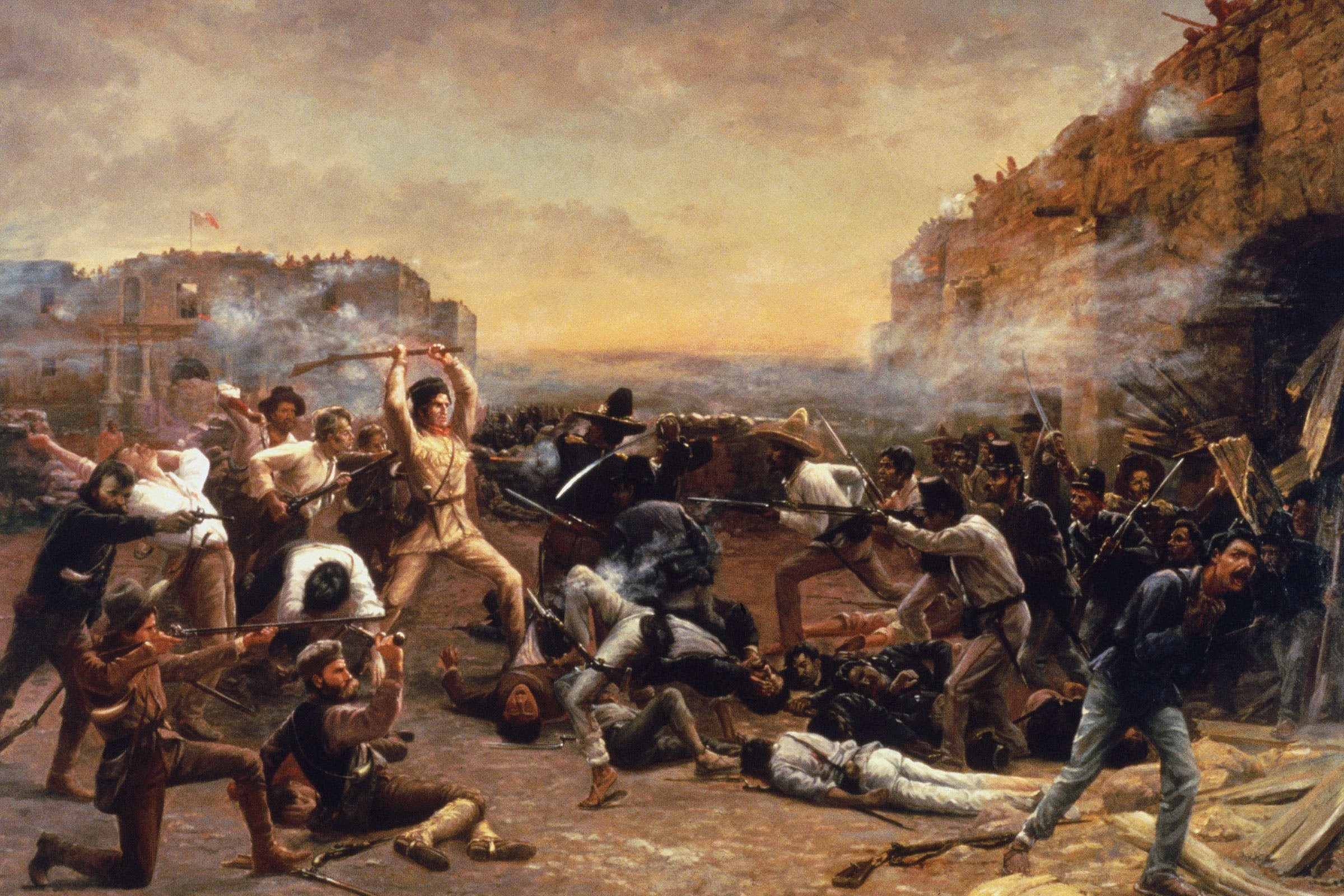
From the Annals of the Revolution –  In 1836, the San Antonio de Valero Mission better known as the Alamo, was stormed after a 13 day siege by the Mexican army.  The Mexican troops were under command of General Antonio Lòpez de Santa Anna who had pledged no quarter to the rebels.  The early morning assault caught the defenders of the makeshift fortress relatively unaware.  The battle lasted only 90 minutes during which time the Alamo was taken and all the Texian forces were killed. The crumbling chapel – which is the  iconic symbol of Texas Independence – fell last.   The historians debate whether the most famous Alamo defender David Crockett – who had arrived in San Antonio days before the siege – was killed or captured along with a handful of survivors.  Crockett did not fancy himself a military figure and was likely surprised to be among the fighters in a hopeless situation.   Santa Anna might have been anxious to take a valued captive.  Regardless of whether Crocket was killed or executed after the battle, his sacrifice and the sacrifice of the other 185 defenders inspired the continued fight for independence from Mexico.

A romanticized version of Crockett’s death from Robert Onderdonk’s  The Fall of the Alamo – at the Texas State Archives.

Today in Texas History – March 3

From the Annals of the Forgotten War – In 1899, the U.S. Congress authorized the formation of the Thirty-Third Infantry Regiment which came to be known as the “Texas Regiment.”  The 33rd was formed for combat to serve in the Philippine-American War (also known somewhat pejoratively as the “Philippine Insurrection”) – a conflict that is sometimes referred to as “America’s Forgotten War.” The PAW was a conflict between the First Philippine Republic and the U.S. that was essentially a continuation of the war for Philippine independence that had begun in 1896 against Spain.  The U.S. came into possession of the Philippines as a result of the Spanish-American War.  At the conclusion of the SAW, the nascent Philippine republic was dissatisfied with the terms of the Treaty of Paris which officially transferred possession to the U.S. and declared war on the U.S. on June 2, 1899.   The PAW was especially brutal and resulted in the deaths of between 200,000 and 250,000 civilians as well as the disestablishment of the Catholic Church as the state religion and the imposition of English as the official language of government, education and commerce.

The 33rd regiment was organized at Fort Sam Houston.  Approximately one-third of the officers and enlisted men were from Texas.  The 33rd served in the Philippines from October 27, 1899, until March 2, 1901 and was in action at the battles of Magnataram, Tirad Pass, Vigan, and Taguidin Pass.  Some of the soldiers chose to remain in the Philippines to serve with the Philippine Constabulary which continued to fight pockets of resistance until the final defeat at the Battle of Bud Bagsak in June of 1913.

Manila after U.S. shelling.

Today in Texas History – March 2


From the Annals of the Republic –  In 1836, the convention at Washington-on-the-Brazos which was comprised of delegates from the seventeen Mexican municipalities in Texas and the settlement of Pecan Point voted for Texas independence from Mexico.  On March 1, George C. Childress presented a resolution calling for independence, and the chairman of the convention appointed Childress to head a committee to draft a declaration of independence. In the early morning hours of March 2, the convention voted unanimously to accept the resolution. After fifty-eight members signed the document, Texas became the Republic of Texas. Actual independence required some fighting.